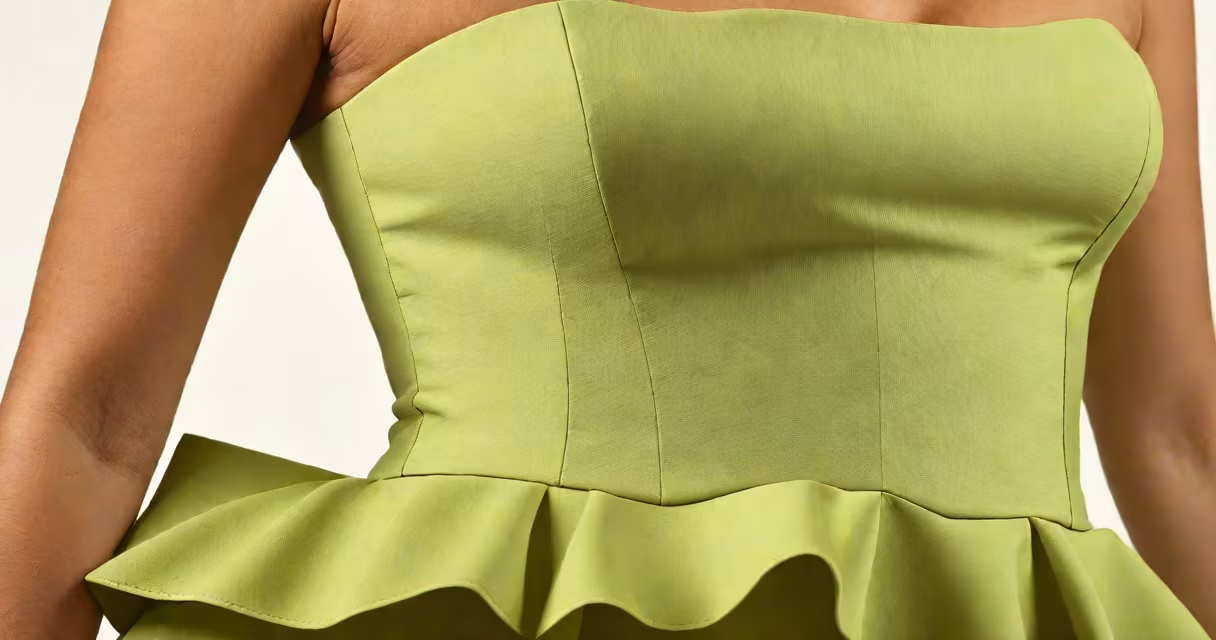
A peplum is a short, flared panel sewn to the waistline of a dress, jacket, or top. It extends outward from the torso, creating a structured, hourglass silhouette. The term originates from French "peplum," meaning a frill or decorative border, and entered English fashion terminology in the 19th century.
The peplum functions as a design element that emphasizes the waist while adding volume and visual interest. It appears on blouses, evening gowns, casual tops, and even outerwear. Its placement at the waist makes it a key feature in shaping the upper body's outline.
Peplums are often seen in high-fashion collections and runway shows. Designers like Alexander McQueen and Dolce & Gabbana have used them to create dramatic silhouettes. They also appear in mass-market clothing, such as those sold by Zara, H&M, and Nordstrom.
Peplums are constructed by attaching a separate piece of fabric-usually cut in a curved or semi-circular shape-to the lower edge of a bodice or top. This panel is typically wider at the front and may taper slightly at the sides. The seam between the bodice and peplum is usually finished with a facing or bias binding to prevent fraying.
When worn, the peplum sits just below the natural waist, drawing attention to the narrowest part of the torso. This creates a balanced proportion between the bust and hips. The effect is especially flattering on people with a defined waist, though it can also be used to visually shorten a long torso.
Some peplums are stiffened with interfacing or boning to hold their shape. Others use lightweight fabrics like chiffon or silk for a softer drape. The choice of material affects both the look and movement of the garment.
Peplums vary by length, shape, and placement. The most common styles include:
| Type | Description | Common Use |
|---|---|---|
| Short peplum | Extends 2-4 inches below the waistband | Casual tops, office wear |
| Long peplum | Reaches mid-hip or lower | Evening gowns, formal wear |
| Asymmetrical peplum | Uneven length, often longer at the back | Fashion-forward designs, runway pieces |
| Detachable peplum | Can be removed or added | Adaptable outfits, travel-friendly clothing |
Designers sometimes combine peplums with other features-like ruffles, lace trim, or metallic embroidery-to improve visual impact. A peplum on a black satin dress with gold trim, for example, adds elegance and drama suitable for red carpet events.
Peplum is used to alter the silhouette of a garment. It adds volume where there is none, making it ideal for slim-fitting pieces that otherwise lack shape. It also draws focus to the waist, which can balance out wider hips or a fuller bust.
It's common in women's wear, particularly in dresses and tops designed for special occasions. However, peplums are increasingly appearing in men's fashion, such as tailored jackets with a subtle flare at the back. The trend reflects a broader move toward gender-fluid design.
According to the Council of Fashion Designers of America (CFDA), peplum silhouettes were featured in 68% of spring 2023 ready-to-wear collections. The American Apparel & Footwear Association (AAFA) reports that peplum tops accounted for 12% of all women's tops sold in U.S. department stores during Q1 2023.
Peplum is often confused with a yoke, which is a shaped panel placed across the back or front of a garment to define the shoulder or waist. Unlike a yoke, a peplum extends downward from the waist and is not meant to support the shoulders.
Another mistake is assuming that peplum garments are only for curvy figures. While they do accentuate the waist, they can also be worn by people of all body types. A well-fitted peplum top on someone with a straighter figure can still create a polished, intentional look.
One non-obvious fact: peplum was popularized in Western fashion during the 1940s and 1950s through Hollywood films. Actresses like Marilyn Monroe wore peplum dresses in movies such as *Gentlemen Prefer Blondes* (1953), helping cement the style as glamorous and timeless.
Consider a navy blue silk peplum dress with a fitted bodice and a 3-inch flared panel at the waist. The dress has a V-neckline and thin spaghetti straps. The peplum extends evenly around the waist, creating a soft flare that moves with the wearer.
This design uses the peplum to create a defined waistline without adding bulk. The flare prevents the dress from looking boxy. When the wearer walks, the peplum sways gently, adding motion and dimension. The dress is appropriate for weddings, cocktail parties, or upscale dinners.
I once wore a similar peplum dress to a friend's wedding. The fabric draped smoothly, and the peplum gave me a confident silhouette. I received multiple compliments on the cut, even from people unfamiliar with fashion terminology.
Peplum is not the same as a flounce, which is a wide, gathered ruffle often used on skirts or sleeves. Nor is it a train-a long extension at the back of a gown. A peplum is specifically a waist-level addition that flares outward.
It's also not synonymous with "ruffle." While some peplums include ruffles, the defining trait is the shape and placement. A ruffled hem on a blouse is not a peplum unless it's attached at the waist and extends outward.