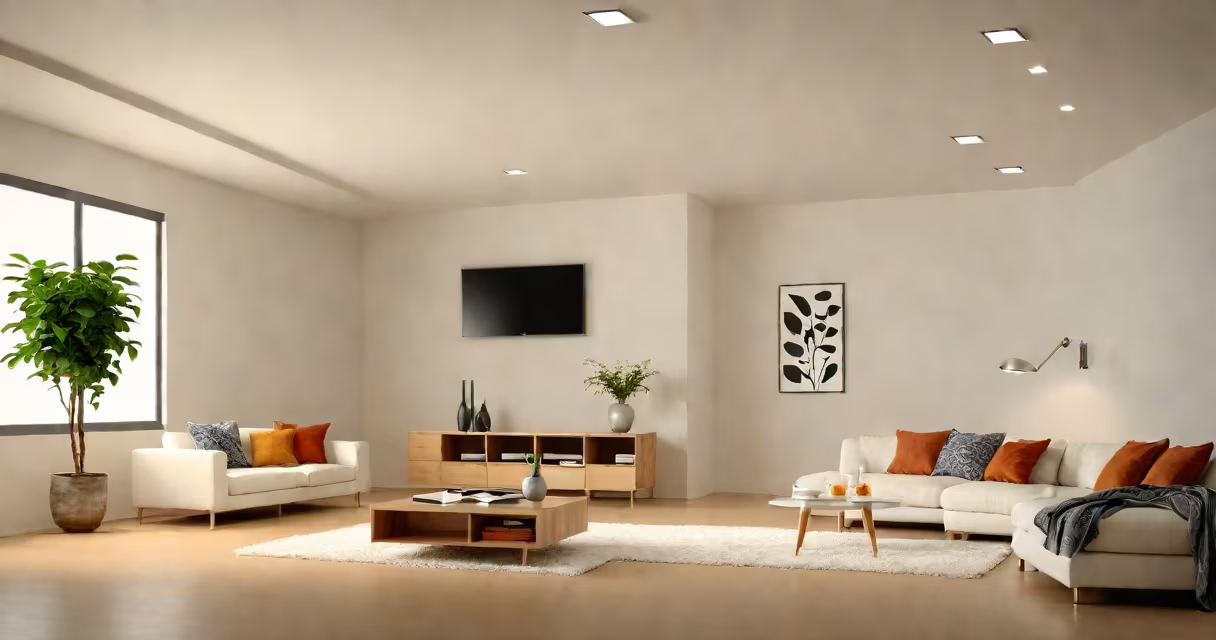
Recessed lighting refers to ceiling-mounted fixtures installed flush with the ceiling surface, with the light source hidden within the ceiling cavity. These fixtures provide directional or ambient illumination without protruding above the ceiling plane.
Recessed lighting is commonly used in residential and commercial spaces to create clean, unobtrusive lighting. The fixture is mounted into a hole cut into the ceiling structure, and the visible part-the trim-aims to blend with the ceiling finish. This design minimizes visual clutter and emphasizes architectural space.
According to the Illuminating Engineering Society (IES), recessed lighting offers efficient light distribution and improved spatial perception in interior environments. It is especially effective in rooms where ceiling height is limited or where a minimalist aesthetic is desired.
Recessed lighting operates by housing a lamp-typically LED, halogen, or incandescent-inside a metal housing called a "can" or "housing." The housing is secured into the ceiling joists or structural framing. A reflector inside the housing directs light downward through a lens or diffuser.
The visible portion of the fixture, known as the trim, sits at the ceiling surface and controls beam spread, glare, and appearance. Trims come in various styles: baffle, recessed, wide-angle, and adjustable. Each affects how light spreads and how much glare is produced.
For example, a baffle trim reduces glare by blocking direct view of the bulb. A wide-angle trim spreads light over a larger area, ideal for general room illumination. Adjustable trims allow precise aiming of the beam, useful in accent lighting for artwork or architectural features.
Recessed lighting systems vary based on mounting method, trim type, and intended function. The most common classifications are based on installation depth and trim style.
| Type | Depth | Best For | Common Use Cases |
|---|---|---|---|
| Standard (Shallow) | 3-4 inches | Low ceilings, drywall-only ceilings | Bedrooms, hallways, small kitchens |
| Deep (High-Profile) | 6-8 inches | High ceilings, insulation access | Living rooms, vaulted ceilings, basements |
| IC-Rated | Varies | Insulated ceilings | Attics, insulated walls, energy-efficient builds |
| Adjustable | Standard or deep | Accent lighting, task areas | Display cases, kitchen islands, reading nooks |
IC-rated fixtures are designed to be in contact with insulation without overheating. They meet safety standards set by Underwriters Laboratories (UL) and are required in many building codes when installed in insulated ceilings.
LED lamps are now standard in recessed lighting due to their energy efficiency and long lifespan. A typical 12-watt LED replaces a 75-watt incandescent while producing similar brightness-around 800 lumens.
Recessed lighting dominates modern interior design because it delivers functional light without disrupting ceiling lines. It's frequently used in kitchens, bathrooms, living rooms, and bedrooms.
In kitchens, recessed lights are placed along cabinetry lines or centered over countertops to eliminate shadows during food prep. In bathrooms, they're often arranged in a grid pattern to ensure even illumination for grooming tasks.
A real-world example: In a 2021 renovation of a 1950s ranch home in Portland, Oregon, the homeowner replaced outdated track lighting with 12 recessed LED fixtures. The new layout used 4-inch deep cans with IC-rated housings and baffle trims. After installation, the average illuminance increased from 50 lux to 300 lux in the main living area, meeting recommended levels for indoor comfort.
Many assume recessed lighting is simply "ceiling lights." That's inaccurate. Not all ceiling-mounted fixtures are recessed. Surface-mounted fixtures, such as flush-mount ceiling fans or pendant lights, sit on top of the ceiling and are not recessed.
Another misconception is that recessed lighting always produces harsh, glaring light. Modern trims and diffusers reduce glare. For example, a 4-inch baffle trim with a frosted lens can lower perceived brightness by up to 60% compared to a bare reflector.
Some contractors install recessed lighting without considering thermal performance. If a non-IC-rated housing is placed in an insulated ceiling, it can overheat and pose a fire risk. The National Fire Protection Association (NFPA) 70 code requires proper labeling and installation methods for all recessed fixtures in insulated spaces.
I once helped install recessed lighting in a client's newly remodeled kitchen. We used 6-inch deep cans with IC-rated housings and adjustable trims. The challenge was aligning the fixtures precisely-each had to be level and spaced evenly to avoid uneven lighting patterns.
We measured spacing using a laser level and marked each hole with a template. After cutting the holes, we secured the housings with spring-loaded brackets. The final step was installing the trims and testing each light with a dimmer switch. The result was a balanced, glare-free environment perfect for cooking and entertaining.
Recessed lighting is not just about brightness-it's about control, placement, and integration with the room's architecture. When done correctly, it enhances both function and aesthetics.
Understanding what recessed lighting means involves recognizing it as a system-not just a single fixture. It includes the housing, trim, lamp, and proper installation practices. Choosing the right combination ensures safety, efficiency, and visual harmony.