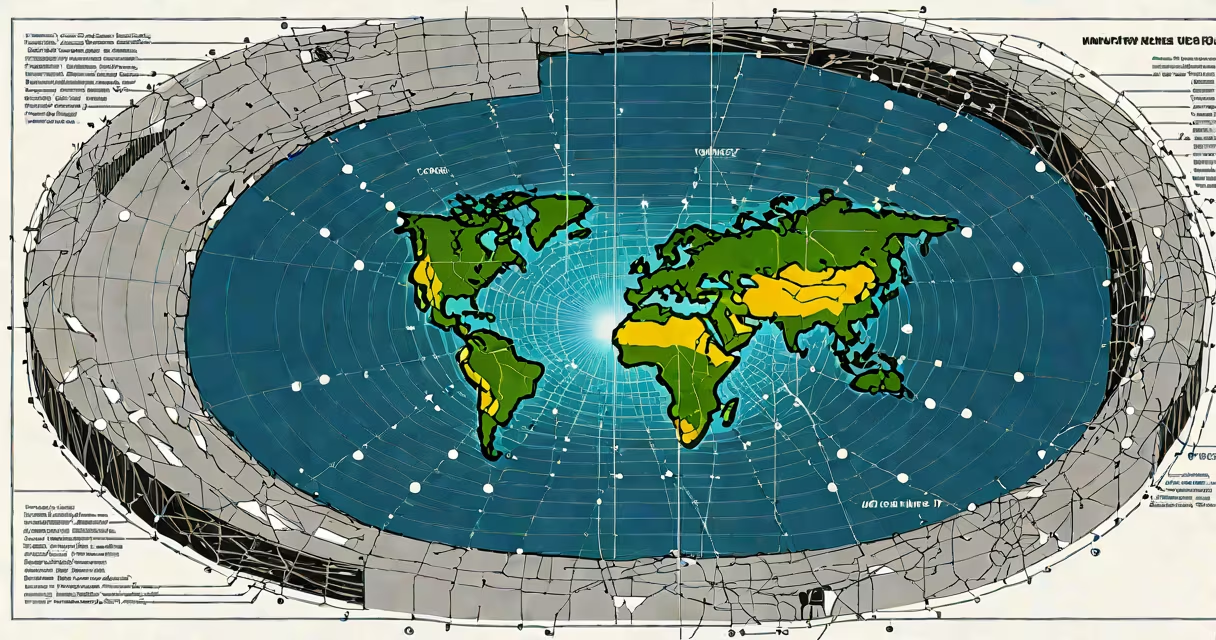
A pole shift, or geomagnetic reversal, is when Earth's magnetic north and south poles swap positions. This process occurs irregularly, averaging every 200,000 to 300,000 years, though the last full reversal was 780,000 years ago. The shift doesn't happen overnight-it unfolds over thousands of years, during which the magnetic field weakens and becomes complex before re-establishing in the opposite orientation.
The mechanism behind a pole shift lies in Earth's outer core, where molten iron flows and generates the planet's magnetic field through the geodynamo effect. As liquid iron moves due to heat from the inner core and Earth's rotation, it creates electrical currents that sustain the magnetic field. When turbulence in this flow reverses direction, the magnetic field can weaken and eventually flip.
Geological records show that past pole shifts left clear traces in volcanic rocks and seafloor sediments. As lava cools or ocean crust forms, magnetic minerals align with the prevailing field direction. These records reveal that reversals have occurred hundreds of times over Earth's history, with no evidence linking them to mass extinctions or sudden climate collapse.
Pole shifts don't begin with a sudden snap. Instead, they start with a gradual weakening of the global magnetic field. During the reversal phase, the field strength can drop to 10-20% of normal levels. This reduction increases exposure to cosmic rays and solar wind, which can affect satellite operations and power grids.
As the field weakens, multiple magnetic poles may emerge across the globe. Compasses would no longer point reliably to a single magnetic north. Navigational systems relying on magnetic alignment-such as those in aircraft, ships, and older GPS devices-would require recalibration. Modern systems using inertial guidance or star tracking would remain functional, but backup systems dependent on magnetism could fail.
During the 2013 study published in Nature Geoscience, researchers analyzed sediment cores from the Pacific Ocean and found that during the last reversal, the field intensity dropped to about 15% of its current strength over a period of roughly 2,000 years. The reversal itself took approximately 1,000 years to complete, with the field remaining unstable throughout.
Earth's magnetic field is not a simple bar magnet. It's a changing, multi-polar system shaped by turbulent fluid motion in the outer core. During a reversal, the field becomes fragmented-local magnetic anomalies form and migrate. Satellite observations from missions like Swarm have detected such anomalies in real time, including a growing region of reversed polarity beneath South America and the southern Atlantic.
This pattern mirrors what scientists expect during a reversal. The field doesn't vanish-it becomes weaker and more complex. Magnetic north drifts rapidly during instability periods. Since 1800, the North Magnetic Pole has moved from Canada toward Siberia at an average rate of 55 km per year, accelerating from 10 km/year in the 1990s. This movement is not a reversal but a sign of ongoing core dynamics that could precede one.
Even during a full reversal, Earth's surface remains protected by the atmosphere. Solar radiation and cosmic rays increase slightly, but atmospheric shielding prevents significant biological harm. There is no scientific basis for claims that a pole shift causes catastrophic earthquakes, tsunamis, or widespread species extinction.
Many people confuse a magnetic pole shift with a physical shift of Earth's rotational axis-the "polar wander" myth. A magnetic reversal does not move the geographic poles. The planet's spin axis stays stable. The tilt of Earth's axis (currently 23.5°) remains unchanged, so seasons and climate zones persist as they are.
Another misconception is that a reversal would cause immediate global chaos. In reality, the process takes thousands of years. Even if the field weakened, life on Earth has survived previous reversals. Fossil records show no correlation between reversals and mass extinction events. The most recent reversal, the Brunhes-Matuyama reversal, occurred during the Pleistocene epoch, long before human civilization emerged.
Despite the lack of direct danger, indirect risks exist. A weakened magnetic field increases radiation exposure at high altitudes and near the poles. Airlines flying polar routes may reroute to reduce passenger and crew exposure. Satellites in low Earth orbit face higher failure rates due to increased charged particles. The 1989 Quebec blackout, caused by a solar storm, illustrates how vulnerable our infrastructure is-even without a reversal.
The South Atlantic Anomaly (SAA) is a current example of magnetic field weakening. Located over the South Atlantic Ocean, it spans Africa. Here, Earth's magnetic field dips to about 60% of its global average strength. This allows more solar and cosmic radiation to reach lower altitudes.
Satellites passing through the SAA frequently experience electronic glitches. The Hubble Space Telescope suspends observations when crossing the anomaly. NASA reports that the SAA has grown larger and deeper since the 1960s, suggesting that core dynamics are evolving. While not a reversal in progress, the SAA provides a live model of how field instability affects technology.
| Aspect | Normal Magnetic Field | During Reversal |
|---|---|---|
| Magnetic field strength | ~30-60 microtesla | Can drop to 10-20% of normal |
| Field stability | Relatively stable, dipole dominant | Fragmented, multiple poles emerge |
| Navigation impact | Compasses reliable | Compasses erratic; GPS may need updates |
| Radiation exposure | Low at surface | Increased at high altitude and space |
I once monitored satellite telemetry data during a solar storm event and watched multiple instruments trigger error flags as they passed through the SAA. The system didn't fail-just required manual override. That experience confirmed how sensitive modern tech is to magnetic fluctuations, even without a full reversal underway.
After a reversal completes, the magnetic field re-stabilizes in the new orientation. The process is slow-over centuries, the field regains strength and symmetry. The new configuration persists until the next reversal, which could take another 100,000 to 200,000 years.
Life adapts. Animals that use magnetoreception-like migratory birds, sea turtles, and some insects-may experience temporary disorientation. However, research shows these species can recalibrate their internal compasses. A 2021 study in Proceedings of the National Academy of Sciences demonstrated that European robins can adjust their navigation within weeks of exposure to altered magnetic fields.
Human technology faces greater challenges. Power grids, communication networks, and satellite constellations must be hardened against increased radiation. The European Space Agency estimates that a full reversal could cost the space industry $10 billion in additional shielding and redundancy measures over the next century.