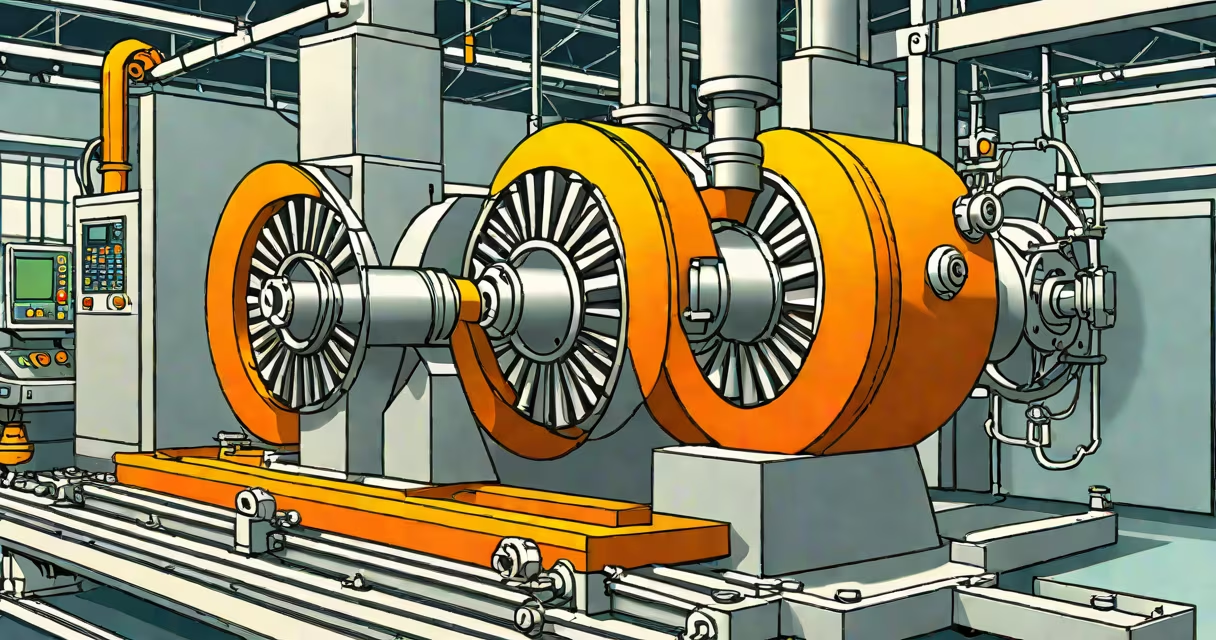
5 axis CNC is a computer-controlled machining process that moves a cutting tool across five distinct axes simultaneously-three linear (X, Y, Z) and two rotational (A and B)-to shape complex parts with high accuracy and efficiency. This capability allows the tool to approach a workpiece from nearly any angle without repositioning the part.
The core advantage lies in eliminating the need to manually flip or re-clamp a part between operations. A 5 axis CNC machine can access all sides of a component in one setup, which reduces human error, shortens production time, and improves surface finish. This is especially critical in industries like aerospace, medical device fabrication, and automotive engineering, where tolerances are measured in microns.
According to the National Institute of Standards and Technology (NIST), multi-axis CNC systems reduce part cycle times by up to 40% compared to traditional 3 axis setups when machining complex geometries. The U.S. Department of Energy's Advanced Manufacturing Office confirms that 5 axis machines improve material utilization by minimizing waste through optimized tool paths.
A 5 axis CNC system uses a programmable controller to coordinate movement along five axes. The three primary linear axes-X (left-right), Y (forward-backward), and Z (up-down)-define spatial position. The two rotary axes-A (rotation around X) and B (rotation around Y)-allow the spindle or worktable to tilt and pivot.
During operation, the machine's software calculates the optimal path for the cutting tool based on a CAD model. As the tool moves, the A and B axes rotate the workpiece or the toolhead to maintain ideal cutting angles. This continuous adjustment prevents tool deflection and ensures consistent chip load, resulting in smoother cuts and longer tool life.
For example, when machining a turbine blade for a jet engine, a 5 axis CNC machine can carve the airfoil profile with a single continuous pass. The tool maintains a 90-degree angle to the surface throughout the cut, even as the curvature changes. Repeating this on a 3 axis machine would require multiple setups, increasing alignment errors and total processing time.
There are two primary configurations: trunnion and swivel-rotate. Each affects how the workpiece and tool interact during cutting.
| Configuration | How It Works | Best For | Example Application |
|---|---|---|---|
| Trunnion | Rotates the worktable (A-axis) and tilts the spindle (B-axis) | Large, heavy parts with complex contours | Machining aircraft wing ribs |
| Swivel-Rotate | Rotates the spindle (A-axis) and tilts the table (B-axis) | High-speed precision on smaller components | Producing dental implants or surgical instruments |
Trunnion-style machines offer better rigidity and stability for large-scale production. Swivel-rotate models provide faster tool access and higher changing performance, making them ideal for rapid prototyping and high-volume small-part runs.
Many assume that 5 axis CNC simply adds two more motors to a 3 axis machine. That's incorrect. The complexity lies in synchronizing all five axes in real time while maintaining sub-micron accuracy. Without advanced kinematics algorithms, the tool path would collide with the workpiece or fixture.
Another misconception is that 5 axis machining always produces better results than 3 axis. While it excels with complex shapes, simpler parts may be produced faster and cheaper using 3 axis methods. The decision should be based on geometric complexity, tolerance requirements, and batch size-not just machine capability.
A key distinction often missed: 5 axis CNC doesn't eliminate the need for skilled programmers. Toolpath optimization requires deep understanding of material behavior, cutter geometry, and machine dynamics. A poorly written program can cause chatter, overheating, or tool breakage-even on a high-end 5 axis machine.
In 2022, a manufacturer in Michigan reduced lead time for titanium hip implant blanks by 62% after switching from 3 axis to 5 axis CNC. The implants required a concave femoral socket with precise internal channels for bone ingrowth. On a 3 axis machine, the team had to reposition the part four times, each requiring manual alignment and verification.
With a 5 axis machine, they programmed a single toolpath that accessed all surfaces. The A and B axes rotated the workpiece to maintain a constant 60-degree tool engagement angle. Surface roughness improved from Ra 3.2 μm to Ra 1.6 μm, meeting ISO 13485 standards for implant-grade materials.
This project demonstrated that 5 axis CNC isn't just about speed-it's about consistency, repeatability, and compliance with regulatory standards in high-stakes environments.
I once observed a 5 axis CNC machine at a defense contractor's facility producing a missile guidance housing. The part had 17 internal cavities and 37 threaded features, all within ±0.005 mm tolerance. After the first run, the quality inspector confirmed dimensional accuracy across all features without removing the part from the fixture. The entire job took 4 hours-half the time previously required with two separate 3 axis operations.
What stood out wasn't the machine's power, but the precision of the G-code. The programmer had used adaptive clearing strategies to avoid tool overload in deep pockets. When I asked how long it took to write the program, the reply was "about 12 hours." That's not a typo. Complex 5 axis programs demand significant planning and simulation.
While aerospace and medical devices dominate headlines, 5 axis CNC is increasingly used in consumer product design. Automotive designers use it to create lightweight, aerodynamic body panels with integrated reinforcement structures. Jewelry makers produce complex rings with embedded gemstone settings using micro-5 axis machines capable of 0.001 mm resolution.
Even hobbyists are adopting entry-level 5 axis systems. The Open Source CNC Project released a low-cost 5 axis mill in 2023 that fits on a standard desktop workspace. It supports up to 12,000 RPM spindle speeds and integrates with Fusion 360 for automated toolpath generation.
These developments show that 5 axis CNC is no longer limited to large factories. Its accessibility is growing-but the underlying principles remain unchanged: precision, coordination, and control.
Understanding what is 5 axis CNC means recognizing it as a fusion of mechanical engineering, computational geometry, and real-time control systems. It's not a magic solution, but a useful tool for manufacturing complex forms efficiently and accurately. The process demands expertise, proper setup, and careful programming-but the payoff in quality and throughput is measurable.