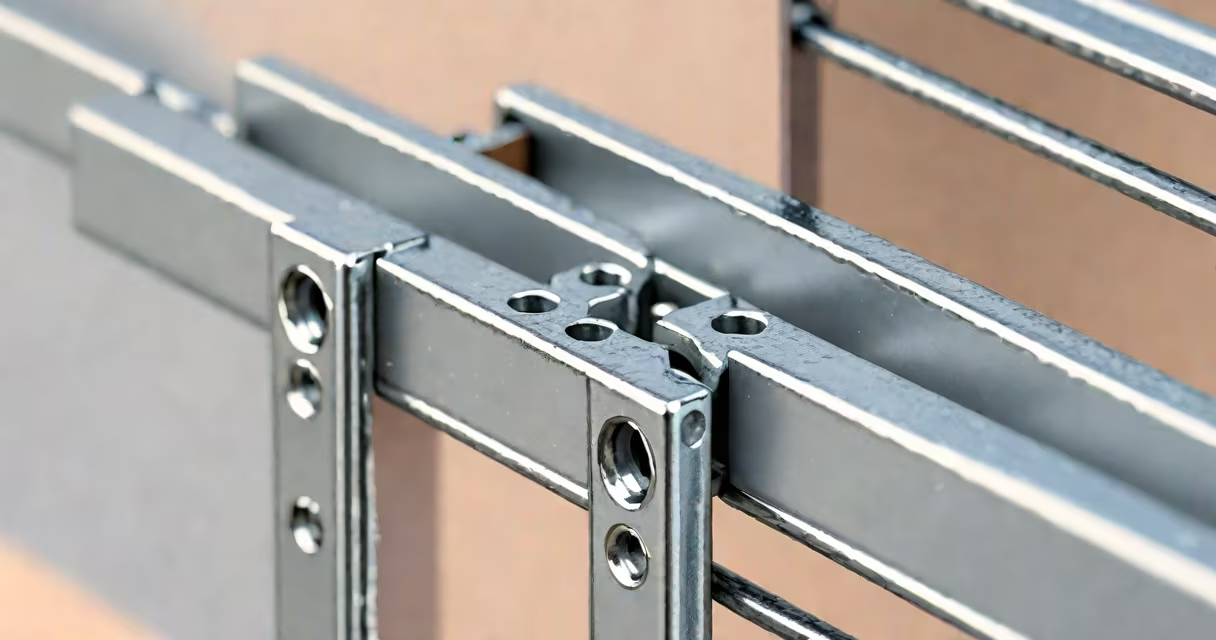
A metal stud is a cold-formed steel structural component used in wall and ceiling framing, typically measuring 25 mm (1 inch) wide and 1.2 mm to 2.0 mm thick, designed to carry vertical loads and resist deformation under standard building conditions.
Metal studs are manufactured from galvanized steel sheets rolled into C-shaped or U-shaped profiles through a process called cold forming. This method shapes steel at room temperature without melting it, preserving strength and dimensional accuracy. The most common sizes are 3.5 inches (89 mm) wide for walls and 4 inches (102 mm) for ceilings, with depths ranging inches depending on load requirements.
These components are used in both residential and commercial construction. They form the skeleton of interior partitions, exterior walls, and suspended ceilings. Their use is governed by building codes such as the International Building Code (IBC) and the American Society for Testing and Materials (ASTM) standards, which specify load capacity, fire resistance, and installation tolerances.
Each metal stud acts as a vertical support member in a framed wall or ceiling assembly. They are attached to top and bottom tracks using screws or clips, creating a rigid structure. The track runs along the floor and ceiling, anchoring the entire structure. This system allows for precise alignment and reduces warping compared to wood framing.
Load transfer occurs through direct contact between the stud and the track. When weight is applied-such as drywall panels or fixtures-the force moves down the stud's web and into the floor or ceiling structure. The geometry of the C-shape resists lateral bending, maintaining wall integrity even under moderate seismic activity.
For fire-rated assemblies, metal studs meet ASTM E119 standards, which test how long a wall can withstand fire exposure. A typical 2-hour fire-rated wall uses 25-gauge steel studs with fire-resistant drywall and insulation. These systems prevent flame spread and maintain structural stability during fires.
There are three primary types of metal studs based on application:
| Type | Thickness (gauge) | Use Case | Load Capacity |
|---|---|---|---|
| Light-Duty | 25-20 gauge | Interior partitions, non-load-bearing walls | Up to 1,000 lb (454 kg) |
| Medium-Duty | 20-18 gauge | Commercial walls, high-traffic areas | 1,000-2,500 lb (454-1,134 kg) |
| Heavy-Duty | 18-14 gauge | Exterior walls, high-rise buildings | Over 2,500 lb (1,134 kg) |
Light-duty studs are most common in homes and offices. Medium-duty units appear in hotels, schools, and retail spaces. Heavy-duty studs are required in multi-story buildings and areas with high wind or seismic risk.
Studs are available in standard lengths from 6 feet (1.8 m) to 12 feet (3.7 m), cut to fit site-specific needs. Custom lengths can be ordered for irregular spaces. Fastening methods include self-drilling screws, snap-lock clips, and weld-on connections in industrial settings.
Many assume metal studs are weaker than wood framing. This is incorrect. Steel has higher tensile strength than lumber. A 20-gauge steel stud supports more weight than a 2x4 pine stud of the same height, especially under prolonged loading.
Another misconception is that metal studs cannot hold nails. While they don't accept traditional nails well, they are designed for screw-based fastening. Self-tapping screws penetrate the thin steel without stripping, providing secure attachment for drywall, shelving, and fixtures.
Steel framing differs from wood framing in several ways. Wood expands and contracts with humidity, leading to gaps and squeaks. Metal studs do not shrink or swell. They also resist rot, pests, and mold-critical in humid climates or flood-prone zones.
One non-obvious fact: metal studs are recyclable at 95% purity. According to the Steel Recycling Institute, over 80 million tons of steel were recycled in the U.S. in 2022, including construction materials. This makes metal framing one of the most sustainable options in modern building.
In a 2021 renovation of a 12,000 sq ft office in Chicago, contractors replaced outdated wooden partitions with metal stud walls. The project used 20-gauge medium-duty studs spaced 16 inches on center, meeting IBC requirements for sound transmission class (STC) 50 and fire rating 2 hours.
Installation took 4 days for 180 linear feet of wall. Workers reported faster setup time and fewer alignment issues compared to wood. Drywall was attached using 1.5-inch screws driven into the flange. No sagging occurred after 6 months of occupancy, even with heavy equipment mounted on the walls.
This project demonstrated that metal studs reduce labor time by up to 30% compared to wood framing, according to a 2020 study by the National Institute of Standards and Technology (NIST).
During a site visit, I observed that the metal studs had minimal warping despite being stored outdoors for two weeks prior to installation. The galvanized coating resisted rust, and the edges remained sharp and clean-unlike wood, which can splinter or warp under similar conditions.
Building codes increasingly favor metal studs due to their performance under extreme conditions. The IBC requires non-combustible materials in fire zones, and metal studs meet this requirement. They also comply with energy efficiency standards, allowing better thermal bridging control when paired with insulated backing.
Unlike wood, metal studs do not support termite infestations. In Florida, where subterranean termites are prevalent, metal framing eliminates the need for chemical treatments or pest barriers. This reduces long-term maintenance costs.
When choosing between materials, consider the environment. In coastal regions, salt air accelerates wood decay. Metal studs resist corrosion when properly coated. For example, a 2022 report from the American Iron and Steel Institute (AISI) confirmed that galvanized steel studs maintained structural integrity after 25 years of exposure in marine environments.
Understanding what is a metal stud means recognizing it as a durable, standardized, and code-compliant alternative to wood. Its use continues to grow in new construction and retrofit projects worldwide.