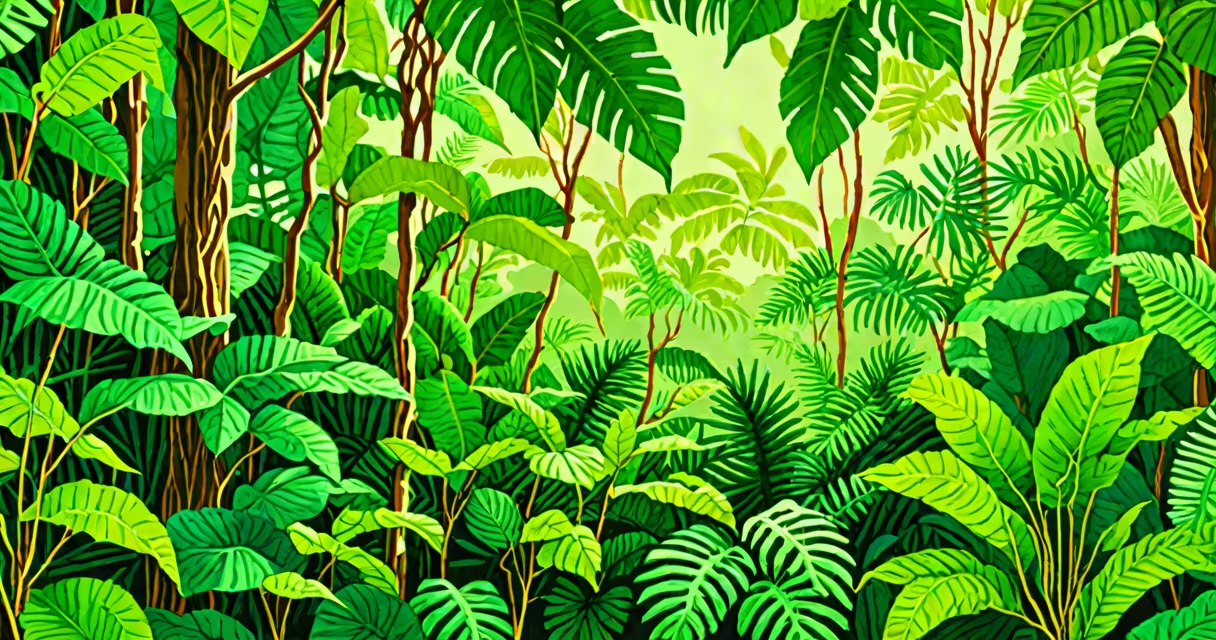
A rainforest biome is a dense, warm, and wet system dominated by broadleaf trees, receiving 175-400 cm of rainfall annually, primarily in tropical regions near the equator. These biomes host the highest biodiversity on Earth, with over 50% of known terrestrial species living within them.
Rainforest biomes form where consistent warmth and abundant moisture create ideal conditions for year-round plant growth. Temperatures remain between 20°C and 30°C (68°F-86°F) throughout the year, with little seasonal variation. The high humidity and steady rainfall prevent drought stress, allowing complex vegetation layers to develop.
These ecosystems are divided into tropical and temperate rainforests. Tropical rainforests occur near the equator-regions like the Amazon Basin, Congo Basin, and Southeast Asian islands. Temperate rainforests exist in cooler coastal zones, such as the Pacific Northwest of North America and parts of Chile and New Zealand. While both support rich life, tropical rainforests have higher species diversity.
The rainforest biome operates through tightly linked ecological processes. Sunlight penetrates only the upper canopy, creating distinct vertical layers: emergent, canopy, understory, and forest floor. Each layer hosts specialized plants and animals adapted to specific light, moisture, and nutrient levels.
Decomposition occurs rapidly due to constant heat and moisture. Organic matter breaks down quickly, returning nutrients to the soil. However, most nutrients are stored in living biomass rather than in the soil itself. This makes rainforests vulnerable to disruption-clearing even small areas can deplete soil fertility within years.
For example, in the Amazon, a single hectare may contain over 480 tree species. In contrast, a similar area in a temperate forest typically holds fewer than 20. This density supports complex food webs: leaf-cutter ants cultivate fungus gardens, jaguars hunt capybaras, and harpy eagles prey on monkeys-all interconnected in a web of dependence.
Two primary types exist, differing in climate, location, and species composition:
| Type | Climate Zone | Annual Rainfall | Notable Regions | Biodiversity Level |
|---|---|---|---|---|
| Tropical | Equatorial (0°-10° latitude) | 175-400 cm | Amazon, Congo, Borneo, Madagascar | Extremely high |
| Temperate | Coastal mid-latitudes (30°-50°) | 150-300 cm | Pacific Northwest, Chilean Coast, Southern Australia | High, but lower than tropical |
Tropical rainforests are the most biodiverse. The Amazon alone contains over 390 billion individual trees across 16,000 species. In comparison, temperate rainforests like those in Washington State's Olympic Peninsula feature dominant conifers such as Douglas fir and western hemlock, with less plant variety but greater biomass per hectare.
Despite their name, temperate rainforests do not experience cold winters. Coastal fog and consistent precipitation sustain mosses, ferns, and epiphytes-plants that grow on other plants without parasitizing them. In the Pacific Northwest, moss-covered branches and towering trees create a misty, cathedral-like atmosphere.
Many assume all rainforests are hot and humid. But temperate rainforests exist in milder climates, often with cool, moist air and frequent cloud cover. The term "rainforest" refers to precipitation patterns, not temperature alone.
Another misconception is that rainforest soils are fertile. In reality, tropical rainforest soils are often thin and nutrient-poor. Most nutrients cycle rapidly through leaves, roots, and animals. When trees are cut down, the soil loses its ability to support new growth quickly-this is why deforestation leads to long-term degradation.
A key distinction lies in human impact. Tropical rainforests face intense pressure from logging, agriculture, and mining. Between 2000 and 2020, the Amazon lost about 17% of its forest cover, according to the World Resources Institute. Deforestation rates in Indonesia and Brazil remain alarmingly high, driven by palm oil and cattle farming.
I once stood beneath the canopy in Costa Rica's Monteverde Cloud Forest Reserve. The air was thick with moisture, and the sound of howler monkeys echoed through the trees. A biologist pointed out a bromeliad growing on a branch-its cup filled with water, hosting tiny frogs and insects. That microhabitat, sustained by drip from above, illustrated how rainforest systems depend on precise ecological balance.
Rainforest biomes regulate global climate by absorbing carbon dioxide. The Amazon alone stores an estimated 120 billion tons of carbon. When forests burn or are cleared, this carbon is released, accelerating climate change.
Research from the Intergovernmental Panel on Climate Change (IPCC) confirms that intact rainforests act as carbon sinks. Deforestation contributes roughly 10% of global greenhouse gas emissions annually. Protecting these biomes is essential for climate stability.
Conservation efforts focus on sustainable land use, indigenous stewardship, and protected reserves. In Brazil, Indigenous territories cover nearly 20% of the Amazon and show lower deforestation rates than surrounding areas. Studies published in Nature show that communities managing land traditionally reduce forest loss by up to 58% compared to state-managed parks.
Understanding the rainforest biome is critical for preserving planetary health. Its survival depends on recognizing that biodiversity isn't just a measure of species count-it's a system of interdependence. Losing one species can disrupt pollination, seed dispersal, and nutrient cycling across entire networks.