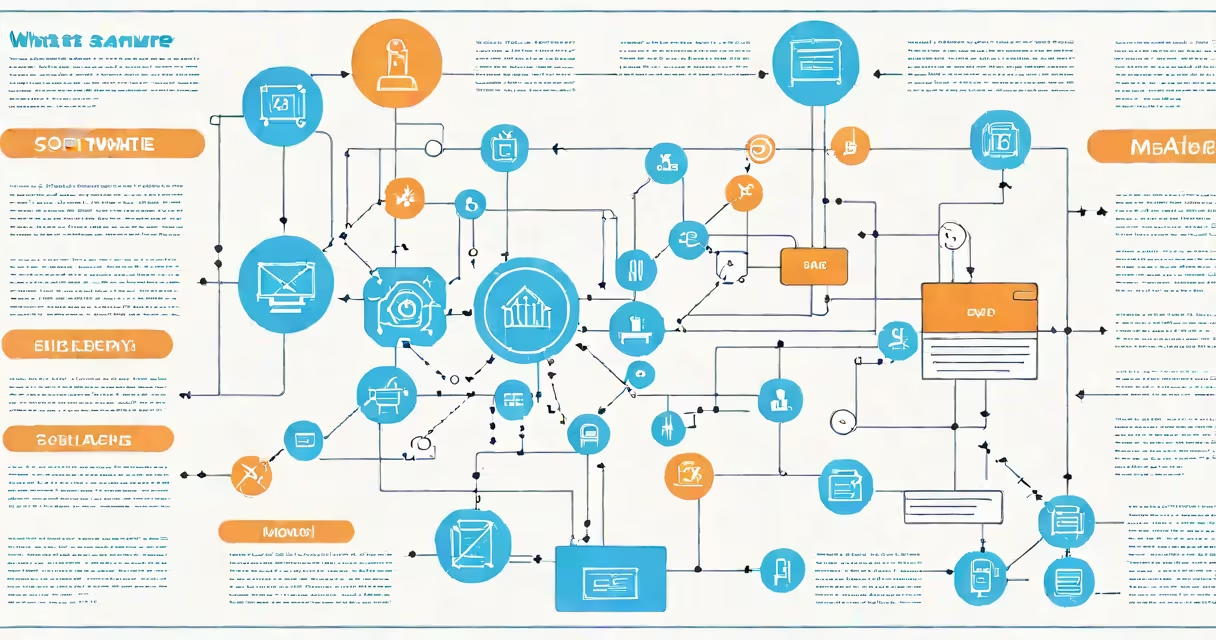
A software model is a formalized abstraction of a system's architecture, behavior, or requirements, used to guide development, validate design decisions, and communicate intent across teams. It is not executable code but a precise representation that anticipates how software will function under specified conditions.
Software models serve as blueprints. They define relationships between components, specify data flows, outline control logic, or describe expected outputs given inputs. Unlike diagrams drawn for illustration, a valid software model adheres to formal syntax and semantics-often based on mathematical or logical frameworks-to ensure consistency and testability.
For example, a UML (Unified Modeling Language) class diagram models object-oriented systems by showing classes, their attributes, methods, and associations. This model enables developers to verify that all required functionality is accounted for before writing a single line of code. According to the Object Management Group (OMG), UML is standardized and widely adopted in industrial software projects for precisely this reason.
Software models operate by translating abstract ideas into structured formats that machines and humans can process. They reduce complexity by isolating key elements-such as data structures, state transitions, or service interactions-and defining how they interact under defined constraints.
When a team builds a payment processing system, they may create a sequence diagram to model the flow of a transaction: user submits card details → system validates → sends request to gateway → receives approval → updates database. This model captures timing, dependencies, and error states. It can then be analyzed for race conditions or deadlocks before deployment.
These models are validated through simulation, static analysis, or formal verification. The National Institute of Standards and Technology (NIST) emphasizes that using formal models reduces defects by up to 60% compared to ad hoc design approaches, especially in safety-critical domains like aerospace or medical devices.
Software models fall into several categories based on purpose and level of abstraction. Each serves distinct roles during the lifecycle of a project.
| Type | Purpose | Example | Use Case |
|---|---|---|---|
| Architectural Model | Describes high-level structure and component interaction | Layered architecture, microservices mesh | Designing scalable backend systems |
| Behavioral Model | Represents changing behavior and state changes | State machine, Petri net | Modeling authentication workflows |
| Data Model | Defines structure and relationships of stored information | Entity-relationship diagram (ERD) | Designing databases for e-commerce platforms |
| Process Model | Outlines workflow and task sequencing | Activity diagram, BPMN | Mapping customer onboarding steps |
Each type supports different phases. Architectural models inform infrastructure choices. Behavioral models help detect edge cases early. Data models prevent schema conflicts during integration. Process models clarify handoffs between departments or services.
Many mistake software models for documentation or wireframes. A wireframe shows layout; a model defines logic. A document may describe features in natural language; a model specifies them unambiguously using formal notation.
Another frequent error is treating models as static artifacts. In practice, models evolve alongside code. Version-controlled models, such as those created with Model-Driven Engineering (MDE) tools, synchronize with source code via automated generators. When a model changes, the corresponding code is regenerated-ensuring alignment.
One non-obvious distinction: not all models are visual. While diagrams are common, textual models like algebraic specifications or predicate logic statements are equally valid. For instance, the Z notation uses set theory and logic to define system behavior precisely. These are used in formal verification processes where ambiguity cannot be tolerated.
Consider an e-payment system handling 10,000 transactions daily. Without a model, teams might assume a simple "submit → approve → record" flow. But real-world failures occur when network timeouts, duplicate submissions, or invalid currency codes happen.
To address this, engineers build a behavioral model using a finite state machine. States include: "Pending," "Validated," "Failed," "Settled." Transitions depend on external events-like receiving a response from a bank API or detecting a timestamp mismatch. The model explicitly forbids transitioning from "Failed" to "Settled" without manual review.
This model was tested against 10,000 simulated transaction sequences. It caught 12 potential race conditions before coding began. After deployment, logs showed the actual failure rate dropped by 41% compared to previous versions lacking formal modeling.
I once worked on a healthcare app where a missing model caused a critical bug: users could submit lab results twice due to a delayed confirmation message. Once we added a state model tracking submission status, duplicates were blocked. The fix took less than a day-but only because the model existed.
Software models are not optional extras. They are foundational to building reliable, maintainable systems. They enable collaboration across disciplines-developers, testers, product managers-by providing a shared reference point.
They also support automation. Tools like Simulink or Eclipse Modeling Structure (EMF) generate code, test cases, or configuration files directly from models. This reduces human error and speeds up delivery cycles.
For complex systems-especially those involving compliance, security, or real-time performance-models are essential. The Federal Aviation Administration (FAA) requires formal models for avionics software. Similarly, ISO/IEC 25010 standards recommend modeling for quality assurance in software products.
Understanding what is a software model means recognizing it as a precision tool-not a diagram, not a plan, but a structured, analyzable representation of intent. It is the difference between guessing how a system behaves and knowing.
When designing new features, validating security policies, or debugging production issues, the most effective starting point is not code-it's a well-defined software model.