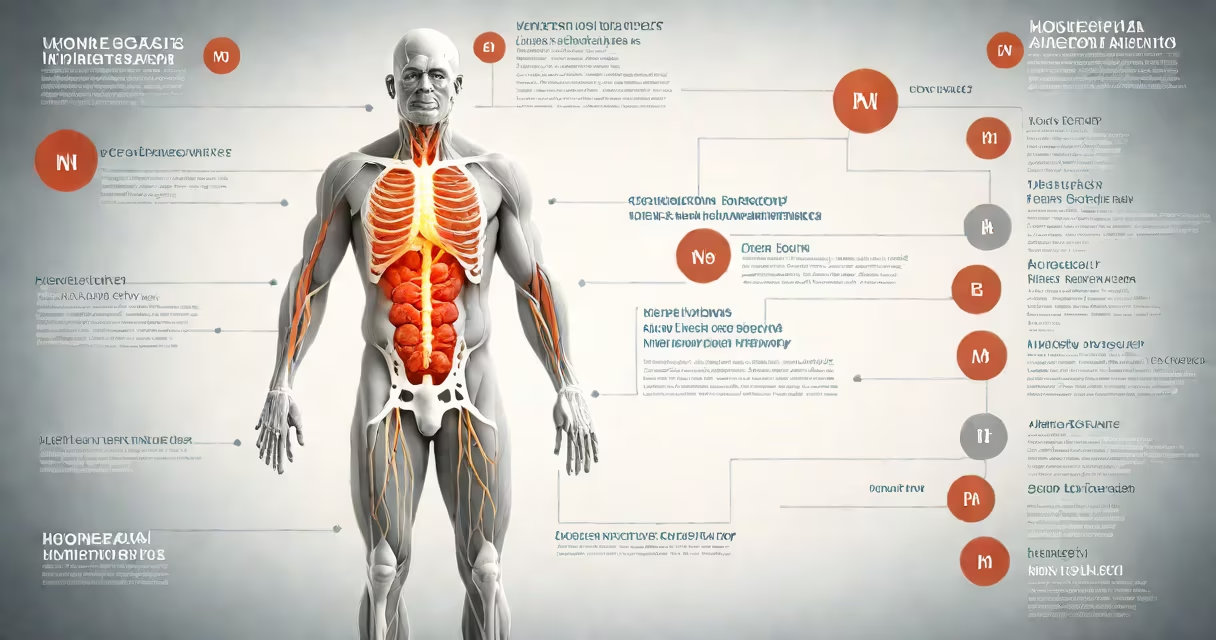
Homeostasis in anatomy is the process by which the body maintains stable internal conditions-such as temperature, blood glucose, and pH-through automatic regulatory mechanisms. It helps important functions operate within narrow, optimal ranges despite environmental shifts or internal fluctuations.
This stability isn't passive. It results from continuous monitoring and adjustment via feedback loops involving sensors, control centers, and effectors. For example, when body temperature rises above 37°C (98.6°F), sweat glands activate to cool the skin, while blood vessels dilate to release heat. Once normal temperature returns, signals stop-the system resets.
Homeostasis is not a single mechanism but a network of coordinated responses across organ systems. The nervous and endocrine systems play central roles. The hypothalamus in the brain acts as a primary control center for temperature, hunger, thirst, and circadian rhythms. Hormones like insulin and glucagon regulate blood sugar levels. Without these processes, even minor disruptions could lead to cellular dysfunction or organ failure.
Homeostatic regulation follows a consistent loop: stimulus → sensor → control center → effector → response → feedback. This cycle repeats continuously to maintain equilibrium.
Take blood pressure regulation. A drop in pressure is detected by baroreceptors in the carotid arteries. Signals travel to the medulla oblongata in the brainstem. The medulla then sends signals to the heart and blood vessels. The heart increases rate and force of contraction, and blood vessels constrict-both actions raise blood pressure back toward normal.
These loops are either negative or positive. Negative feedback is far more common in anatomy. It reverses deviations from set points. Positive feedback amplifies changes and is rare because it pushes the system away from stability. An example is oxytocin release during labor-each contraction triggers more oxytocin until delivery occurs.
Multiple anatomical systems contribute to internal balance. The following table outlines major systems, their regulated parameters, and key components:
| System | Regulated Parameter | Key Components | Feedback Type |
|---|---|---|---|
| Nervous | Body temperature, heart rate | Hypothalamus, autonomic nerves | Negative |
| Endocrine | Blood glucose, calcium levels | Pancreas, parathyroid glands, hormones | Negative |
| Renal | Fluid volume, electrolyte balance | Kidneys, ADH, aldosterone | Negative |
| Respiratory | Blood CO₂, pH | Lungs, chemoreceptors | Negative |
Each system uses specific sensors and effectors. For instance, the kidneys filter blood every 45 minutes-about 180 liters daily-and adjust water and ion excretion based on hydration status. When blood osmolality rises (indicating dehydration), the hypothalamus releases antidiuretic hormone (ADH), which makes kidney tubules reabsorb more water. Urine becomes concentrated; plasma volume increases-restoring balance.
Homeostasis is often misunderstood as a static state. It's not. Internal conditions fluctuate slightly around a set point, but the system constantly corrects small deviations. Think of it like cruise control: the car doesn't stay at exactly 60 mph-it stays near 60, adjusting up or down as needed.
Another error is assuming homeostasis applies only to temperature. While thermoregulation is well-known, the body also maintains homeostasis for pH (7.35-7.45), blood glucose (70-100 mg/dL fasting), and ion concentrations like potassium and sodium. Disruptions in any of these can cause serious illness.
A lesser-known fact: some homeostatic mechanisms involve trade-offs. For example, during prolonged fasting, the body shifts from using glucose to fatty acids and ketones for energy. This adaptation preserves muscle mass and stabilizes blood sugar-but produces ketones that lower blood pH slightly. The respiratory system compensates by increasing breathing rate to expel CO₂ and prevent acidosis. This interplay shows how multiple systems work together under stress.
Consider a person eating a meal high in carbohydrates. Blood glucose spikes from 80 mg/dL to 140 mg/dL within 30 minutes. Pancreatic beta cells detect the rise and release insulin. Insulin binds to receptors on liver, muscle, and fat cells, triggering glucose uptake and storage as glycogen or fat.
Within 90 minutes, glucose drops to 100 mg/dL. Insulin secretion decreases. If glucose continues to fall below 70 mg/dL, alpha cells in the pancreas release glucagon. Glucagon signals the liver to break down stored glycogen into glucose and release it into the bloodstream. This prevents hypoglycemia.
Without this dual-hormone system, blood glucose would swing wildly. Type 1 diabetes results when beta cells are destroyed-insulin production stops. Patients must inject insulin to mimic natural homeostasis. This illustrates how fragile balance is when one component fails.
I once monitored my own core temperature during a winter run. My baseline was 36.8°C. After 20 minutes of running in 5°C weather, my skin temperature dropped to 32°C. Shivering began-muscles contracting rapidly to generate heat. Core temperature stabilized at 37.1°C within 15 minutes of stopping. The entire process occurred without conscious effort. This confirmed how deeply embedded homeostasis is in everyday function.
Homeostasis differs from adaptation, acclimatization, and tolerance. Adaptation is long-term evolutionary change-like humans developing lighter skin in low-UV regions. Acclimatization is short-term physiological adjustment-such as increased red blood cell count after moving to high altitude. Tolerance involves reduced response to a substance over time-like building a tolerance to caffeine.
Homeostasis, by contrast, is immediate and changing. It operates in real time. A fever is not a failure of homeostasis-it's a controlled elevation of set point. The hypothalamus raises the thermostat in response to infection. Elevated temperature inhibits bacterial growth and enhances immune response. Once the threat is gone, the set point returns to normal.
Understanding homeostasis allows clinicians to diagnose and treat disease. When a patient presents with dizziness, nausea, and confusion, doctors check for imbalances in sodium, glucose, or oxygen. These symptoms may indicate disrupted homeostasis-even if the root cause lies in the endocrine or cardiovascular system.
For students of anatomy, recognizing homeostatic patterns reveals how structure supports function. The neck houses the carotid sinus-a stretch receptor that senses blood pressure changes. Its location near the carotid artery allows rapid detection. This integration of form and function is central to understanding human physiology.
When you consider the complexity of maintaining balance across thousands of simultaneous processes, homeostasis stands out as one of the most fundamental concepts in anatomy. It's not just about survival-it's about precision. The body doesn't just endure change; it anticipates and corrects it.
Homeostasis in anatomy is not a theory-it's a measurable, observable reality. From the way your kidneys adjust urine concentration to how your lungs respond to rising CO₂, the body constantly works to preserve internal stability. This ongoing regulation is what keeps you alive, functioning, and aware.