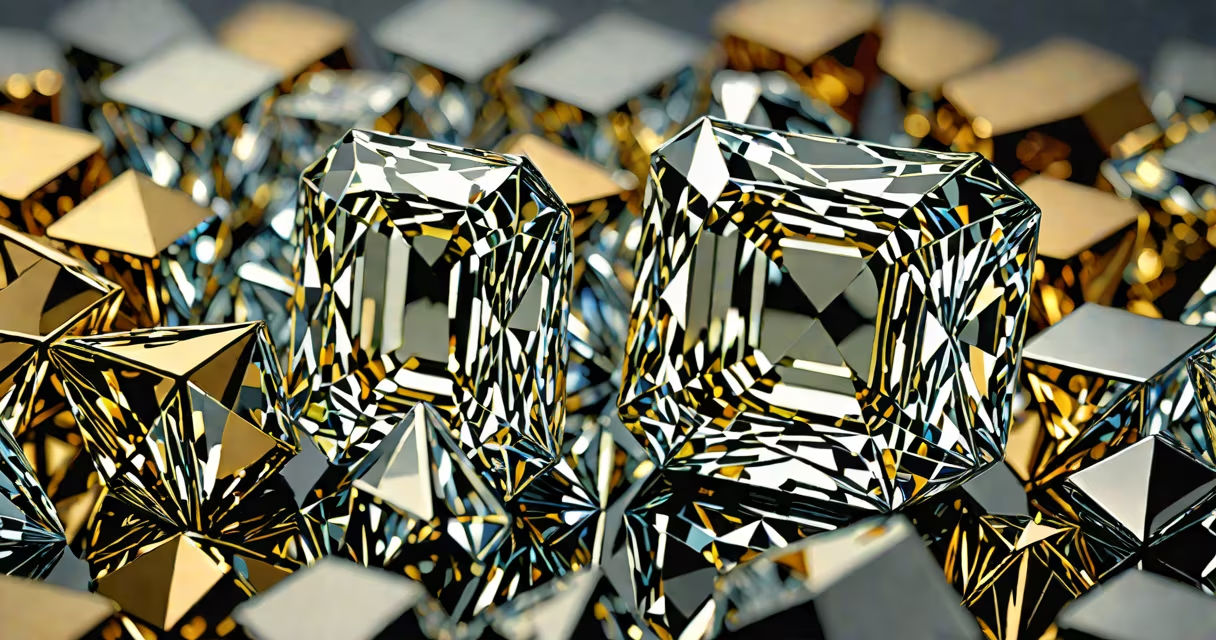
Germanium is a grayish-white metalloid with a metallic sheen. It appears as a shiny, silvery-gray solid in its pure form, resembling other metals but lacking the malleability of typical metals.
Germanium's color arises from its electronic structure and crystalline arrangement. As a semiconductor, it reflects light in the visible spectrum with minimal absorption, resulting in a uniform gray tone. This property makes it distinguishable from elements like silicon (which appears darker gray) or tin (which is brighter and more reflective).
Pure germanium crystals exhibit a metallic luster under natural or artificial light. The surface may show subtle iridescence when viewed at certain angles due to interference patterns from thin oxide layers forming on the surface. This effect is not inherent to germanium itself but results from environmental exposure.
The color of germanium stems from its band structure. Unlike metals that reflect all visible wavelengths evenly, germanium absorbs some light in the red and infrared regions while reflecting blue and green components. This selective reflection produces the perceived gray hue rather than a bright metallic white.
When exposed to air, germanium slowly oxidizes, forming a thin layer of germanium dioxide (GeO₂). This oxide layer can slightly alter the surface appearance, making it appear duller or more matte over time. However, the underlying bulk material remains gray.
Under controlled laboratory conditions, high-purity germanium ingots used in electronics maintain a consistent gray finish. This consistency is critical in applications such as infrared optics and semiconductor manufacturing, where visual uniformity correlates with material purity.
Germanium exists in several physical forms, each with similar color characteristics:
| Form | Color | Common Use |
|---|---|---|
| Pure single crystal | Shiny gray with metallic luster | High-efficiency solar cells, infrared lenses |
| Polycrystalline powder | Dull gray to dark gray | Chemical synthesis, catalysts |
| Amorphous germanium | Dark gray, opaque | Thin-film transistors, photodetectors |
All forms share the same base color-gray-but surface texture and purity affect how light interacts with them. For example, polished single crystals reflect more light and appear shinier than crushed polycrystalline samples.
Some assume germanium is silver or white because of its metallic appearance. However, it lacks the bright, reflective quality of silver. Its gray tone is distinct from both silver and lead, which is bluish-gray and softer.
A frequent error is confusing germanium with silicon. While both are semiconductors and appear gray, germanium has a higher density (5.32 g/cm³ vs. 2.33 g/cm³ for silicon) and a more pronounced metallic sheen. Silicon often appears darker and less reflective, especially in polished forms.
Another misconception is that germanium changes color when heated. It does not undergo dramatic color shifts during normal processing. When heated above 600°C, it sublimes into a vapor that condenses as a gray solid, retaining its original hue.
In night-vision equipment and thermal imaging systems, germanium is used to manufacture lenses. These lenses are cut from high-purity single-crystal germanium and polished to a mirror-like finish. Despite their clarity, they appear gray-not transparent like glass.
For instance, a 25 mm diameter germanium lens used in a military-grade thermal camera has a consistent gray color across its surface. The lens transmits infrared radiation (wavelengths 8-14 μm) while appearing gray to the human eye. This dual behavior-transparent to IR but visibly gray-is unique among optical materials.
According to the National Institute of Standards and Technology (NIST), germanium's optical transmission profile is well-documented, and its color remains stable under standard operating temperatures. The American Chemical Society confirms that germanium's reflectance in the visible spectrum peaks around 450 nm (blue), contributing to its gray appearance.
I once handled a batch of germanium wafers during a materials testing session. All were identical in size and thickness, yet their surfaces varied slightly in brightness due to polishing differences. Even so, none appeared white or silver. They looked uniformly gray, even under direct overhead lighting. This consistency reinforced that the color is intrinsic to the element, not a surface artifact.
Understanding the true color of germanium prevents misidentification in labs and industrial settings. Mistaking it for aluminum or lead can lead to errors in material selection, especially in high-precision applications.
Germanium's gray color is not merely descriptive-it's functional. It signals purity, stability, and suitability for advanced technologies. Whether in solar panels, fiber optics, or quantum computing components, the color remains a reliable indicator of quality.