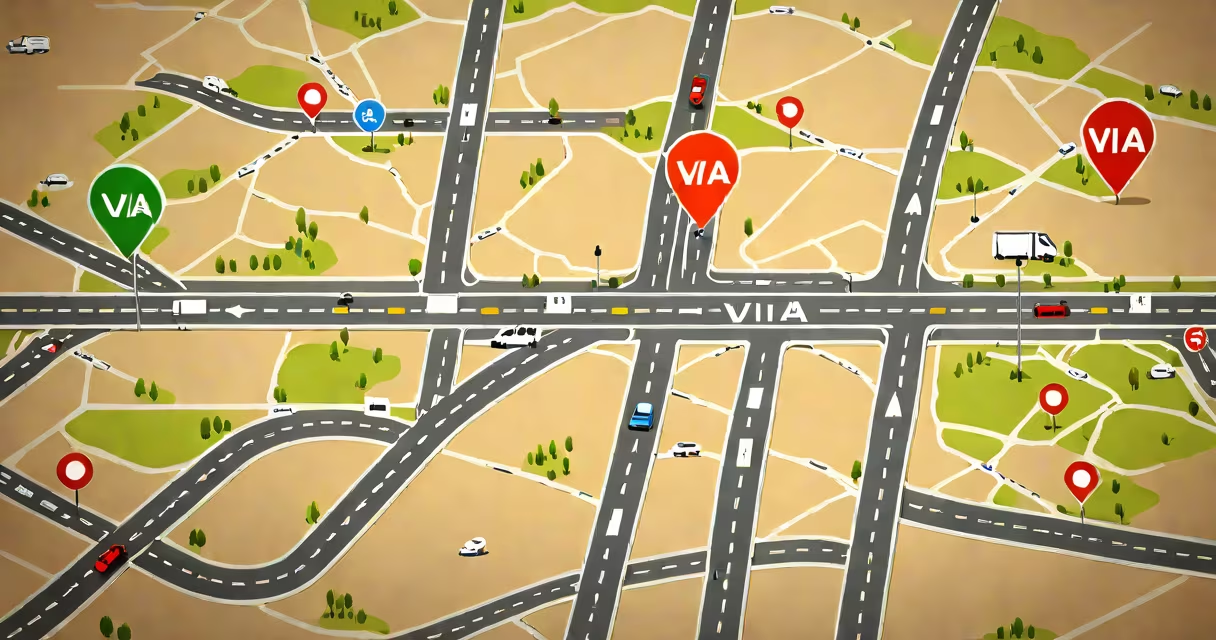
"Via" is a Latin preposition meaning "by way of" or "through." It indicates a route, method, or intermediary step between two points. In modern usage, it appears in addresses, directions, citations, and technical systems.
The word originates from Latin *via*, meaning "road" or "way." It entered English through legal and scholarly Latin, where it denoted a path or medium of transmission. Today, "via" functions as a concise way to express indirect connection or access.
For example, "Flight 452 arrives via Chicago" means the flight stops in Chicago before reaching its destination. Similarly, "The data was obtained via a survey" shows the method of acquisition. The term avoids redundancy while adding precision.
In navigation, "via" signals intermediate stops. GPS systems use it to show alternate routes. A route from New York to Miami might display "via Atlanta" to indicate the plane changes location in Atlanta. This reduces ambiguity compared to saying "through" or "after stopping in."
In academic writing, "via" introduces sources. Instead of saying "I learned this from Smith's 2020 paper," you write "This concept is derived via Smith (2020)." It clarifies the chain of influence without cluttering the sentence.
Technical documentation uses "via" to describe interfaces. For instance, "The signal travels via the HDMI port" specifies the physical channel. This avoids confusion with alternatives like "through" or "using."
While "via" itself doesn't have distinct types, its function varies by context. Below are common applications:
| Context | Usage Example | Purpose |
|---|---|---|
| Transportation | Train 204 goes via Boston | Indicates stop locations |
| Citations | Information sourced via CDC report (2023) | Shows origin of data |
| Technology | Connect via USB-C port | Specifies interface |
| Business | Request approved via email | Documents communication method |
Each use maintains the core idea: a path or channel between two states. The word remains consistent across domains because it describes process flow, not content.
People often mistake "via" for "via" in digital formats. In emails, "via" is sometimes replaced with "through" or "using," but those are less precise. "Through" implies passage, but not necessarily a designated route. "Using" suggests tool selection, not direction.
A key distinction: "via" denotes a route or method, not a cause. Saying "The error occurred via poor wiring" misuses the term. Correct phrasing: "The error resulted from poor wiring." "Via" describes access, not causation.
Another error is capitalizing "Via" in lowercase contexts. In formal writing, "via" is always lowercase unless beginning a sentence. Capitalization implies proper noun status, which it lacks.
Consider a research paper citing a study on climate models. The author writes: "The model output was validated via satellite data collected between 2015 and 2020." Here, "via" identifies the data source and method of verification.
Compare this to: "The model was validated using satellite data." The second version is vaguer. "Using" doesn't specify whether the data was accessed directly or processed through another system. "Via" clarifies the mechanism.
Similarly, in a travel itinerary: "Departure from London via Amsterdam, arriving in Oslo at 10:30 PM." This tells travelers the flight stops in Amsterdam. Without "via," the route would be ambiguous.
I once reviewed a network configuration manual where engineers used "via" to describe packet routing. One entry read: "Traffic flows via the primary gateway." When I asked why not "through," the lead engineer replied, "Because 'via' implies a chosen path, not just movement." That distinction mattered in fault tracing.
Another time, a colleague wrote "sent via email" in a project log. I corrected it to "sent via secure email server" to clarify security level. The original lacked specificity. "Via" allows such precision without adding length.
Some confuse "via" with "vía," the Spanish word for "way." While both derive from Latin, "vía" is not interchangeable in English. "Vía" appears in place names like "Avenida Vía," but not in standard English usage.
Also, "via" is not synonymous with "via" in internet slang. Some online forums use "via" to credit sources, but this is informal. In formal writing, "via" must be used correctly, not as a casual attribution marker.
One non-obvious fact: "via" is used in mathematical notation to denote transformation paths. In category theory, a morphism via C means composition through an intermediate object. This advanced use underscores the word's role in structured logic.
The meaning of via is rooted in Latin, where it meant "road" or "path." Today, it serves as a precise connector in language, indicating a route, method, or intermediary. Whether in travel plans, research papers, or device manuals, "via" adds clarity by naming the channel of access.
Understanding "via" enhances reading accuracy and writing precision. It is not a synonym for "through" or "using"-it defines a specific kind of connection. Mastering its use improves communication across disciplines.