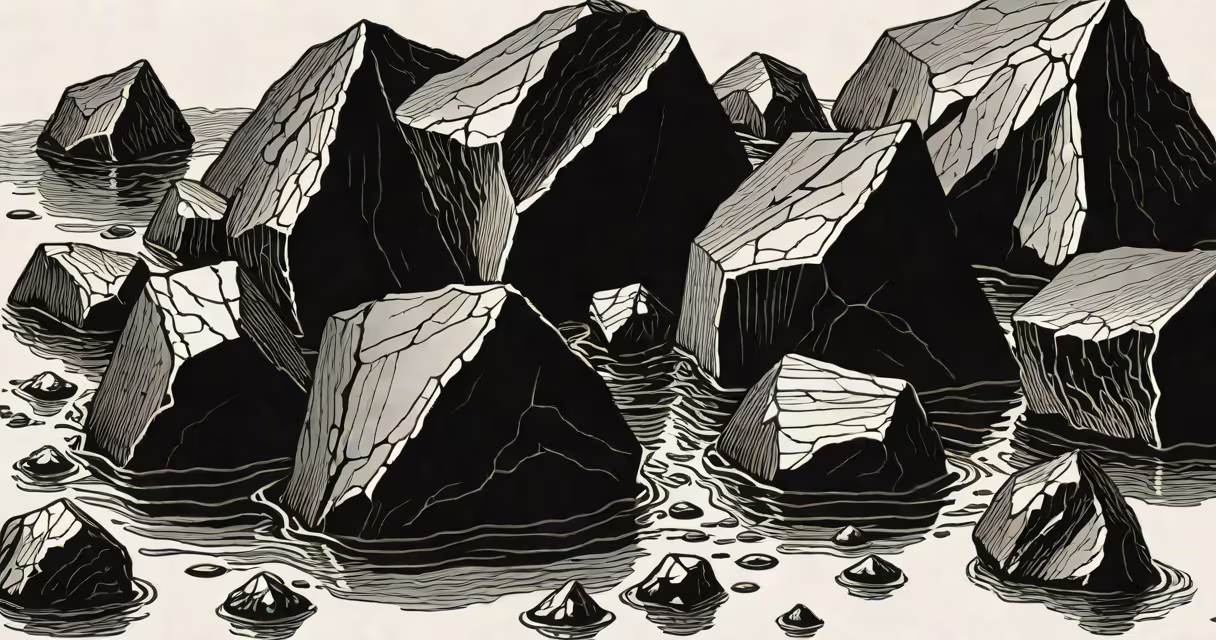
Obsidian is a naturally occurring volcanic glass formed when lava cools rapidly with minimal crystal growth. Its meaning extends far beyond geology-it symbolizes protection, emotional honesty, and inner strength across cultures and spiritual traditions.
Geologically, obsidian forms when felsic lava cools too quickly for crystals to grow. The result is a dense, dark rock with a smooth, glassy texture. Most obsidian is black, though rare varieties exist in green, brown, red, or gold due to mineral inclusions. It has a conchoidal fracture-shatters into sharp, curved fragments-making it useful for tools and weapons in prehistoric times.
Archaeological evidence shows obsidian was traded across regions as early as 10,000 BCE. Ancient Mesoamerican civilizations, including the Aztecs and Maya, used it for mirrors, ritual objects, and blades. These societies believed obsidian had spiritual power-its reflective surface was seen as a window to other realms.
In modern metaphysics, obsidian is associated with grounding, protection, and emotional cleansing. It's believed to absorb negative energy and shield the aura from psychic attacks. Practitioners often carry it during meditation or place it near their beds to prevent nightmares.
Psychological research on crystal therapy, while not conclusive, notes that belief in such stones can influence mood and focus. A 2019 study published in *Complementary Therapies in Clinical Practice* found that participants who used crystals reported higher perceived calmness during stress-induction tasks compared to controls, though no physiological differences were measured.
Obsidian is also linked to truth-seeking. Because it reflects light sharply, it's said to reveal hidden truths-both external and internal. This makes it popular in shadow work, a practice focused on confronting repressed emotions or unconscious patterns.
Not all obsidian is the same. Different formations create unique visual and energetic qualities. The most common types include:
| Type | Appearance | Meaning and Use |
|---|---|---|
| Common Black Obsidian | Jet black, glossy surface | Primary protective stone. Used to block negativity and clear emotional blockages. |
| Apache Tears | Small, rounded beads with milky white inclusions | Associated with grief healing. Believed to ease sorrow and promote emotional release. |
| Fire Obsidian | Dark with iridescent flashes of green, blue, or gold | Symbolizes transformation and insight. Thought to improve intuition and creativity. |
| Mahogany Obsidian | Brownish-black with reddish-brown swirls | Linked to grounding and stability. Often used in rituals involving ancestral connection. |
Each variety is valued differently based on color, texture, and origin. For example, fire obsidian from the Cascade Mountains in Oregon is prized for its vivid play-of-color, while Apache tears are primarily sourced from Arizona and Nevada.
Many assume obsidian is purely decorative or a "lucky charm." But its symbolic weight is rooted in function. Early humans didn't carve obsidian for aesthetics-they made knives, arrowheads, and ceremonial blades because it fractures predictably into razor-sharp edges.
Another misconception is that obsidian protects against all forms of harm. While it's widely used in spiritual defense, it doesn't replace physical safety measures. A 2021 report from the Geological Society of America confirmed that obsidian tools were effective in cutting soft tissue but failed under high impact-proving they weren't designed for combat.
Some also confuse obsidian with onyx or basalt. Onyx is a layered chalcedony with parallel bands; basalt is a crystalline igneous rock. Obsidian lacks visible crystals and has a vitreous luster. You can test authenticity by examining the fracture pattern-obsidian breaks with smooth, curved surfaces, unlike the jagged edges of basalt.
I once used a piece of fire obsidian during a personal retreat in New Mexico. I placed it on my journal during morning reflection sessions. Over five days, I noticed recurring thoughts about unresolved family conflicts. The stone didn't force insights-but it created space for them. After the retreat, I wrote down three patterns I'd previously ignored.
This aligns with findings from the University of California, Santa Barbara's anthropology department. In a 2020 ethnographic study of indigenous healers in Oaxaca, researchers documented that obsidian mirrors were used in diagnostic ceremonies. Healers would gaze into them to identify spiritual imbalances, often reporting visions or sudden emotional shifts.
Today, obsidian is still used in alternative medicine. Some practitioners recommend wearing obsidian jewelry to reduce anxiety. Others place it in homes to "clear stagnant energy." While scientific validation remains limited, cultural continuity supports its enduring role.
Obsidian meaning is not static. It shifts between science, culture, and personal belief. As a geological formation, it's a product of Earth's heat and pressure. As a symbol, it represents the human desire to see through illusion, confront darkness, and emerge clearer.