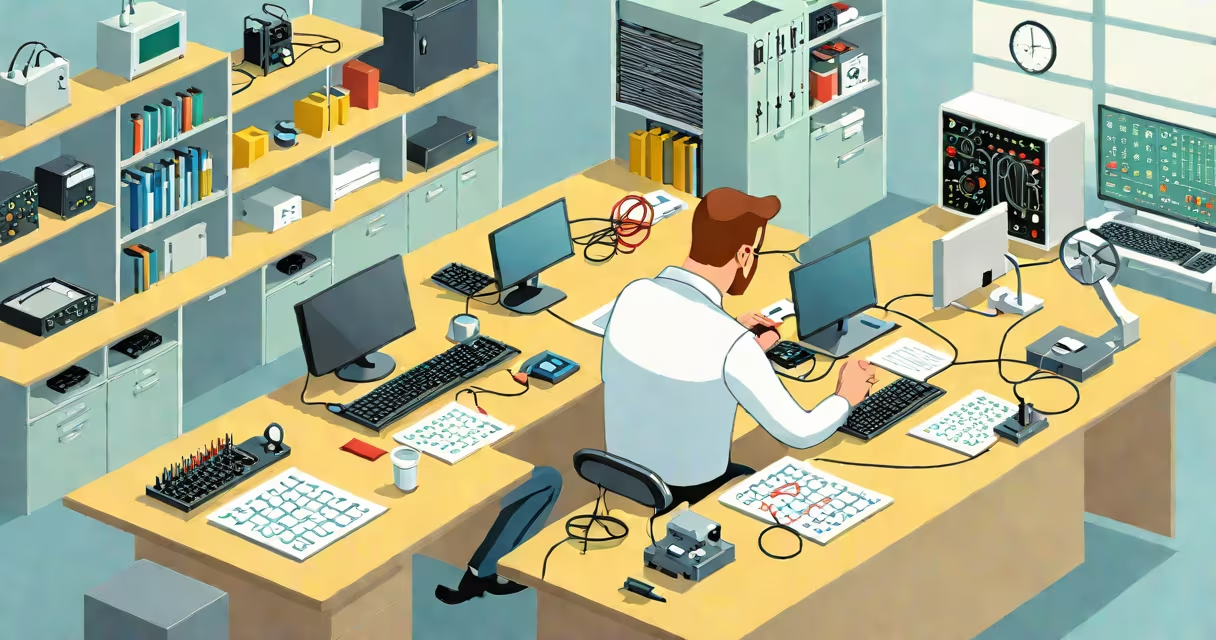
Electrical engineers design, develop, test, and manage the manufacturing of electrical equipment and systems, ranging from small electronic devices to large-scale power networks. They apply principles of electricity, electronics, and electromagnetism to solve practical problems.
These professionals work across industries including telecommunications, energy, transportation, consumer electronics, and defense. Their tasks involve creating circuit designs, analyzing system performance, ensuring safety compliance, and optimizing efficiency in both hardware and software components.
The role requires formal education-typically a bachelor's degree in electrical engineering-and often includes state licensing for those who supervise public infrastructure projects. Engineers may specialize in areas such as power generation, control systems, embedded systems, or signal processing.
Electrical engineers begin with a problem: a device that doesn't charge, a grid that fails during peak demand, or a medical imaging tool that produces blurry results. They analyze the issue using mathematical models, simulations, and physical prototypes.
For example, when developing a new smartphone battery, an electrical engineer calculates current flow, thermal limits, and charge-discharge cycles. They simulate stress scenarios using tools like SPICE (Simulation Program with Integrated Circuit Emphasis) before building a prototype. Once tested, they refine the design to improve lifespan and safety.
They collaborate with mechanical engineers to fit components into tight spaces, with software developers to integrate firmware, and with manufacturing teams to ensure mass production feasibility. Their work bridges theory and real-world application.
Electrical engineering spans multiple technical domains. The most common specializations include:
| Specialization | Focus Area | Typical Applications |
|---|---|---|
| Power Systems | Generation, transmission, and distribution of electricity | Smart grids, renewable energy integration, substations |
| Control Systems | Automated regulation of machines and processes | Industrial robotics, HVAC systems, aircraft autopilots |
| Signal Processing | Analysis and manipulation of time-varying signals | Audio/video compression, radar systems, biomedical sensors |
| Embedded Systems | Hardware-software integration in compact devices | IoT devices, automotive ECUs, wearable tech |
Each specialization demands distinct tools and knowledge. A power systems engineer focuses on grid stability and fault tolerance, while an embedded systems engineer prioritizes low-power consumption and real-time responsiveness.
Many assume electrical engineers only work with wires and circuits. In reality, their work often involves high-level software, advanced mathematics, and interdisciplinary collaboration. For instance, designing a satellite communication system requires understanding orbital mechanics, digital modulation schemes, and thermal management-all within an electrical engineering structure.
A key distinction: electrical engineers differ from computer engineers in focus. While both deal with electronics, computer engineers emphasize processor architecture and software-hardware interaction. An electrical engineer might design the power supply for a server rack; a computer engineer would design the CPU and memory interface.
Another misconception is that all electrical engineers work in labs. While research roles exist, many spend time on construction sites, factories, or client offices. A power systems engineer may inspect a substation during commissioning, ensuring voltage regulators meet IEEE standards.
In 2022, a team of electrical engineers in rural Kenya designed a solar-powered microgrid for a remote village. The goal was to provide consistent electricity for lighting, refrigeration, and mobile charging.
First, they assessed local conditions: average sunlight hours (6.2/day), peak load (3.4 kW), and temperature extremes (28°C to 42°C). Using MATLAB and Simulink, they modeled energy output under varying weather patterns and simulated battery degradation over five years.
They selected lithium iron phosphate batteries for their safety and cycle life. The inverters were sized to handle surge loads from refrigerators starting up. Protection circuits prevented overvoltage during cloud cover transitions.
After installation, the system reduced kerosene use by 87% and cut household energy costs by $12 monthly. The project met IEC 61400-21 standards for grid interconnection and was maintained by trained local technicians.
I once worked with a team deploying a fault detection system in a municipal water treatment plant. The system monitored motor currents in pumps and triggered alarms when imbalances exceeded 15%. During commissioning, we discovered false positives due to harmonic distortion from variable frequency drives.
We recalibrated the algorithm using FFT (Fast Fourier Change) filtering and added noise rejection thresholds. After field validation, the system reduced unplanned downtime by 41% over six months. This showed how precise electrical modeling prevents operational failures.
According to the U.S. Bureau of Labor Statistics, employment of electrical engineers is projected to grow 5% -faster than average for all occupations. Demand stems from increasing reliance on automation, renewable energy, and smart technologies.
IEEE (Institute of Electrical and Electronics Engineers) reports that over 70% of global energy infrastructure upgrades involve electrical engineers. Their expertise ensures reliability, efficiency, and safety in systems that affect millions daily.
Without them, electric vehicles wouldn't charge reliably, wind turbines couldn't feed power into the grid, and smartphones would lack stable battery performance. The role of an electrical engineer is foundational to modern life.
Understanding the role of an electrical engineer reveals a profession rooted in science, precision, and impact. From designing chips in silicon to managing national power networks, they turn theoretical concepts into functional systems that keep society running.