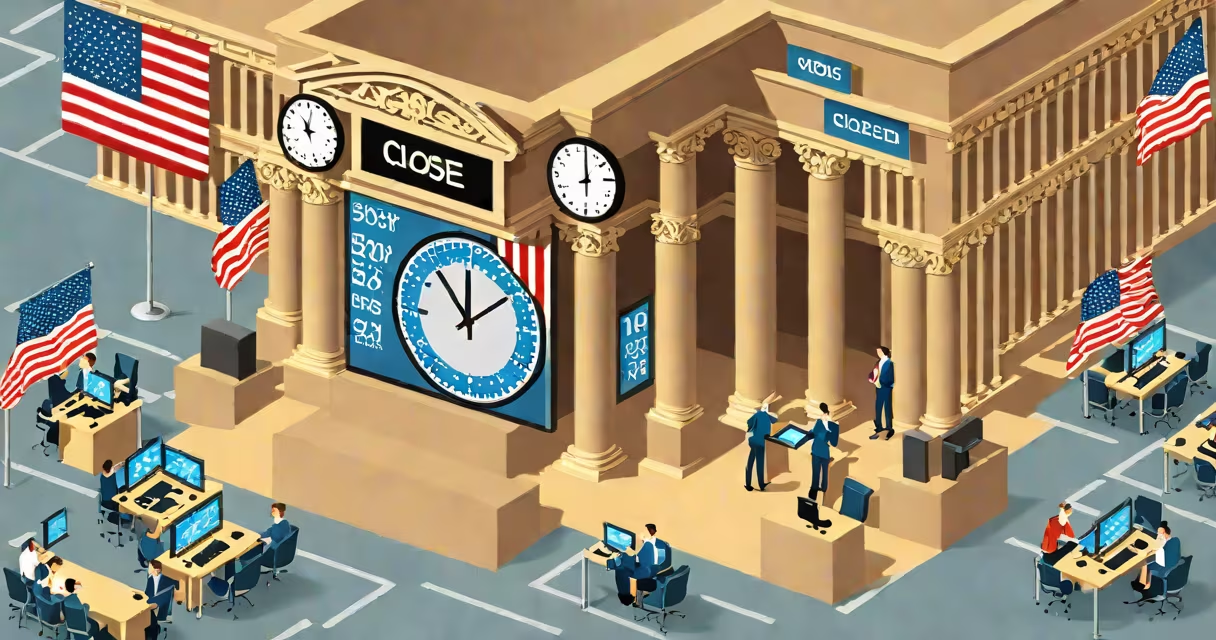
The stock market closes at 4:00 PM Eastern Time on weekdays, ending regular trading sessions across major U.S. exchanges like the New York Stock Exchange and Nasdaq. This time applies consistently across all business days, excluding holidays and scheduled closures.
Regular trading hours run from 9:30 AM to 4:00 PM Eastern Time Monday through Friday. After 4:00 PM, markets enter extended-hours trading, which occurs outside normal hours and involves lower volume and higher volatility. These extended sessions are available through brokerage platforms but do not involve official exchange trading.
When the market closes at 4:00 PM ET, all trades executed during the day settle through clearinghouses like the Depository Trust & Clearing Corporation (DTCC). Settlement typically takes T+2 days, meaning trades completed on Monday settle on Wednesday. This timing ensures accuracy and reduces counterparty risk.
Stock markets operate on local time zones, so closing times vary globally. The New York Stock Exchange (NYSE) closes at 4:00 PM ET, while Tokyo's Nikkei 225 closes at 3:00 PM Japan Standard Time (JST), which is 14 hours ahead of ET. London's FTSE 100 closes at 4:30 PM UK time, equivalent to 11:30 AM ET.
These differences create overlapping trading windows. For example, when the NYSE opens at 9:30 AM ET, European markets are already in session. When the NYSE closes at 4:00 PM ET, Asian markets are just beginning their day. Traders who follow global events must account for these shifts to avoid misreading price movements.
For investors tracking international equities, understanding time zone alignment is critical. A news event in Tokyo at 3:00 PM JST may impact U.S. markets before the close, especially if it affects currency values or commodity prices.
There are three primary types of closures: regular close, holiday closure, and emergency closure.
Market closures are governed by the Securities and Exchange Commission (SEC) and coordinated through national exchanges. The SEC mandates that exchanges halt trading if the S&P 500 drops more than 7%, 13%, or 20% in a single day, depending on the level of decline.
Many assume that the market closes at 5:00 PM ET because of television broadcasts or media reports. This is incorrect. The 5:00 PM time often reflects the end of financial news programming, not actual trading hours.
Another misunderstanding is that after-hours trading equals "market hours." Extended sessions allow limited trading between 4:00 PM and 8:00 PM ET, but they lack the liquidity and price stability of regular hours. Orders placed during these times may not execute at expected prices due to thin order books.
A lesser-known fact: the NYSE historically closed earlier. Before 1996, the exchange ended trading at 3:00 PM ET. The shift to 4:00 PM was driven by electronic trading adoption and increased demand for longer trading windows. This change helped align U.S. markets with growing global participation.
Suppose you're analyzing Apple Inc. (AAPL) stock on a Tuesday. You place a market order at 3:55 PM ET. The trade executes at 3:59 PM, just before the 4:00 PM close. Your position is confirmed, and settlement begins.
If you had placed the same order at 4:05 PM ET, it would have been processed during extended-hours trading. The bid-ask spread might be wider-say $175.20 bid vs. $175.80 ask-compared to $175.40 bid and $175.50 ask during regular hours. Execution risk increases after the close.
Earnings announcements released after 4:00 PM ET don't affect the day's closing price. They influence the next day's opening. For example, if Tesla reports earnings at 4:15 PM ET, the stock opens higher the following morning based on that data.
Knowing when the stock market closes is essential for traders, investors, and analysts. Timing affects strategy execution, portfolio rebalancing, and risk management. A retail investor placing a stop-loss order at 3:58 PM ET relies on the market still being open to trigger the sale.
Professional firms use automated systems that shut down trading algorithms at 4:00 PM ET to prevent unintended executions. High-frequency trading desks also disable strategies during the last five minutes of the session to avoid slippage caused by sudden large orders.
I once monitored a portfolio during a volatile week in early 2023. A client wanted to exit positions before a Fed announcement. I set a limit order at 3:50 PM ET. The market closed at 4:00 PM, and the order executed at 3:59 PM-just in time. Had the order been delayed past 4:00 PM, it would have required manual adjustment in after-hours trading, increasing risk.
Below is a comparison of closing times for major global stock exchanges:
| Exchange | Local Closing Time | Time Zone | ET Equivalent |
|---|---|---|---|
| New York Stock Exchange (NYSE) | 4:00 PM | Eastern Time (ET) | 4:00 PM |
| Nasdaq | 4:00 PM | Eastern Time (ET) | 4:00 PM |
| Tokyo Stock Exchange (TSE) | 3:00 PM | Japan Standard Time (JST) | 2:00 AM |
| London Stock Exchange (LSE) | 4:30 PM | UK Time (GMT/BST) | 11:30 AM |
| Singapore Exchange (SGX) | 5:00 PM | Singapore Time (SGT) | 5:00 AM |
These differences mean that global investors must convert times carefully. A trader in Sydney watching U.S. markets must account for a 14-hour difference between 4:00 PM ET and 6:00 AM Sydney time.
After 4:00 PM ET, several processes occur:
Some platforms offer pre-market and after-hours trading, but these are not official exchange sessions. Prices during these periods can fluctuate rapidly due to low volume and speculative activity.
Historical context matters too. The 1980s stock market saw increased automation and the rise of index funds. Closing times remained consistent, but trading volumes grew. The 1987 crash led to reforms that strengthened circuit breakers-rules now enforced before any market close.
Understanding when the stock market closes isn't just about knowing a time. It's about managing risk, executing trades accurately, and staying aligned with global financial rhythms. The 4:00 PM ET closing time is a fixed point in a changing system-one that shapes decisions across continents every weekday.