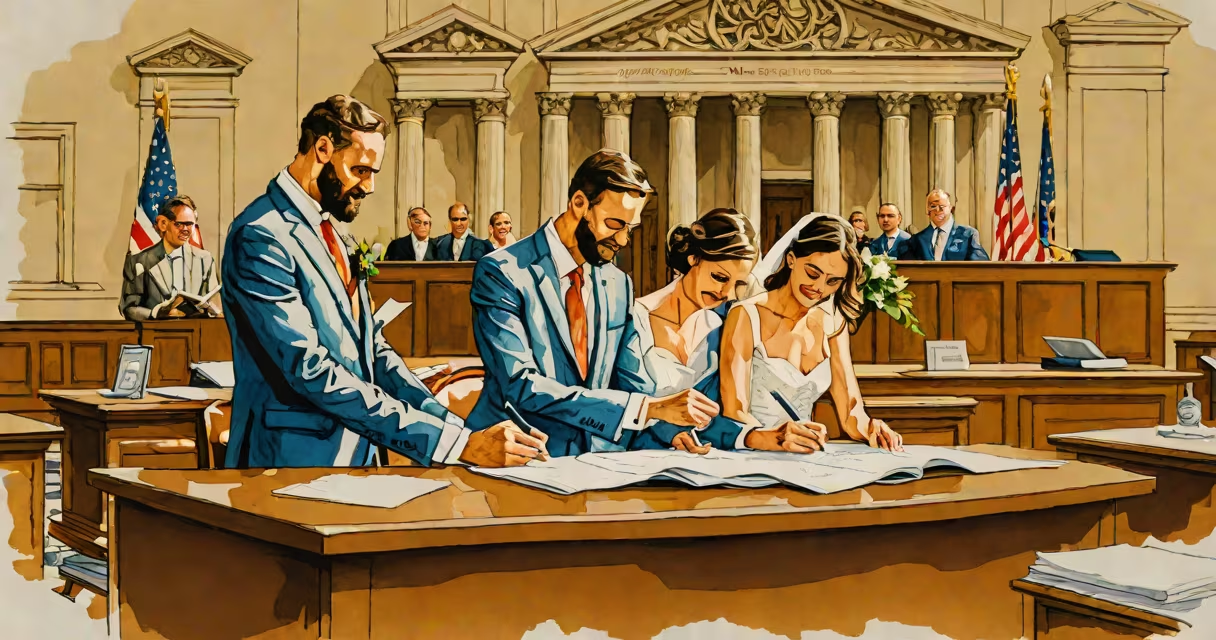
The steps to getting married begin with choosing a date and location, obtaining a marriage license, arranging a ceremony, and completing legal documentation. This process ensures both personal commitment and legal validity under state law.
Marriage in the United States requires a civil license issued by a county clerk's office. The license is valid for 60 days and must be signed by both parties and an authorized officiant. Without this document, a ceremony cannot be legally binding.
After the ceremony, the couple receives a certified copy of the marriage certificate. This document serves as official proof of marital status and is required for name changes, tax filings, and spousal benefits.
Each state sets its own rules for marriage. Most require both parties to appear in person at a county clerk's office to apply for a license. Some states allow online applications, but in-person verification remains standard.
During the application, couples provide government-issued photo IDs, proof of age (typically 18 or older), and sometimes a blood test or affidavit of marital status. Minors may marry with parental consent and court approval, but requirements vary widely.
Once approved, the license is issued. The couple must have the ceremony performed within the 60-day window. Afterward, the officiant signs the license and returns it to the issuing authority. The county then files the record and issues a certified copy.
There are two primary paths to marriage: civil and religious. Civil marriages are conducted by a judge, justice of the peace, or other authorized official. Religious ceremonies follow faith-specific rites but still require a valid license to be legal.
Couples may choose a formal wedding, elopement, or vow renewal. Formal weddings often involve planners, venues, and guest lists. Elopements are typically low-budget and private. Vow renewals are not legally binding unless a new license is obtained.
| Type | Legal Validity | Typical Setting | Time Required |
|---|---|---|---|
| Civil Ceremony | Yes - state-recognized | Courthouse, city hall, park | 15-30 minutes |
| Religious Ceremony | Yes - if license is obtained | Church, temple, mosque, synagogue | 30-60 minutes |
| Destination Wedding | Yes - if license is valid in host state | Beach, mountain, foreign country | Varies |
Some couples opt for a symbolic ceremony without a license. These are not legally recognized and do not confer rights such as inheritance or healthcare decision-making.
The steps to getting married are used nationwide to formalize relationships under U.S. law. They ensure that both parties meet minimum age, identity, and consent standards. The process prevents bigamy and verifies that neither party is currently married.
States enforce these rules through local registries. For example, California requires a 3-day waiting period after applying for a license. New York allows same-day issuance. Texas mandates a 72-hour waiting period.
Understanding these differences is critical. A couple who applies in one state and marries in another may face invalidation if the second state doesn't recognize the license. The Uniform Marriage Act provides model guidelines, but enforcement remains state-level.
Many assume that a religious ceremony alone makes a marriage legal. This is false. A Catholic mass or Jewish chuppah ceremony is meaningful but not legally binding without a valid marriage license.
Another myth is that a common-law marriage exists in all states. Only nine states and the District of Columbia recognize common-law marriage. These states require cohabitation, mutual acknowledgment as spouses, and intent to be married. Most states do not recognize this form of union.
A lesser-known fact: some states allow marriage by proxy. In Idaho and Utah, a person can be married via a representative if they are physically unable to attend. The proxy must be sworn in and submit a notarized statement.
Consider a couple in Denver, Colorado. They start by checking the county clerk's website. They find that applicants must appear in person, bring a driver's license or passport, and pay a $30 fee. There is no waiting period.
They schedule an appointment for Friday morning. Both arrive with ID and pay the fee. The clerk issues the license. The couple selects a Saturday wedding at a garden venue. The officiant, a licensed minister, performs the ceremony and signs the license.
On Monday, the couple requests a certified copy from the county. They receive it by mail within five business days. This document is used to update their Social Security card and apply for joint health insurance.
I've personally helped plan a wedding in Oregon. The couple applied online, but still had to visit the county office to verify IDs. The entire process took less than two hours. The key insight: even with online tools, in-person verification is unavoidable.
Marriage differs from domestic partnership, civil union, and cohabitation. Domestic partnerships offer limited legal rights and are not recognized federally. Civil unions were abolished in most states after the 2015 Obergefell v. Hodges ruling.
Co-habitation without a license grants no legal standing. A couple living together for years cannot claim spousal benefits unless formally married.
For comparison, the steps to getting married resemble the phases of software development life cycle (SDLC). Just as SDLC includes planning, design, implementation, testing, and deployment, marriage involves intent, preparation, ceremony, and registration. However, while SDLC is iterative and technical, marriage is a one-time, emotionally driven event with legal consequences.
Understanding the steps to getting married ensures clarity, legality, and emotional readiness. Whether planned over months or decided in a weekend, the process must follow state law to be valid.