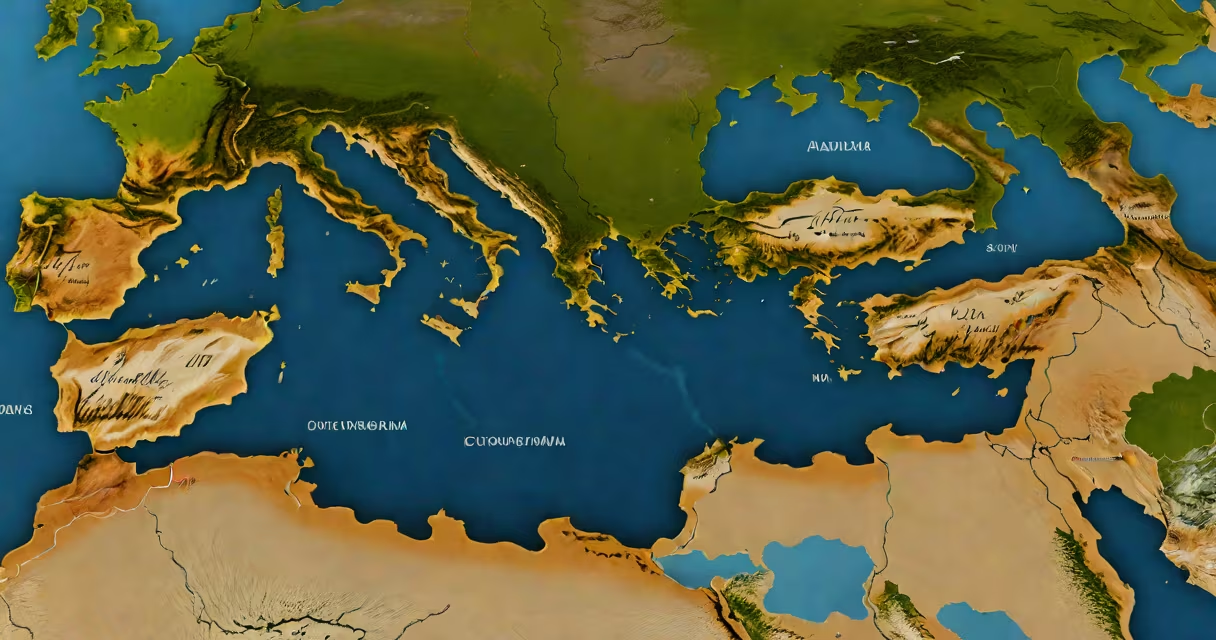
The Mediterranean Sea is a large inland sea bordered by Europe to the north, Africa to the south, and Asia to the east. It stretches approximately 2,500 miles from the Strait of Gibraltar in the west to the eastern coast of Turkey and Syria in the east.
It connects to the Atlantic Ocean through the Strait of Gibraltar, a narrow passage about 14 kilometers wide between Spain and Morocco. From there, it extends eastward, splitting into two main basins: the western basin, centered near the Balearic Islands and the coasts of Spain and Italy, and the eastern basin, which includes the Aegean Sea, the Levantine Sea, and the waters around Egypt and Israel.
Geographically, the Mediterranean is enclosed by three continents. Its northern rim runs along the Iberian Peninsula, southern France, Italy, the Balkans, Greece, Turkey, and the Black Sea via the Bosporus. The southern edge follows the coasts of North Africa-Morocco, Algeria, Tunisia, Libya, and Egypt. The eastern shore includes Lebanon, Syria, Israel, Palestine, and parts of Turkey's southern coast.
The Mediterranean is defined by tectonic activity. It sits within a complex zone where the African Plate is slowly moving northward and colliding with the Eurasian Plate. This collision created mountain ranges such as the Alps, the Apennines, and the Atlas Mountains, and continues to shape the region's geology. Subduction zones beneath the sea floor contribute to frequent seismic events, including earthquakes and occasional tsunamis.
Coastal features reinforce the sea's natural boundaries. The Strait of Gibraltar, for example, is only 280 meters deep at its narrowest point, limiting water exchange with the Atlantic. The Dardanelles and Bosporus straits regulate flow between the Mediterranean and the Black Sea. These passages are critical for maritime traffic and regional security.
Marine currents follow a clockwise gyre driven by wind patterns and Earth's rotation. Surface waters move from the western basin toward the eastern basin, then return along the northern coast of Africa. This circulation influences climate, marine life distribution, and historical navigation routes.
The Mediterranean can be divided into distinct subregions based on geography, climate, and human use. These areas differ in temperature, salinity, and ecological characteristics.
| Subregion | Location | Key Features |
|---|---|---|
| Western Basin | Between Spain and Tunisia | Lower salinity due to freshwater input from rivers like the Rhône; major shipping lanes; high biodiversity |
| Aegean Sea | Between Greece and Turkey | High seismic activity; historically significant for ancient civilizations; home to over 1,400 islands |
| Levantine Basin | East of Cyprus and south of Turkey | Warmer temperatures; higher salinity; key route for oil and gas transport |
| Adriatic Sea | Between Italy and the Balkans | Deep, narrow basin; strong seasonal currents; rich in fish stocks |
Each subregion supports different ecosystems. The western basin hosts seagrass meadows like Posidonia oceanica, which stabilize sediments and absorb carbon dioxide. The Levantine Sea has experienced rising temperatures linked to climate change, affecting coral health and fish migration patterns.
Many assume the Mediterranean Sea is part of the Atlantic Ocean. It is not. While connected via the Strait of Gibraltar, it is a separate body of water with distinct physical properties. The Atlantic is deeper and colder, while the Mediterranean is shallower and warmer, especially in summer months.
Another misconception is that the sea is entirely surrounded by Europe. In reality, North Africa controls nearly half of the coastline. Countries like Egypt, Libya, Tunisia, Algeria, and Morocco have extensive Mediterranean shores. This shared geography shapes migration patterns, fishing rights, and international agreements.
Some confuse the Mediterranean with the Red Sea or the Black Sea. The Red Sea lies between Africa and Arabia, separated by the Sinai Peninsula. The Black Sea is bounded by Eastern Europe and Western Asia, connected to the Mediterranean via the Bosporus. These are distinct seas with different origins and hydrology.
In 2023, the Suez Canal closure caused a rerouting of over 1,200 vessels. Many ships bound for Northern Europe had to sail around Africa, increasing travel time by 14 days. However, those using the Mediterranean still benefited from shorter distances compared to transatlantic routes.
Consider a cargo ship departing from Málaga, Spain, traveling to Alexandria, Egypt. The route crosses the western Mediterranean, passes through the Strait of Gibraltar, enters the eastern basin, and proceeds along the North African coast. The process covers about 1,600 nautical miles and takes five to seven days depending on weather and speed.
This path avoids the longer detour around the Cape of Good Hope. The Mediterranean remains a important corridor for goods, energy, and people. Over 100 million tons of freight pass through its ports annually, according to the European Commission's 2022 maritime report.
I once sailed a small dinghy from the Greek island of Mykonos to Crete during late September. The sea was calm, with visibility exceeding 100 meters. Wind speeds averaged 12 knots from the northwest. I noted that the water color shifted from deep blue near the coast to turquoise in open waters-consistent with high clarity and low nutrient levels.
At sunset, I observed the sun setting behind the Libyan coast, visible despite being over 200 kilometers away. That moment underscored how vast the sea appears from within. The horizon stretched unbroken, reinforcing the idea that the Mediterranean is not just a body of water-it's a cultural and environmental bridge.
The Mediterranean Sea is central to modern geopolitics. It serves as a frontline for refugee crossings from North Africa to Southern Europe. In 2022, over 17,000 migrants arrived in Italy and Greece via Mediterranean routes, according to UNHCR data. Border enforcement, search-and-rescue operations, and humanitarian aid depend heavily on accurate geographic knowledge.
Climate change is altering the sea's thermal structure. A 2021 study published in Nature Climate Change found that surface temperatures in the eastern Mediterranean rose by 1.5°C between 1982 and 2019. This warming contributes to more frequent marine heatwaves, which damage coral reefs and disrupt fisheries.
For historians and archaeologists, the location of the Mediterranean Sea explains why civilizations like the Phoenicians, Greeks, Romans, and Ottomans flourished along its coasts. Trade, conquest, and cultural exchange were possible because of consistent maritime access across regions.
Understanding where the Mediterranean Sea is located isn't just academic. It affects migration policy, environmental conservation, military strategy, and global supply chains. Knowing its exact position and boundaries enables better planning, research, and response to crises.