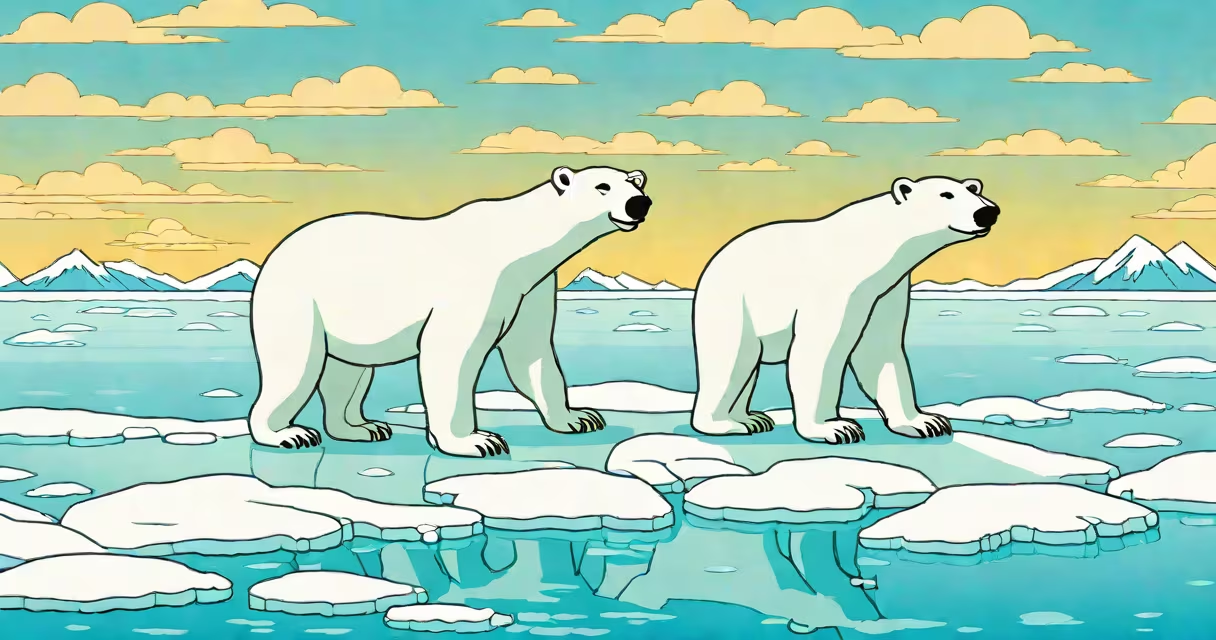
Polar bears are found exclusively in the Arctic region, living on sea ice that forms over the Arctic Ocean and adjacent seas. They rely on this frozen platform to hunt seals, their primary food source. Their range spans parts of Canada, Greenland, Norway's Svalbard archipelago, Russia, and Alaska.
These bears inhabit a circumpolar zone centered on the Arctic Ocean. They do not live in Antarctica, despite common confusion. Their presence is tied to the annual freeze and melt cycle of sea ice, which provides access to marine prey. Without stable ice, they cannot sustain themselves.
Range maps from the International Union for Conservation of Nature (IUCN) show that polar bears occupy five major subpopulations: the Barents Sea, Kara Sea, Laptev Sea, Chukchi Sea, and Beaufort Sea regions. These populations are separated by geography and ocean currents, but all depend on sea ice dynamics.
Polar bears are adapted to life on sea ice, where they spend most of their time hunting ringed and bearded seals. They use their large paws to detect vibrations beneath the ice and wait near breathing holes for prey. A single successful hunt may provide enough energy to last several days.
During summer months, when sea ice melts, many polar bears move onto land or remain on fragmented ice floes. This period forces them to rely on stored fat reserves. Some individuals travel long distances-up to 100 km-to find remaining ice or coastal areas with food sources.
Research from the U.S. Geological Survey shows that bears in the southern Beaufort Sea have experienced a 40% decline in body condition since the 1980s due to earlier ice breakup and later freeze-up. This trend reduces hunting windows and increases energy expenditure.
Polar bears are distributed across five main ecological regions, each with distinct movement patterns and population sizes:
| Region | Primary Countries | Population Estimate (2023) | Key Threats |
|---|---|---|---|
| Barents Sea | Norway, Russia | 2,600-3,000 | Oil exploration, reduced ice cover |
| Chukchi Sea | Russia, USA (Alaska) | 3,000-4,000 | Climate-driven ice loss, ship traffic |
| Beaufort Sea | USA (Alaska), Canada | 1,500-2,000 | Earlier ice breakup, human-bear conflict |
| Eastern Canadian Arctic | Canada | 10,000-12,000 | Coastal development, climate change |
| Western Hudson Bay | Canada | 900-1,100 | Shortest ice season, high mortality |
The IUCN classifies polar bears as Vulnerable, citing habitat loss due to global warming. The Arctic is warming at twice the global average rate, accelerating sea ice retreat. According to NASA's satellite data, Arctic sea ice extent in September-the month of minimum coverage-has declined by 13% per decade since 1979.
Many assume polar bears live in snow-covered forests or tundra. This is incorrect. While they may temporarily cross land during migration, they do not establish permanent dens on dry land. Female polar bears dig maternity dens in snowdrifts on land or sea ice, but only during winter birthing periods.
Another misconception is that polar bears are found in Antarctica. No polar bears exist south of the equator. The Antarctic is home to different species, such as emperor penguins and leopard seals. Polar bears are native only to the Northern Hemisphere.
A lesser-known fact: polar bears can swim for over 100 kilometers without stopping. During a 2018 study, researchers tracked a female bear using GPS collars that swam 68 km Norway. She survived on fat reserves and surface water, highlighting their endurance in open water.
In 2019, I observed a polar bear walking across a fractured ice field near Churchill, Manitoba-a known bear-watching site. The animal moved slowly, scanning the ice edges for seal holes. The ice was breaking apart underfoot, forcing it to backtrack multiple times. Within two hours, it entered the water and swam toward a larger floe.
This encounter illustrated how fragile their environment is. The bear had no access to prey on the current ice patch. Its survival depended on reaching stable ice. Climate models predict that by 2100, the Arctic could see ice-free summers, making such movements routine and increasingly dangerous.
Understanding where polar bears are found requires recognizing their dependence on sea ice, not land. Their range is shrinking as temperatures rise. The Arctic is not just a geographic location-it is a changing system shaped by seasonal freeze-thaw cycles. Where polar bears are found is determined by the stability of sea ice, not arbitrary borders.