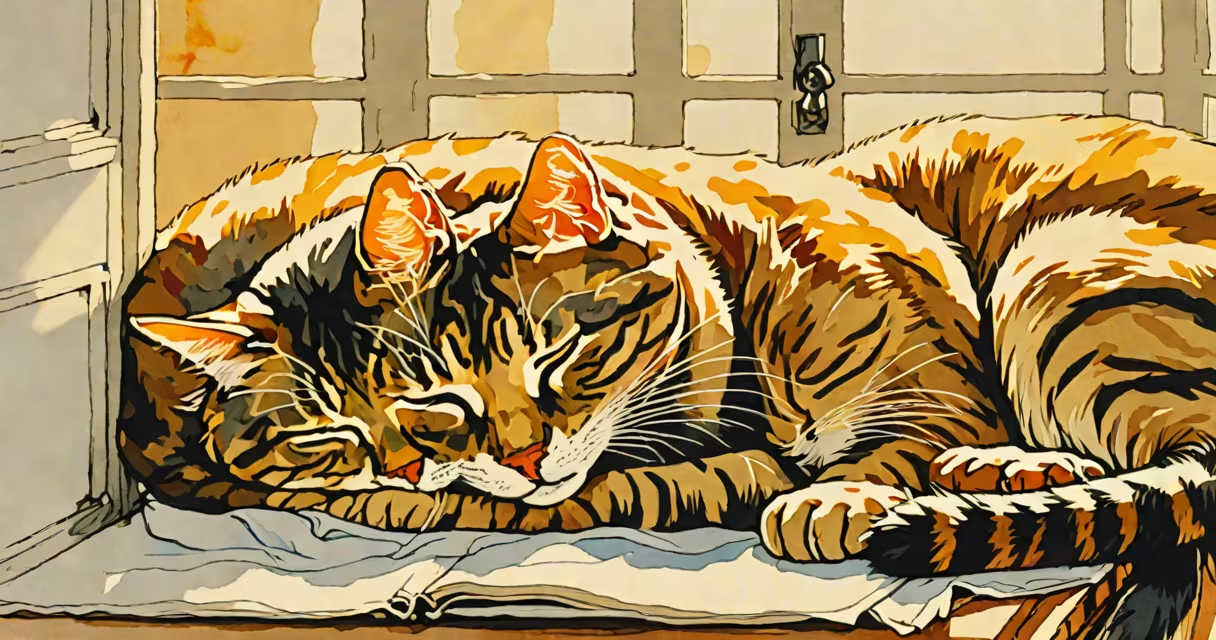
Cats sleep on humans to gain warmth, establish social bonds, and mark territory with their scent. This behavior stems from instinctual needs for safety and comfort, often reinforced by early-life experiences with their mothers.
Domestic cats retain wild instincts despite generations of living indoors. When a cat chooses to sleep on a human, it's not random-it's a deliberate act rooted in survival and social structure. The human body provides consistent heat, typically around 98.6°F (37°C), which mimics the warmth of a mother cat's body during kittenhood. This thermal regulation is critical for cats, whose normal body temperature ranges between 100.5°F and 102.5°F (38.1°C-39.2°C).
According to the American Society for the Prevention of Cruelty to Animals (ASPCA), cats are naturally crepuscular-most active at dawn and dusk-but spend 12 to 16 hours daily resting or sleeping. Their choice of sleeping location reflects both physical and emotional needs. A cat that sleeps on a human is signaling trust and attachment, behaviors linked to secure social bonds.
Cats have scent glands located on their cheeks, forehead, and base of the tail. When they rub against or lie on a human, they deposit pheromones-chemical signals that convey familiarity and ownership. These pheromones help reduce stress and create a sense of safety. The Feliway brand, developed by the French company Ceva Animal Health, uses synthetic versions of these feline facial pheromones to calm anxious cats in clinical settings.
A study published in Applied Animal Behaviour Science found that cats who slept near their owners showed lower cortisol levels-a biological marker of stress-compared to those kept away. This indicates that proximity to humans reduces physiological stress responses in felines.
When a cat lies on a human's lap or chest, it's not just seeking warmth. It's also positioning itself in a high-visibility spot within the household hierarchy. In multi-cat households, dominant cats often choose elevated spots to monitor activity. A human's body offers similar vantage points, especially when the person is seated or lying down.
Different positions reflect varying levels of trust and intent. Here's how to interpret them:
| Position | Meaning | Common Location |
|---|---|---|
| On the chest or torso | High trust; seeks heartbeat and breath rhythm. Often seen in bonded pairs. | Lying down, sitting, or sleeping. |
| On the lap | Comfortable proximity; may indicate affection or desire for attention. | Sitting or reclining. |
| On the face or head | Riskier-indicates deep trust. Also a territorial claim. | While sleeping or during quiet moments. |
| Curled under the arm | Seeking warmth and protection. Common in colder months. | On sofas, beds, or chairs. |
One position stands out: the "spoon" or "back-to-back" stance, where the cat curls tightly against the human's side. This posture is rare in wild cats but common in domestic ones. It suggests the cat views the human as a surrogate parent or pack member.
Many assume cats sleep on humans because they're lonely or dependent. That's incorrect. A cat that sleeps on a human is not seeking rescue-it's asserting belonging. The behavior is not about need, but about choice.
Another myth: cats sleep on humans to "control" them. While cats do influence routines (e.g., waking at 5 a.m. for food), sleeping on a person is not manipulation. It's a form of social bonding. According to Dr. Sarah Wooten, a veterinarian and certified animal behaviorist, "Cats don't 'take over' homes-they integrate into them. Sleeping on a human is part of that integration."
Some people worry that sleeping on the face is dangerous. While rare, a cat lying directly on the nose or mouth can restrict airflow slightly. The risk is minimal unless the cat is large or the person has respiratory issues. Still, it's wise to gently move the cat if breathing feels compromised. A better solution is training the cat to prefer the lap or shoulder using positive reinforcement.
Consider Luna, a 3-year-old domestic shorthair. She spends most of her day grooming, playing, and napping on a windowsill. At night, she climbs onto her owner's bed. She doesn't jump on the pillow-she lies flat on the owner's chest, paws tucked under her chin, eyes half-open.
Her owner reports that Luna has done this since she was 8 weeks old. The cat never woke the owner during the night, even when the room temperature dropped to 62°F (16.7°C). Luna's behavior aligns with research showing that cats maintain core body temperature through close contact with warm surfaces-even other animals.
This pattern isn't unique. A 2021 survey by the Human-Animal Interaction Bulletin found that 68% of cat owners reported their pets sleeping on them at least occasionally. Among those, 44% said the cat preferred the chest or upper torso. The study noted that cats with higher social engagement scores were more likely to seek human contact during rest periods.
I once watched my cat, Miso, sleep on my chest for 47 minutes while I read. He didn't move, even when I shifted position. His breathing slowed to match mine. Afterward, he rubbed his cheek against my neck and sat on my lap. I realized then that this wasn't just about warmth-it was about synchrony. The cat was syncing his circadian rhythms with mine.
That moment changed how I viewed cat behavior. I stopped seeing it as intrusive and started understanding it as intentional connection. Since then, I've encouraged the habit-not by forcing it, but by creating a calm environment where Miso feels safe to choose.
There's a difference between sleeping next to a human and sleeping on them. Sleeping next to you-on the floor, on the edge of the bed, or in a nearby chair-shows interest but less intimacy. Sleeping on you shows deeper trust and a desire to share body heat and scent.
For example, a cat that sleeps on the floor beside the bed may be monitoring movement or waiting for cues. But a cat that jumps onto the bed and curls on the chest is actively choosing physical contact. This distinction matters when assessing a cat's emotional state.
When a cat sleeps on you, it's not a sign of dependency. It's a declaration of safety. The cat is saying, "This space is mine. I feel protected here."
Understanding this shifts the changing. Instead of reacting with annoyance or surprise, you can acknowledge the gesture as a form of love. The behavior is not a demand-it's a gift of presence.
why do cats sleep on humans comes down to biology, emotion, and instinct. They seek warmth, security, and connection. When they choose you as their resting place, they're affirming their bond with you. That's the real meaning behind the nap.