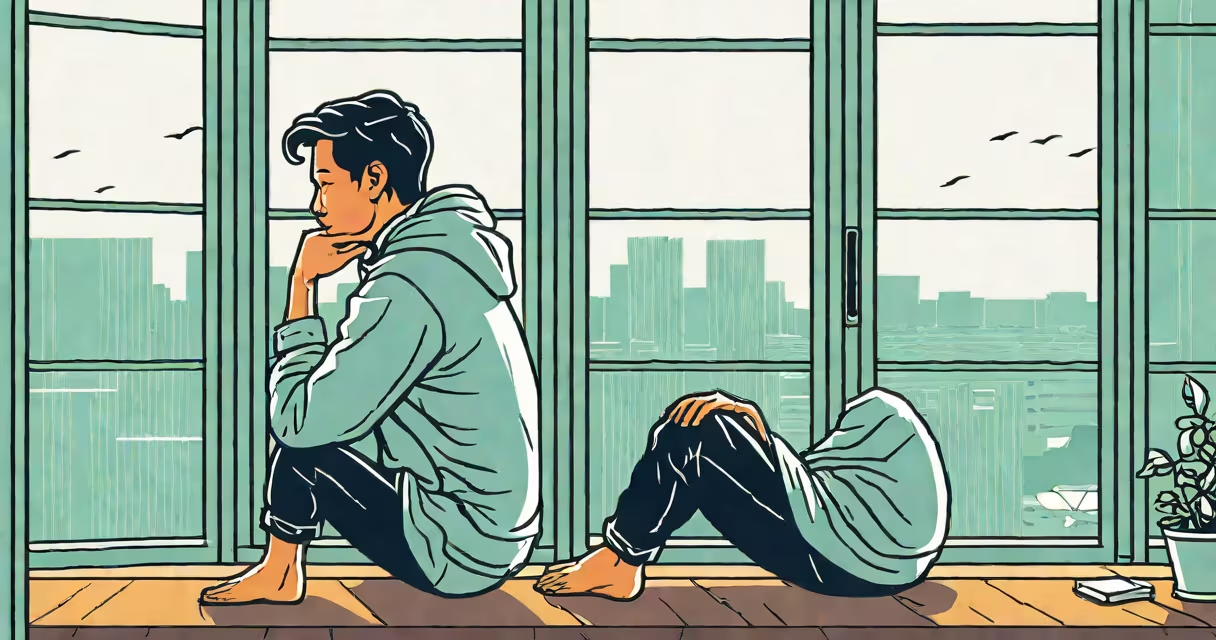
Some people experience a sense of peace, clarity, or even warmth when feeling sad-this isn't a contradiction, but a known psychological phenomenon where melancholy provides emotional stability, reflection, and connection to deeper experiences.
Comfort in sadness arises when negative emotions serve a functional role. Rather than being purely distressing, sadness can act as a signal to pause, reflect, and process internal states. This function is rooted in human evolution: the ability to slow down during loss or transition helped early humans conserve energy, reassess relationships, and prepare for recovery.
Neuroscience confirms that sadness activates brain regions linked to introspection and empathy, such as the medial prefrontal cortex and anterior cingulate cortex. These areas regulate emotion, evaluate personal significance, and support social bonding-all while reducing activity in the reward centers associated with pleasure-seeking. The result is not despair, but stillness.
When sadness is not overwhelming, it can trigger a state of cognitive slowing. This allows the mind to focus inward, assess past events, and identify patterns in behavior or relationships. People who report comfort in sadness often describe it as "clearing the mental clutter."
A 2021 study published in *Emotion* found that individuals who engaged in reflective rumination-revisiting emotional memories with curiosity rather than judgment-reported higher levels of emotional insight and lower anxiety over time. This wasn't about dwelling, but about integrating difficult experiences into a coherent life narrative.
For example, someone listening to a song that reminds them of a lost relationship may feel tears come-not out of pain, but because the music triggers a sense of completion. The emotion is processed, validated, and released. This is not avoidance-it's integration.
Sadness isn't uniform. Different forms carry different psychological functions. The most comforting types are:
| Type | Trigger | Function | Example |
|---|---|---|---|
| Reflective sadness | Memory recall, art, music | Introspection, identity consolidation | Feeling moved by a film scene about loss |
| Transitional sadness | Endings, changes, milestones | Closure, emotional release | Feeling calm after a breakup, despite grief |
| Empathetic sadness | Witnessing others' suffering | Connection, moral alignment | Being touched by a story of resilience |
Reflective sadness-often sparked by music, literature, or visual art-is the most common source of comfort. A 2019 study in *Psychological Science* showed that participants who listened to sad music reported increased feelings of awe, connectedness, and emotional clarity compared to those who heard neutral or happy music.
This comfort doesn't require the sadness to be resolved. The emotional safety comes from knowing the feeling is valid, contained, and temporary. It's not about fixing the past-it's about allowing space for it.
Many assume that finding comfort in sadness indicates depression or emotional dysfunction. This is incorrect. Clinical depression involves persistent low mood, anhedonia (inability to feel pleasure), and impaired functioning. Comfort in sadness occurs within normal emotional range and often enhances well-being.
Another misconception is that sad people are weak or overly sensitive. Research from the University of North Carolina shows that individuals who experience and process sadness effectively demonstrate higher emotional intelligence and better long-term coping strategies. They're not avoiding pain-they're engaging with it.
A key distinction: comfort in sadness is not the same as seeking sadness. One can enjoy the depth of feeling without craving it. The difference lies in agency-the person chooses to sit with the emotion, not flee from it.
I once sat with a friend who played a song by Bon Iver-"Holocene"-after a long day. He didn't speak for ten minutes afterward. When he did, he said, "I don't know why, but I feel lighter."
The song features layered vocals, sparse instrumentation, and lyrics about smallness in vast landscapes. It evokes loneliness, but also beauty. He later told me he'd been struggling with uncertainty about his career path. The music didn't solve anything-but it gave him permission to feel the weight without trying to fix it.
This mirrors findings from the *Journal of Positive Psychology*: people who listen to sad music during stressful periods report greater emotional regulation and reduced cortisol levels. The act of listening becomes a ritual of containment, not escape.
Not all sadness leads to comfort. When sadness becomes persistent, intrusive, or disconnected from context, it may indicate underlying issues. Signs include:
If sadness consistently interferes with daily functioning, professional support is advised. The American Psychological Association notes that prolonged sadness unlinked to meaningful events may signal depression or trauma-related conditions.
But when sadness is brief, intentional, and accompanied by insight, it's not a flaw-it's a feature of emotional intelligence.
Understanding why you find comfort in sadness isn't about diagnosing yourself. It's about recognizing that your emotional responses aren't random-they're signals. The brain uses sadness not to punish, but to recalibrate.
When you feel drawn to a quiet moment, a familiar song, or a memory that brings tears, you're not broken. You're processing. You're connecting. You're human.