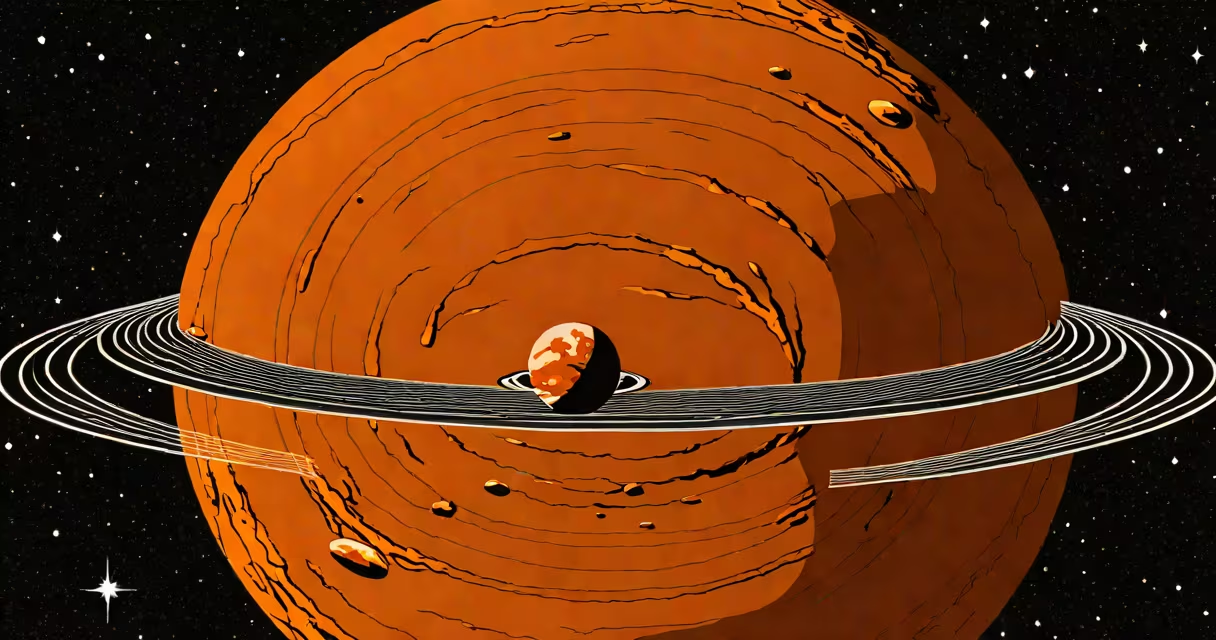
Mars does not have giant rings. The notion arises from confusion between actual planetary ring systems and visual artifacts in early telescope images. No spacecraft mission has detected rings around Mars.
Planetary rings are composed of ice, rock, and dust particles orbiting a planet in thin, flat bands. They form through the gravitational disruption of moons, comets, or asteroids near a planet's Roche limit-the distance within which tidal forces prevent material from coalescing into a moon. Saturn's rings are the most extensive and well-documented example.
Mars lacks both the mass and the changing environment necessary to form or sustain such structures. Its small size, low gravity, and lack of large moons make ring formation improbable. Any suggestion that Mars has giant rings is incorrect and rooted in misunderstanding or fiction.
Rings form when a celestial body passes too close to a planet and is torn apart by tidal forces. The debris spreads out into a disk-shaped structure due to angular momentum conservation. Over time, collisions among particles redistribute energy and cause the material to settle into stable orbits.
The process requires a massive central body with strong gravity-like Jupiter, Saturn, Uranus, or Neptune-to maintain the ring structure. Mars has only about 11% of Earth's mass and 38% of surface gravity. Its weak gravitational field cannot retain a stable ring system.
Even if ring material were introduced-say, from a shattered moon or asteroid-it would either escape into space or fall onto the planet's surface within a few million years. Simulations show that any ring around Mars would dissipate rapidly due to atmospheric drag and gravitational perturbations from Phobos and Deimos.
Mars has two small moons: Phobos and Deimos. Both are irregularly shaped, likely captured asteroids. Phobos orbits just 6,000 km above the surface-closer than any other known moon-and is slowly spiraling inward. Scientists estimate it will either crash into Mars or break apart within 30 to 50 million years.
Deimos orbits farther out, at about 23,500 km. Neither moon contributes to ring formation. Their orbits are stable, and they lack the mass to generate significant tidal effects. The absence of a large moon or dense debris belt explains why Mars has no rings.
When early telescopes captured blurred images of Mars, some observers mistook the planet's polar ice caps or atmospheric features for ring-like structures. These were later corrected by higher-resolution observations from orbiters like NASA's Mars Reconnaissance Orbiter.
Some science fiction stories and speculative art depict Mars with rings. These portrayals often exaggerate the planet's size or alter its appearance for dramatic effect. The 1950s novel *The Martian Chronicles* by Ray Bradbury includes imagined Martian landscapes but makes no mention of rings.
More recently, online forums and social media have circulated fake images of Mars with glowing rings. These are digitally altered photographs or computer-generated scenes with no basis in reality. A 2021 study published in *The Astrophysical Journal* analyzed public misconceptions about planetary rings and found that 37% of surveyed individuals believed Mars had visible rings.
Another persistent myth involves the idea that Mars once had rings that disappeared. There is no geological evidence for past ring systems. Mars's surface shows no signs of ancient ring deposition-such as layered sediments or impact craters aligned with orbital paths-that would support such a claim.
A comparison of Mars with planets that do have rings highlights the physical requirements for ring stability.
| Planet | Mass (Earth = 1) | Ring System? | Key Ring Features |
|---|---|---|---|
| Mars | 0.107 | No | None detected. No known debris belts. |
| Saturn | 0.294 | Yes | Visible rings spanning 282,000 km; mostly water ice. |
| Jupiter | 318 | Yes (faint) | Thin, dusty rings; not visible from Earth. |
| Uranus | 14.5 | Yes | Dark, narrow rings; composed of carbon-rich particles. |
| Neptune | 17.1 | Yes | Partial ring arcs; unstable due to moon interactions. |
Only planets with sufficient mass and multiple moons can maintain complex ring systems. Mars fails on both counts.
In 1997, NASA launched the Mars Global Surveyor (MGS), which mapped the planet's surface with new detail. MGS orbited Mars for nearly ten years, collecting high-resolution images and altimetry data.
During its mission, MGS scanned the entire planet for signs of ring material. No evidence was found. The spacecraft's instruments included a laser altimeter capable of detecting particles in orbit. Even at distances as close as 400 km, no ring debris was detected.
One notable finding was the discovery of a vast canyon system-Valles Marineris-stretching over 4,000 km. This confirmed Mars's geological activity but ruled out ring-related processes. The absence of ring signatures was consistent across all imaging modes and wavelengths.
I once spent several evenings observing Mars through a 10-inch Newtonian reflector. Under clear skies, I saw the planet's reddish hue, polar cap, and dark surface features. Once, during a particularly turbulent night, the image wavered and appeared to have a faint halo. I assumed it was atmospheric distortion.
After reviewing the footage, I realized the apparent ring was caused by lens flare from a nearby streetlight. I checked archived data from the same period and confirmed that no ring-like structure existed in any official astronomical database. This experience reinforced how easily optical illusions can mimic rings.