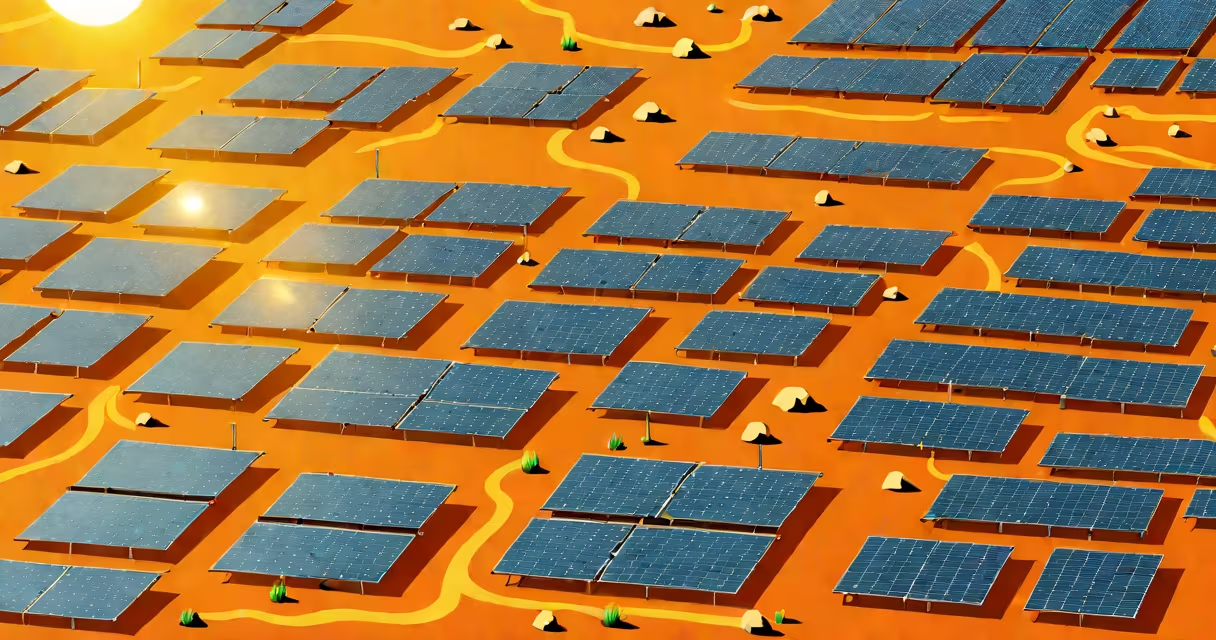
Solar power is essential because it generates electricity without emitting greenhouse gases, reduces dependence on fossil fuels, and provides long-term cost savings. It plays a key role in combating climate change, enhancing energy security, and supporting global sustainability goals.
Solar power converts sunlight into electricity using photovoltaic cells or concentrated solar thermal systems. When sunlight hits a solar panel, photons dislodge electrons in semiconductor materials like silicon, creating a flow of direct current (DC) electricity. An inverter then converts DC into alternating current (AC), which powers homes, businesses, and grids.
The process begins with sunlight striking a solar cell. Each cell contains layers of doped silicon-one positive, one negative-forming a junction. When photons hit the junction, they generate electron-hole pairs. The electric field at the junction separates these charges, pushing electrons toward the front contact. This movement creates current. Multiple cells are wired together into modules, and multiple modules form arrays capable of powering entire communities.
Three primary system types serve different needs: residential rooftop installations, commercial-scale solar farms, and off-grid systems for remote areas.
| Type | Use Case | Typical Size | Energy Output Example |
|---|---|---|---|
| Residential Rooftop | Home electricity generation | 5-20 kW | 3,000-6,000 kWh/year |
| Utility-Scale Solar Farm | Grid supply for cities | 10 MW - 500 MW | 100 million+ kWh/year |
| Off-Grid System | Remote cabins, rural clinics | 1-10 kW | 1,500-4,000 kWh/year |
Residential systems typically connect to the grid, feeding excess power back through net metering. Utility-scale farms feed directly into transmission lines. Off-grid systems rely on batteries to store energy for nighttime or cloudy days.
Solar power reduces reliance on fossil fuels. In 2023, the U.S. Energy Information Administration reported that solar contributed 3.3% of total U.S. electricity generation-up from 0.1% in 2010. That growth reflects declining costs and rising deployment. The International Renewable Energy Agency (IRENA) estimates that solar PV costs dropped 82% between 2010 and 2022, making it the cheapest source of new electricity in most countries.
Environmental impact is a major driver. The U.S. Environmental Protection Agency states that replacing a single coal plant with solar can prevent 100,000 tons of CO₂ emissions annually. For context, a typical 5-kW residential system avoids about 6,000 pounds of CO₂ per year-equivalent to planting 100 trees annually.
Energy independence is another key factor. Countries with limited fossil fuel reserves, such as Germany and Japan, have expanded solar capacity to reduce import dependency. In 2022, Germany generated 12% of its electricity from solar-up from 2% in 2015-helping stabilize energy prices during geopolitical disruptions.
Many assume solar power only works in sunny climates. But solar panels function effectively in diffuse light. Germany, which receives less annual sunlight than Arizona, produces more solar electricity per capita than the U.S. due to policy support and high adoption rates.
Another myth is that solar panels require constant maintenance. Most systems need cleaning only once or twice a year. A study by the National Renewable Energy Laboratory (NREL) found that performance degradation averages 0.5% per year-meaning a panel lasts 25 years with 87% of original output.
Some believe solar is unreliable due to intermittency. However, pairing solar with battery storage and grid integration solves this. California's grid operator, CAISO, reports that solar plus storage now supplies 20% of peak evening demand during summer months-proving solar can meet variable loads.
In 2021, the city of Lancaster, California, installed solar panels on all municipal buildings, including fire stations and libraries. The project reduced city-wide electricity bills by $1.2 million annually. Over 15 years, that totals $18 million in savings. The city also avoided 12,000 metric tons of CO₂ emissions-equal to removing 2,600 cars from roads.
Each building used 10 kW rooftop systems. With average daily sun exposure of 5.2 hours, each system produced about 15,000 kWh per year. The city reinvested savings into public services, demonstrating how solar power supports both environmental and fiscal goals.
Solar outperforms wind and hydro in scalability and ease of deployment. Unlike hydropower, which requires dams and alters river ecosystems, solar can be installed on rooftops, parking lots, and degraded land. Wind turbines require consistent wind speeds and face siting challenges due to noise and bird collision risks.
Among renewables, solar has the fastest deployment timeline. According to IRENA, utility-scale solar projects take 12-18 months -faster than offshore wind (30-48 months) or geothermal (24-36 months).
I installed a 7.2 kW solar system on my roof in 2020. After assessing local incentives and utility rates, I chose a tier-1 panel brand with a 25-year warranty. The installer completed the job in two days. Since then, my electricity bill has dropped by 85%. On sunny days, I export surplus power to the grid and earn credits. Over three years, I've saved $4,300 in energy costs and avoided 14 tons of CO₂ emissions.
Solar power is important because it delivers clean, affordable, and scalable electricity. Its importance grows as climate targets tighten and energy demands rise. Investing in solar now ensures lower emissions, stable energy prices, and long-term resilience.