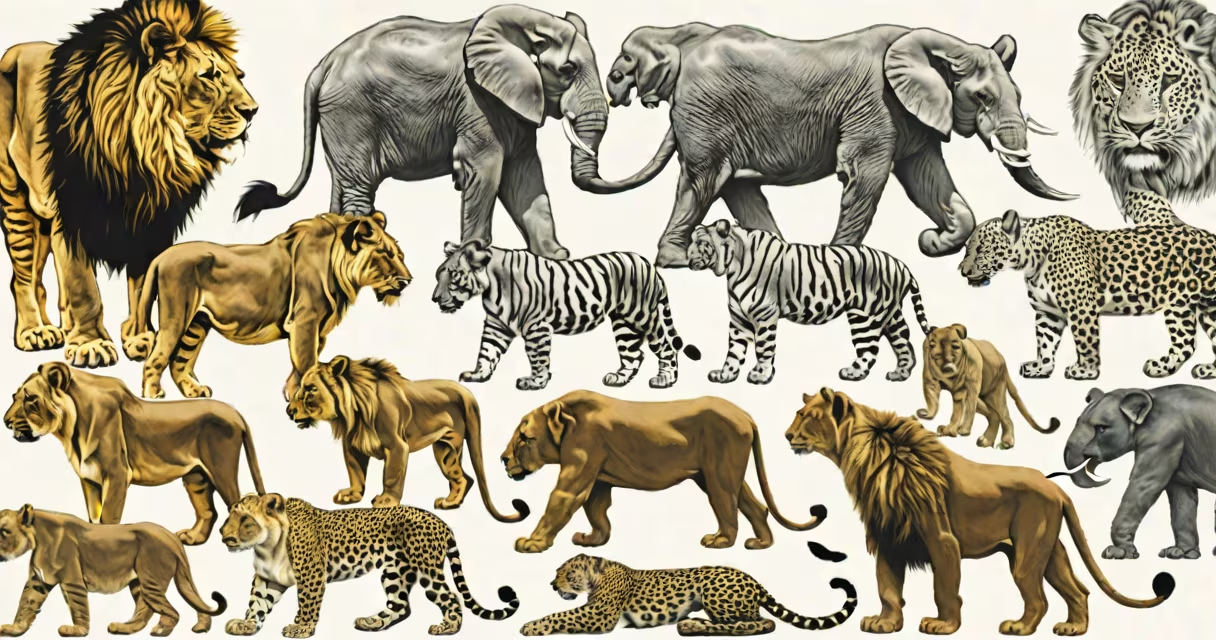
wild animals names refer to the official scientific and common designations for non-domesticated vertebrates living freely in natural ecosystems. These names identify species based on taxonomy, geography, and ecological role, such as African lion (Panthera leo) or red fox (Vulpes vulpes).
Each wild animal name follows standardized nomenclature established by the International Code of Zoological Nomenclature (ICZN). The scientific name uses binomial format-genus and species-such as Ursus arctos for brown bear. Common names vary by region and language, leading to multiple local terms for the same species.
Wild animals names are essential for research, conservation, and education. Misidentifying a species can lead to incorrect management decisions. For example, mistaking a non-native feral cat for a native wildcat risks misallocating limited conservation resources.
Scientific names follow strict rules. The genus is capitalized and italicized, the species is lowercase and italicized. For example, Panthera tigris is the tiger. The name reflects evolutionary relationships. Species within the same genus share a recent common ancestor.
Common names often originate from local languages or descriptive traits. "Grizzly bear" describes the grayish fur, while "snow leopard" references its high-altitude habitat. Some names are misleading-"koala" is not a bear, despite the name.
Names can change as new genetic data emerges. The African cheetah was once classified as Acinonyx jubatus. Recent DNA analysis confirmed its placement in the genus Acinonyx, but the name remains unchanged due to taxonomic stability rules.
Wild animals names fall into three categories: scientific, common, and regional. Scientific names are globally consistent. Common names vary by country. Regional names reflect local ecology and culture.
| Category | Example | Use Case |
|---|---|---|
| Scientific | Panthera pardus | Research, legal documents, databases |
| Common | Leopard | Public communication, education |
| Regional | Black panther (melanistic form) | Local storytelling, folklore |
Some species have multiple common names. The American black bear is also called the cinnamomum bear or simply grizzly in parts of the West. This variation causes confusion in public records and media reporting.
When naming new species, scientists often honor individuals or locations. The recently described frog species Pristimantis yaku was named after the indigenous Yaku people of Ecuador. This practice strengthens cultural ties to biodiversity.
Wild animals names are critical in conservation. The IUCN Red List uses scientific names to track extinction risk. A species listed as Critically Endangered must be identified precisely to trigger protection measures.
For example, the Amur leopard (Panthera pardus orientalis) is distinct from other leopard subspecies. Its name specifies its geographic origin and genetic uniqueness. Conservation programs targeting this population rely on accurate naming to avoid mixing data with other leopards.
Wild animals names also influence policy. The U.S. Endangered Species Act requires listing by scientific name. Misnaming a species during federal review can delay protections. In 2016, a petition to list the Florida panther failed because the petitioners used the outdated name Felis concolor coryi instead of Puma concolor coryi.
Many assume that common names are universal. The term "lynx" applies to four species: Eurasian lynx (Lynx lynx), Canadian lynx (Lynx canadensis), Iberian lynx (Lynx pardinus), and bobcat (Lynx rufus). They differ in size, behavior, and habitat-but all share the name due to similar physical features.
Another myth is that all wild animals have unique names. In reality, many species are still unnamed. The World Register of Marine Species (WoRMS) lists over 250,000 marine species, but nearly 10% remain undescribed. Scientists discover new species daily-some only through genetic sequencing.
A lesser-known fact: some wild animals names are derived from myths. The okapi (Okapia johnstoni) was unknown to science until 1901. Its name honors Sir Harry Johnston, who led the expedition. The animal's striped legs inspired early European comparisons to a mythical creature, leading to the name's symbolic roots.
In 2022, a viral video showed a large cat in the Indian Himalayas. Viewers debated whether it was a snow leopard or a mountain lion. Experts analyzed the footage using key identifiers:
Using these traits, researchers concluded it was a snow leopard (Panthera uncia). The correct name enabled accurate reporting and helped track rare sightings in protected zones.
I once observed a red fox near a trail in northern Michigan. Its reddish coat and bushy tail matched the description of Vulpes vulpes. I verified the ID using field guides and online databases. The scientific name confirmed it was not a different fox species, such as the Arctic fox (Vulpes lagopus), which lives farther north.
Wild animals names differ from domestic animal names, pet names, and fictional creatures. Domestic dogs (Canis lupus familiaris) descend from wolves (Canis lupus), but their names reflect human selection. Wild animals names describe free-living populations.
Fictional animals like dragons or unicorns do not have valid scientific names. They are cultural constructs. Real animals must meet criteria for classification: observable traits, reproducible data, and peer-reviewed validation.
Some people confuse "wild animal" with "exotic pet." Exotic pets may be wild-caught but are not wild animals. A pet parrot from the Amazon is not a wild animal-it lives in captivity. Its name may be the same (e.g., Amazon parrot, Amazona aestiva), but its status differs.
Understanding wild animals names prevents ecological harm. Using the wrong name can result in illegal trade. The pangolin (Manis spp.) is poached for its scales. Mislabeling it as "scaly anteater" in markets delays enforcement.
Knowing wild animals names supports accurate science, responsible policy, and informed public engagement. Use both common and scientific names when researching or sharing information. Always verify against authoritative sources like the Integrated Taxonomic Information System (ITIS) or the IUCN Red List.