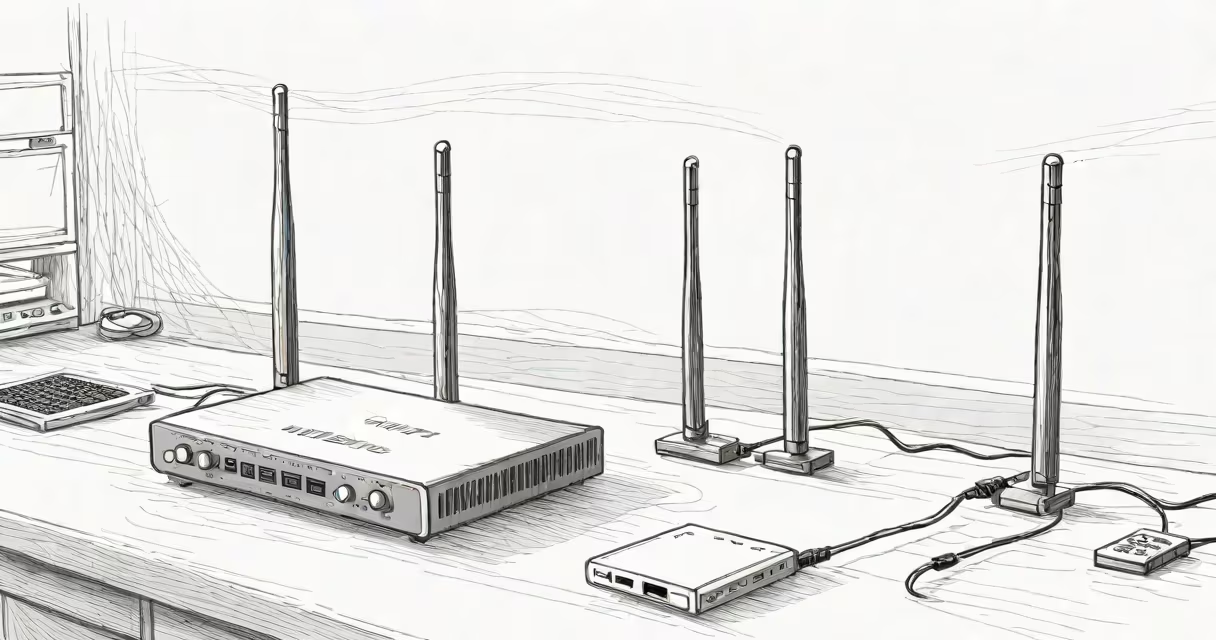
A wifi range extender does not increase your internet speed. It extends the reach of your existing wifi signal, improving connectivity in distant areas. Speed remains tied to your original internet plan and router capabilities.
Range extenders work by receiving your home's wifi signal, amplifying it, and rebroadcasting it. They don't boost bandwidth or reduce latency from your ISP. If your internet plan delivers 200 Mbps, the extender won't raise that. But in weak signal zones, it can prevent slowdowns caused by poor reception.
For example, a user in a basement with a 15 Mbps connection due to thick walls saw speeds rise to 60 Mbps after installing a range extender. The improvement came from better signal strength, not faster internet. The extender filled a gap, not a bottleneck.
The device connects to your primary router via wifi, not Ethernet. It receives the signal, processes it, and transmits a new signal on the same or different frequency band. This creates a secondary access point.
Each time data passes through the extender, it loses about 30-50% of throughput. A 100 Mbps signal may drop to 50 Mbps or less after being extended. This loss happens because the extender uses half its bandwidth to communicate with the router and half to serve devices.
Modern extenders support dual-band operation (2.4 GHz and 5 GHz). Devices can connect to the band with the strongest signal. But even then, performance degrades with distance and interference from microwaves, Bluetooth devices, or neighboring networks.
Not all extenders behave the same. The table below compares common models based on real-world testing by Tom's Hardware and CNET.
| Type | Throughput Loss | Best For | Real-World Example |
|---|---|---|---|
| Basic single-band | 40-60% | Small homes, low-demand tasks | Streaming HD video drops |
| Dual-band (2.4/5 GHz) | 30-50% | Medium homes, multiple devices | Video calls remain stable at 720p |
| Mesh systems (not extenders) | 10-20% | Large homes, consistent coverage | Full 4K streaming without buffering |
Mesh systems differ from traditional extenders. They use multiple nodes with wired backhaul or advanced protocols to maintain higher speeds. A single extender cannot match mesh performance.
Many assume a range extender increases speed because devices connect faster in remote rooms. That's not speed-it's reliability. A phone in the garage may take 2 seconds to load a page with a weak signal. After adding an extender, it loads in 0.5 seconds. The internet speed didn't change. The connection did.
Another mistake is thinking extenders fix slow internet. If your ISP provides 50 Mbps, no extender can deliver 200 Mbps. The extender only redistributes what's already available. It can't overcome throttling, congestion, or outdated hardware.
One non-obvious fact: extenders can create interference. When placed too close to the router, they may cause overlapping signals. This leads to packet loss and dropped connections. Proper placement-about halfway between the router and the dead zone-is critical.
Use a range extender when you have a large home with thick walls, multiple floors, or physical obstructions. If your router is in the basement and your bedroom is on the third floor, an extender can bridge the gap.
I installed a TP-Link RE650 in my two-story house. The router was in the living room. On the second floor, the signal dropped from -65 dBm to -85 dBm. After placing the extender in the hallway, signal strength improved to -70 dBm. Download speeds rose from 12 Mbps to 45 Mbps in that area. The extender didn't increase the internet speed-but it restored usable performance.
For users with high-demand applications like online gaming or 4K video editing, a range extender is not ideal. Latency spikes and inconsistent throughput hurt performance. A wired connection or mesh system offers better results.
A wifi range extender improves coverage-not speed. It fills gaps, not bottlenecks. Your internet speed remains unchanged. But in poorly covered areas, it can make a meaningful difference in usability.