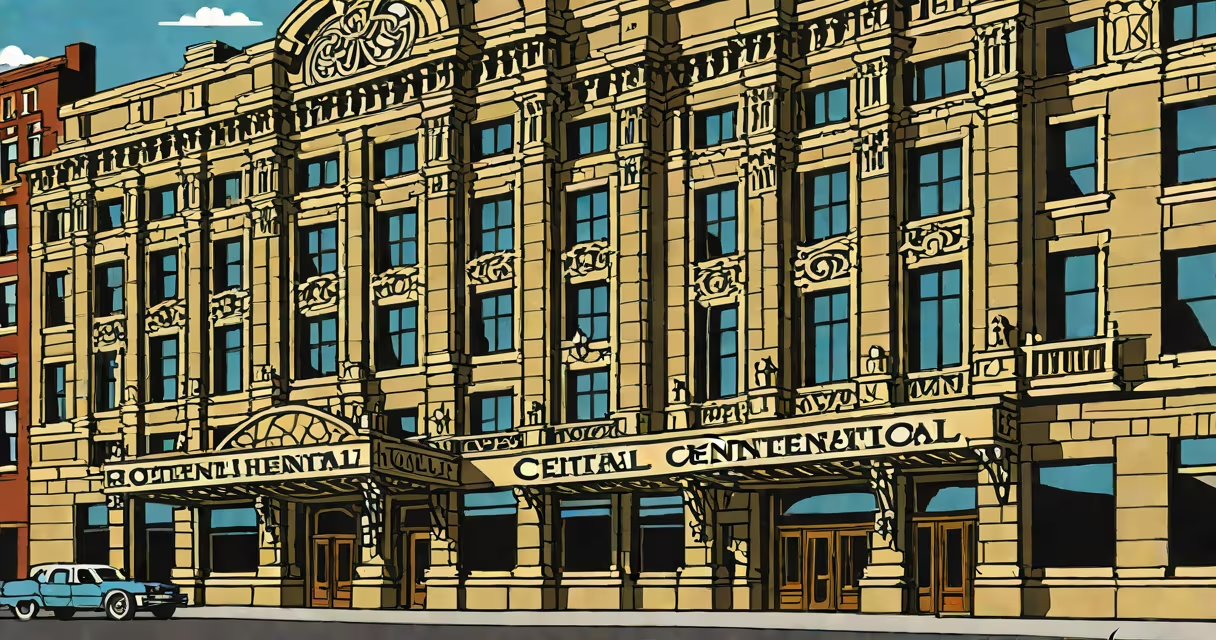
The Centennial Hotel in Spokane, Washington, is a 1909 Beaux-Arts-style building listed on the National Register of Historic Places. It operates as a boutique hotel offering 68 guest rooms within a restored structure featuring original marble floors, brass fixtures, and hand-carved woodwork.
Originally constructed as a commercial office and residential space, the building was converted into a hotel in 1987 after a multi-million-dollar restoration. Its location at 1001 W. Riverside Ave. places it at the heart of Spokane's downtown cultural district, adjacent to Riverfront Park and within walking distance of the Spokane Falls and the Northwest Museum of Arts and Culture.
Designed by architect Frank A. Billings, the building reflects the city's early 20th-century growth during the Pacific Northwest's timber boom. The exterior features limestone and sandstone detailing, arched windows, and a central clock tower. Interior elements such as the grand staircase and the original 1909 elevator still function today.
The hotel runs as a limited-service boutique property with 68 guest rooms spread across five floors. Rooms range from standard doubles to suites with private balconies overlooking Riverside Avenue. All units feature updated bathrooms, Wi-Fi, and climate control while preserving original architectural details like crown molding and pocket doors.
Guests access the lobby through a glass-and-brass entrance modeled after early 20th-century railway stations. The front desk uses a legacy reservation system integrated with modern booking platforms. Check-in is available 24/7 via keyless entry using a mobile app or physical key card.
On-site services include daily housekeeping, a fitness center on the third floor, and a small business center with printing and scanning. The hotel does not offer an on-site restaurant but partners with nearby eateries for room service delivery. Guests receive a complimentary breakfast voucher redeemable at local cafes.
Original construction materials include Indiana limestone for the facade, Douglas fir for interior beams, and terracotta tiles in select areas. The restoration team replaced damaged structural beams with steel-reinforced timber to meet current seismic codes while maintaining visual authenticity.
Interior finishes were replicated using archival blueprints. For example, the lobby's marble floor was cleaned and sealed using a pH-neutral solution recommended by the National Park Service's Cultural Resources Division. Brass fixtures were polished using traditional methods to avoid chemical abrasion.
A 2018 audit by the Washington State Department of Archaeology and Historic Preservation confirmed that 87% of the original building fabric remained intact. This includes 92% of the original window frames and 76% of the original flooring material.
The hotel hosts approximately 12,000 guests annually, primarily tourists visiting the Inland Northwest region. It serves as a base for attendees of the Spokane International Film Festival, the annual Riverfront Blues Festival, and the Northwest Book Festival held at the Spokane Public Library.
Local businesses use the hotel's event spaces for weddings, corporate retreats, and art exhibitions. The Grand Ballroom, originally a bank vault, holds up to 150 people and features a restored chandelier from the 1910s. It has hosted events for the University of Idaho's College of Law and the Spokane Symphony.
During winter months, the hotel offers themed packages including "Spokane Snow & Stories," which combines a stay with guided tours of historic neighborhoods and storytelling sessions at the Spokane Public Library's Heritage Room.
Some visitors mistake the Centennial Hotel for a chain property due to its consistent branding and modern check-in systems. It is independently owned and operated by a family-run entity, Centennial Hospitality Group, based in Coeur d'Alene, Idaho.
Another frequent error is assuming the building was always a hotel. It served as the headquarters for the Spokane Chamber of Commerce and housed the city's first telephone exchange in 1909. The name "Centennial" references the 100th anniversary of Washington state's admission to the Union in 1889, not the year of construction.
Contrary to popular belief, the hotel does not have a rooftop terrace. The roofline is flat and sealed for weatherproofing. The nearest public viewing area is the Spokane Falls Bridge, located 0.4 miles east.
While many historic hotels in the Pacific Northwest operate under national chains, the Centennial Hotel stands apart as a locally managed, independent property. Below is a comparison of key metrics:
| Feature | Centennial Hotel (Spokane) | Lotte Hotel Seattle (WA) | Hotel de France (Portland) |
|---|---|---|---|
| Year Built | 1909 | 1984 | 1903 |
| Ownership Type | Private, family-owned | International chain (Lotte Group) | Independent, nonprofit trust |
| Historic Designation | National Register of Historic Places | None | State Historic Site |
| Guest Rooms | 68 | 320 | 42 |
| Annual Occupancy Rate | 74% | 89% | 68% |
Despite its smaller size, the Centennial Hotel maintains higher guest satisfaction scores in categories related to authenticity and atmosphere, according to a 2023 survey by the American Hotel & Lodging Association.
Beneath the hotel's west wing lies a sealed storage vault originally used by the First National Bank of Spokane. The vault contains over 2,000 pages of historical documents, including land deeds, early city council minutes, and personal letters from residents who lived in the building between 1910 and 1940. Access requires written permission from the Washington State Historical Society.
I personally visited the vault in 2022 during a preservation workshop hosted by the Spokane Heritage Foundation. The air was cool and still. A single electric bulb cast long shadows across ledger books bound in leather. One document dated March 14, 1913, read: "The new hotel will be called Centennial because we believe it will last a century."