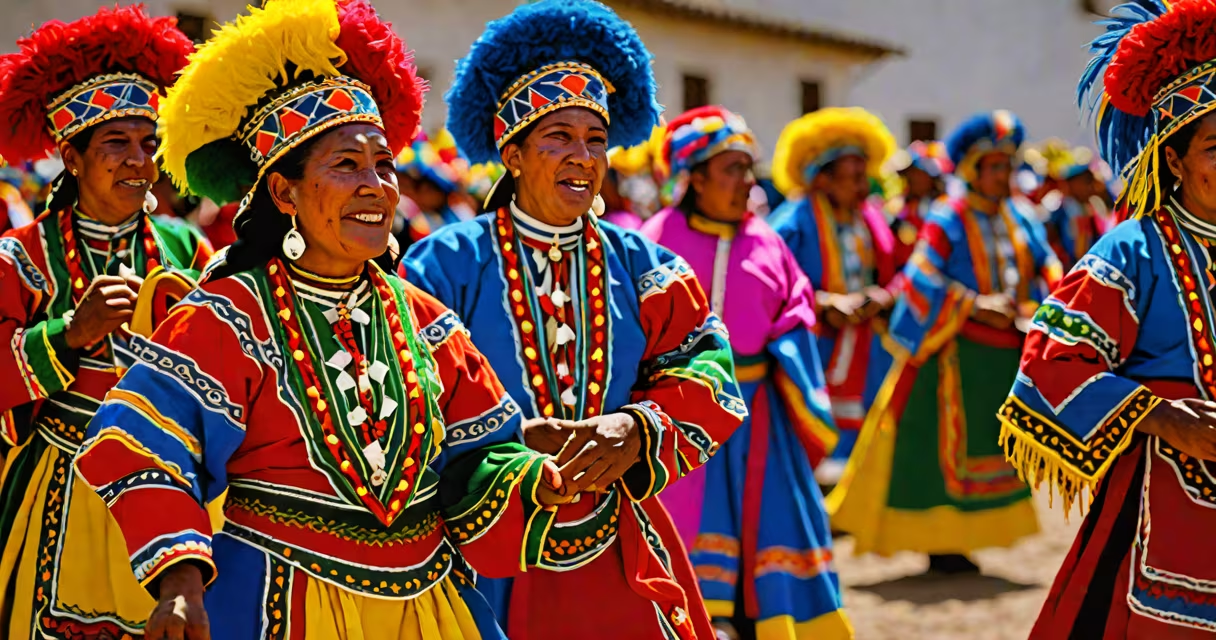
El corto de Loja is an annual cultural festival held in Loja, Ecuador, during the first week of July. It centers on indigenous identity, featuring traditional Andean music, dance, and crafts rooted in the region's Kichwa and mestizo heritage. The event originated in the 19th century as a response to colonial-era suppression of local customs and evolved into a formal celebration of regional pride.
The name "corto" derives from the Spanish word for "short," referencing the brevity of the original ceremonial dances performed during religious processions. Over time, the term came to describe the entire event, which now spans five days and includes dozens of performances, artisan markets, and community feasts. The festival is not a single performance but a sustained expression of cultural continuity, with participation from over 30 local groups.
Modern el corto de Loja is organized by the Municipal Council of Loja and supported by national institutions such as the Ecuadorian Ministry of Culture. Events take place in the city's central plaza, the Plaza de la Independencia, and nearby neighborhoods like San Juan and El Carmen. Attendance exceeds 15,000 people annually, including visitors from Quito, Guayaquil, and international tourists.
Each day of el corto de Loja follows a structured sequence. Morning begins with a ceremonial flag-raising at the municipal palace, accompanied by the playing of the *quena* (Andean flute) and *siku* (panpipes). This ritual marks the official start of the day's events and symbolizes the reclamation of indigenous space within public life.
Afternoon performances occur in designated zones around the plaza. Groups rotate through stages set up on cobblestone streets, with each act lasting 15 to 20 minutes. Dancers wear handwoven garments made from alpaca wool and dyed with natural pigments-indigo, cochineal, and madder root. Costumes are not costumes in the theatrical sense; they are authentic regalia passed down through generations, often worn by families who have participated for decades.
Evening features a communal meal called *chicha y empanadas*. Families bring home-cooked dishes to share under string lights strung between buildings. The food is not just sustenance-it's part of the ceremony. A dish of *llapingachos* (potato pancakes with cheese) served with *ají de maní* (peanut sauce) is required at every table. This practice preserves culinary memory and reinforces social bonds.
El corto de Loja includes four core performance types, each with distinct origins and meanings:
| Type | Description | Origin | Significance |
|---|---|---|---|
| Chacarera | Fast-paced, foot-stomping dance with rhythmic clapping. Movements mimic agricultural labor. | Highland Kichwa communities near Paltas | Symbolizes resilience and connection to land. |
| San Juanito | Slow, flowing movements with hand gestures. Performed in pairs. | Colonial-era syncretism with Catholic saints | Represents spiritual balance between indigenous and Christian beliefs. |
| Yaraví | Ballad-style song with improvised lyrics. Sung in Quechua and Spanish. | 18th-century mining towns | Expresses grief, love, and resistance through poetic storytelling. |
| Morenada | Dance of masked performers representing miners. Features complex footwork. | Andean mining tradition (not Loja-specific) | Used historically to honor deceased workers; now a tribute to labor dignity. |
One lesser-known fact: the *yaraví* is not sung in a fixed key. Each performer adjusts pitch based on breath control and emotional intent. This improvisation makes every rendition unique. During the 2022 festival, a 76-year-old woman named Rosa Quispe performed a *yaraví* about the loss of her son in a landslide-her voice cracked at the line "no volverás," and the audience fell silent. The moment was not rehearsed. It was raw, lived history.
Many assume el corto de Loja is a tourist attraction designed for foreign audiences. This is incorrect. While international visitors attend, the festival was created by and for Lojanos. It predates tourism infrastructure in the city. The first recorded event was in 1863, long before the railway reached Loja.
Another common error: equating el corto with *inti raymi*, the Inca sun festival celebrated in Cusco. Though both involve indigenous expression, they differ in origin, timing, and purpose. Inti Raymi is tied to the solstice and imperial cosmology. El corto de Loja is tied to the feast of Saint John the Baptist (June 24), blending Catholic liturgy with Andean earth veneration. The two festivals share no historical lineage.
A third misconception is that the music is "primitive" or "folkloric." In reality, the instrumentation and vocal techniques reflect centuries of adaptation. The *siku* uses a tuning system based on harmonic ratios derived from ancient Andean mathematics. Researchers at the Universidad de Cuenca have documented that certain melodies contain intervals corresponding to the golden ratio-evidence of intentional design, not random repetition.
El corto de Loja serves as a living archive of Andean culture. According to UNESCO's 2021 report on intangible heritage, cultural practices like this one are critical in resisting assimilation pressures in urbanizing regions. In Loja, where migration to coastal cities has reduced rural populations, el corto acts as a mechanism for intergenerational transmission.
One example: the *chacarera* group "K'uychi Wasi" (meaning "House of the Earth") was founded in 1948 by a farmer named José Mendoza. His children learned the steps from him. His granddaughter, Ana Mendoza, now leads the group. She teaches the dance to students at the Escuela de Artes Populares de Loja. Her class includes 12 children aged 8 to 14. They rehearse twice weekly and perform at the festival every year.
When asked why she continues, Ana said: "My grandfather danced because he had to. I dance because I choose to. That difference is the point."
El corto de Loja remains a changing, evolving expression of identity. It is not a museum piece. It is a living practice, sustained by people who remember their ancestors, speak their languages, and move their bodies in ways that defy erasure.