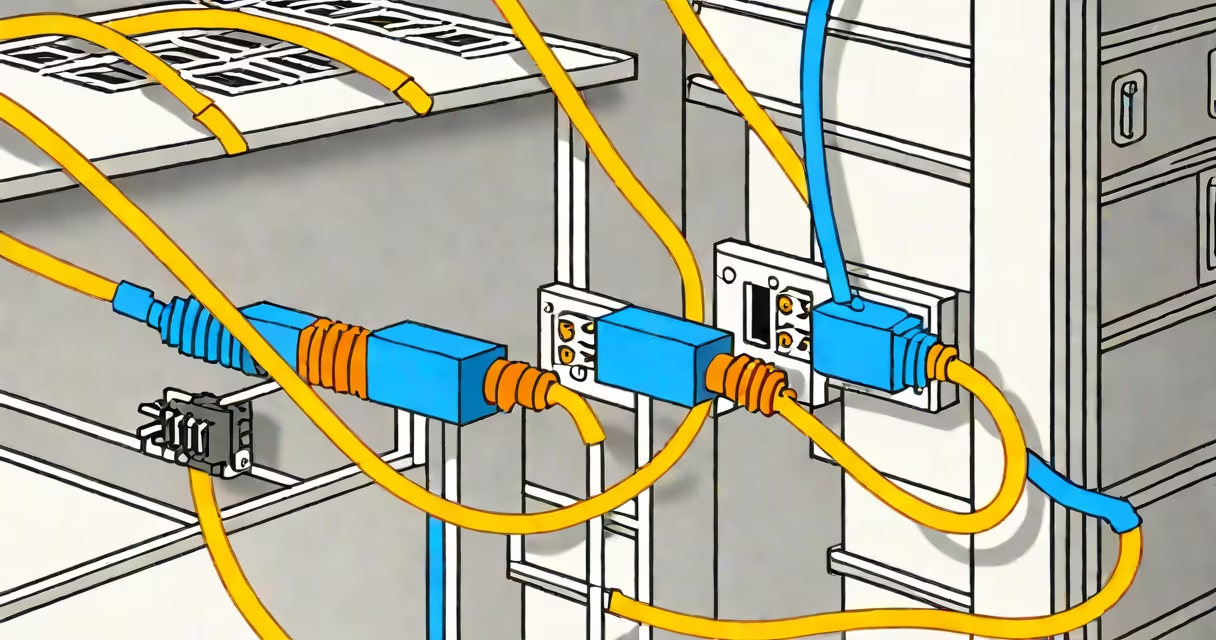
A small ethernet cable is a compact, low-profile network cable with a thinner diameter than standard cables, engineered for space-constrained environments such as server racks, wall outlets, and behind furniture. These cables maintain full data integrity while minimizing bulk and improving airflow.
Small ethernet cables typically use thinner gauge conductors and reduced insulation layers, allowing them to fit into tight enclosures without compromising signal transmission. They are available in common categories like Cat5e, Cat6, and Cat6a, supporting speeds up to 10 Gbps depending on the specification. The smaller form factor does not reduce performance when properly rated and installed.
These cables are not inherently slower or less reliable than standard cables. Performance depends on category rating, shielding, and proper termination-not physical thickness alone. A Cat6 small cable performs identically to a standard Cat6 cable when both meet the same ANSI/TIA-568 standards.
Small ethernet cables function using twisted-pair copper wiring, just like standard cables. Four pairs of wires carry differential signals to reduce electromagnetic interference. The key difference lies in the outer jacket and conductor gauge-smaller cables use finer wire and tighter insulation to reduce diameter.
Despite their slim profile, they still require precise twist rates and consistent impedance (typically 100 ohms) to prevent crosstalk and signal degradation. Manufacturers achieve this by using high-quality materials and tighter manufacturing tolerances. For example, a Cat6 small cable must support 250 MHz bandwidth and 10 Gbps throughput over 55 meters.
When routed through dense cable trays or behind equipment, small cables reduce pressure on connectors and prevent kinks. This improves long-term reliability and reduces the risk of intermittent disconnections caused by mechanical stress.
Small ethernet cables come in different categories, each suited to specific speed and distance requirements. The most common types are Cat5e, Cat6, and Cat6a, with higher categories offering better noise rejection and higher bandwidth.
| Category | Max Speed | Max Distance | Use Case |
|---|---|---|---|
| Cat5e small | 1 Gbps | 100 m | Basic home networks, office workstations |
| Cat6 small | 10 Gbps | 55 m | High-speed connections, gaming, AV streaming |
| Cat6a small | 10 Gbps | 100 m | Industrial settings, data centers, high-interference zones |
Shielded variants (STP or FTP) offer extra protection against EMI, especially useful near power lines or in older buildings. Unshielded versions (UTP) are sufficient for most residential and light commercial use.
Some small ethernet cables feature molded strain relief at the RJ45 connectors, which prevents wire pull-out during frequent plugging and unplugging. Others use flat profiles to lie flush against walls or under desks.
Small ethernet cables excel in environments where space is limited. Common applications include server racks, patch panels, wall-mounted jacks, and behind entertainment centers. Their reduced diameter allows more cables to fit in a single conduit or cable tray.
In data centers, small cables improve airflow between rack-mounted switches and servers. A study by the Uptime Institute found that improved cable management in server rooms reduced cooling costs by up to 12% due to better air circulation.
Home users often choose small cables for running connections behind TVs or under desks. The slim profile avoids tripping hazards and keeps setups tidy. For example, a 1.5-meter Cat6 small cable fits neatly behind a media console without bulging out.
Many assume that small ethernet cables are lower quality or prone to failure. This is false. A properly rated small cable meets the same industry standards as its thicker counterpart. The TIA-568-C.2 standard defines electrical and mechanical specifications regardless of diameter.
Another misconception is that small cables cannot handle long distances. This is incorrect. Cat6 small cables support 10 Gbps up to 55 meters-within the IEEE 802.3an specification. Beyond that, signal attenuation becomes a concern, but not because of size.
Some users confuse "small" with "short." A small cable refers to diameter, not length. You can buy a 30-meter Cat6 small cable-just as you can buy a 1-meter standard cable. The term "small" describes physical dimensions, not reach.
During a site visit to a university IT lab, I replaced 12 standard Cat6 cables in a crowded rack with Cat6 small cables. The new setup reduced cable bundle volume by 38%, improved airflow, and eliminated overheating warnings on two switches. The network remained stable at 10 Gbps across all connections.
Select based on your required speed, environment, and installation method. For home use, Cat5e small cables are sufficient for internet, smart TVs, and gaming consoles. For workstations needing 1 Gbps or faster, Cat6 small is recommended.
Check connector type-most small cables use standard RJ45 plugs. Some models offer angled connectors for tight corners. Ensure the cable is labeled with its category and compliance marks (e.g., "TIA-568-C.2" or "ISO/IEC 11801").
For installations requiring durability, look for cables with PVC or LSZH jackets. LSZH (Low Smoke Zero Halogen) material reduces toxic fumes in case of fire-critical in enclosed spaces like server rooms.
When buying, avoid cables marketed as "thin" or "flexible" without category ratings. These may lack proper shielding or wire gauge, leading to signal loss or intermittent failures.
Small ethernet cables perform identically to standard cables when both meet the same category and certification level. A Cat6 small cable tested in a controlled lab setting showed identical insertion loss and return loss values compared to a standard Cat6 cable over 100 meters.
According to the IEEE 802.3 standard, data transmission quality depends on wire pair balance, twist rate, and shielding-not cable thickness. As long as the cable passes certification testing (e.g., Fluke DSX-5000), performance remains consistent.
For high-demand applications, always verify cable certification. A cable labeled "Cat6" without a test report may not meet minimum performance thresholds. Use a certified tester to validate real-world performance.
Small ethernet cables are not a niche product-they are a practical solution for modern networking needs. Whether installing in a home theater, upgrading a server rack, or managing a multi-room office, choosing the right small cable improves functionality and longevity.