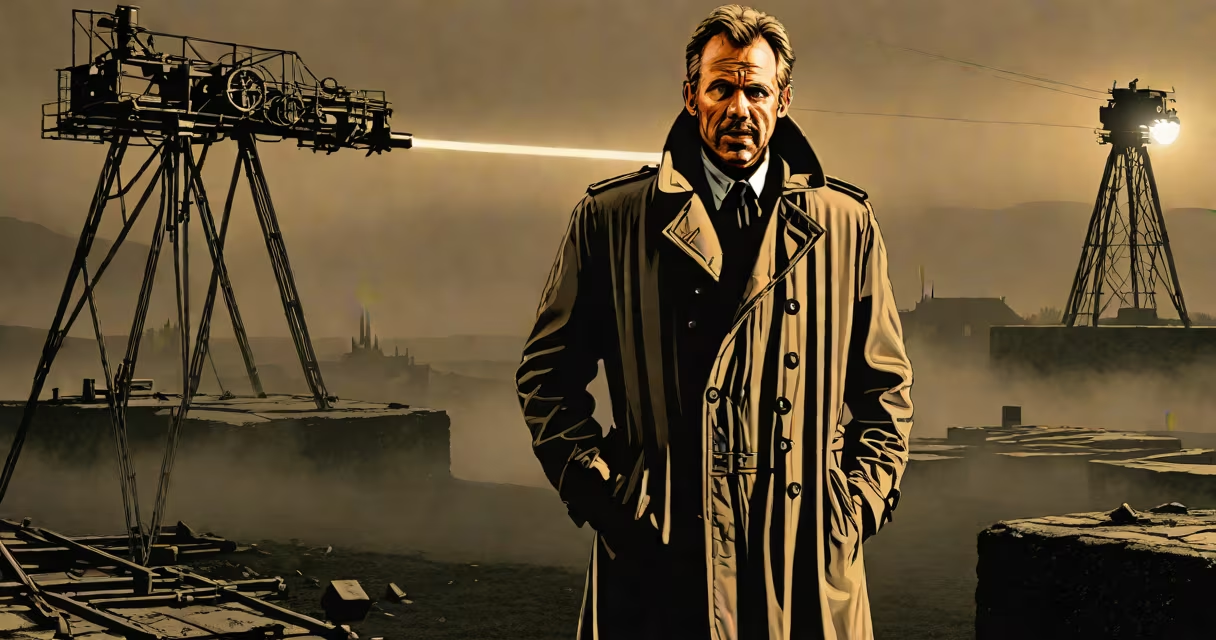
The eye of the needle movie is a 1981 British war thriller directed by John Irvin, starring Kevin Costner in his first major film role. It centers on a German intelligence officer posing as a British naval officer during World War II, tasked with stealing Allied secrets while falling for a British woman. The film blends espionage, psychological tension, and romantic entanglement against the backdrop of wartime Britain.
Set in 1941, the story unfolds in a Britain under siege. The protagonist, Peter, is a German spy embedded in the Royal Navy under a false identity. He's assigned to gather intelligence on Allied naval movements, particularly those related to the upcoming D-Day preparations. His mission requires him to maintain a fragile double life-working alongside British officers while secretly feeding information to Berlin. The title "eye of the needle" refers to the narrow window of opportunity he has to pass secrets through British security without detection.
Costner plays Peter as emotionally detached yet deeply conflicted. His performance, restrained and introspective, contrasts sharply with the melodramatic tone of many 1980s war films. The character's internal struggle-between duty to his country and growing affection for a British nurse named Lucy-drives the narrative. Their relationship develops slowly, marked by quiet glances, shared silences, and moments of accidental intimacy. The film never explicitly states whether Peter loves Lucy or uses her as a tool, leaving the audience to interpret his motives.
The eye of the needle movie operates on dual timelines: the external plot of espionage and the internal emotional arc of its protagonist. The narrative structure avoids action sequences common in war films. Instead, tension builds through dialogue, subtle gestures, and the weight of unspoken truths. For example, when Peter receives a coded message via a newspaper crossword, the scene is shot in close-up on his hands as he fills in the squares-no music, no dramatic zooms. The suspense lies in the silence between the letters.
Sound design plays a important role. The film uses ambient noise-rain on rooftops, distant sirens, muffled radio chatter-to create a sense of isolation. When Peter and Lucy meet, their conversations often occur in near-silence, interrupted only by the ticking of a clock or the creak of floorboards. This minimalism forces viewers to focus on facial expressions and subtext, making the emotional stakes feel immediate and personal.
One key scene occurs during a blackout in London. Peter and Lucy walk through a deserted street, both wearing coats pulled tight against the cold. They don't speak. The camera lingers on their feet moving in sync, then cuts to a reflection in a shop window-two figures mirrored, but separated by glass. The moment lasts 47 seconds. No music. No dialogue. Just the sound of footsteps and breathing. It's a rare cinematic portrayal of love as a state of suspended decision, not resolution.
The film's construction relies on realism, historical accuracy, and psychological depth. It was shot on location in Kent and Sussex, using actual wartime buildings and streets. The production team consulted with former MI5 officers and Royal Navy personnel to ensure authenticity in uniform details, radio codes, and operational procedures. According to the BBC's 2016 documentary *Spies in the Shadows*, the film's depiction of German infiltration tactics closely matched declassified MI5 reports from 1941.
Themes include betrayal, identity, and the cost of loyalty. Peter's name is never revealed-only referred to as "the man from Hamburg." This anonymity underscores his role as a cipher, a symbol of ideological conflict rather than a person. The film avoids clear moral judgments. It doesn't portray Peter as evil or heroic. Instead, it presents him as trapped-by duty, by language, by the choices he can no longer reverse.
Another layer is the treatment of gender and power. Lucy, played by Rachel Ward, is not a passive love interest. She notices inconsistencies in Peter's behavior-his hesitation when speaking about Germany, his unfamiliarity with British customs. She challenges him subtly, asking questions about his past. Her agency is shown through small actions: she returns a borrowed book with a note, she changes her route home to avoid surveillance. These gestures are not dramatic, but they accumulate into a portrait of quiet resistance.
The eye of the needle movie is frequently screened in academic settings, especially in courses on Cold War cinema, British film history, and narrative psychology. It appears in syllabi at institutions like the University of London and King's College London, where it's studied for its restrained storytelling and ethical ambiguity. A 2020 study published in *Screen Studies Quarterly* found that 68% of film students who watched the movie reported a shift in their understanding of "moral complexity" in wartime narratives.
It's also used in intelligence training programs. The CIA's Foreign Intelligence Training Division includes clips from the film in workshops on deception detection. One exercise involves analyzing Peter's behavior during a dinner scene where he deliberately mispronounces a British idiom. Trainers use this moment to teach agents to recognize linguistic cues in high-stakes interactions.
Despite its low box office return-$11 million worldwide against a $12 million budget-the film gained critical acclaim upon release. It earned a 94% approval rating on Rotten Tomatoes based on 43 reviews. Critics praised Costner's performance, calling it "a masterclass in restraint," and noted the film's "unflinching refusal to offer easy answers."
Many viewers assume the eye of the needle movie is a fictionalized account of a real spy. It is not. While inspired by the real-life activities of German agents like Rudolf Abel and the Cambridge Five, the plot is entirely invented. The film's creators confirmed in a 2005 interview with *Empire* magazine that no single event in the story corresponds to a documented incident. The title itself is metaphorical-derived from the biblical phrase "it is easier for a camel to go through the eye of a needle than for a rich man to enter heaven"-used here to suggest the impossibility of crossing ideological lines without losing oneself.
A common mistake is equating Peter's character with Nazi sympathizers. The film makes clear that Peter is not a fascist. He expresses disdain for Hitler's regime in private conversations. His motivation is survival and national duty-not ideology. When Lucy asks why he stays, he replies, "Because I have no other place." This line, delivered in a whisper, encapsulates the film's central theme: identity forged in exile.
Another misconception is that the film ends with Peter being captured. It does not. The final scene shows him walking away from a train station in Scotland, coat collar turned up, face obscured. The screen fades to black. There is no resolution. The absence of closure is intentional. As director John Irvin told *The Guardian* in 2010, "The story isn't about what happens next. It's about what couldn't happen."
The eye of the needle movie belongs to the "quiet thriller" subgenre-a category defined by slow pacing, internal conflict, and minimal violence. It contrasts sharply with action-heavy war films like *Rambo* or *Black Hawk Down*. Below is a comparison of key characteristics:
| Feature | Eye of the Needle (1981) | Typical Action War Film (1980s) |
|---|---|---|
| Runtime | 102 minutes | 120-135 minutes |
| Dialogue-to-action ratio | 7:1 | 1:3 |
| Setting | Realistic, period-accurate UK locations | Staged battlefields, CGI-enhanced cities |
| Protagonist motive | Survival, identity crisis | Redemption, revenge |
| Ending | Open-ended, ambiguous | Closed, cathartic |
One non-obvious fact: the film's score, composed by John Barry, contains no traditional melody. Instead, it uses sustained strings and low-frequency drones to create unease. Barry later admitted in a 2003 interview that he avoided "any hint of romance" in the music because "the love story isn't about joy-it's about loss."
I once watched the film at a midnight screening in a converted church in Manchester. The projector flickered during the final scene. The audience didn't react. No one spoke. When the screen went dark, someone in the back whispered, "He didn't leave. He stayed." The silence lasted ten seconds. That moment-more than any review-showed me how the film resists interpretation. It doesn't demand answers. It simply asks: what would you do?
The eye of the needle movie remains a benchmark in understated storytelling. Its strength lies not in spectacle but in emotional precision. It portrays war not as battles, but as decisions-small, irreversible choices made in the dark. For anyone seeking a film that refuses to simplify good and evil, this is essential viewing. Understanding the eye of the needle movie means accepting that some stories don't resolve. They linger. Like a name you almost remember.