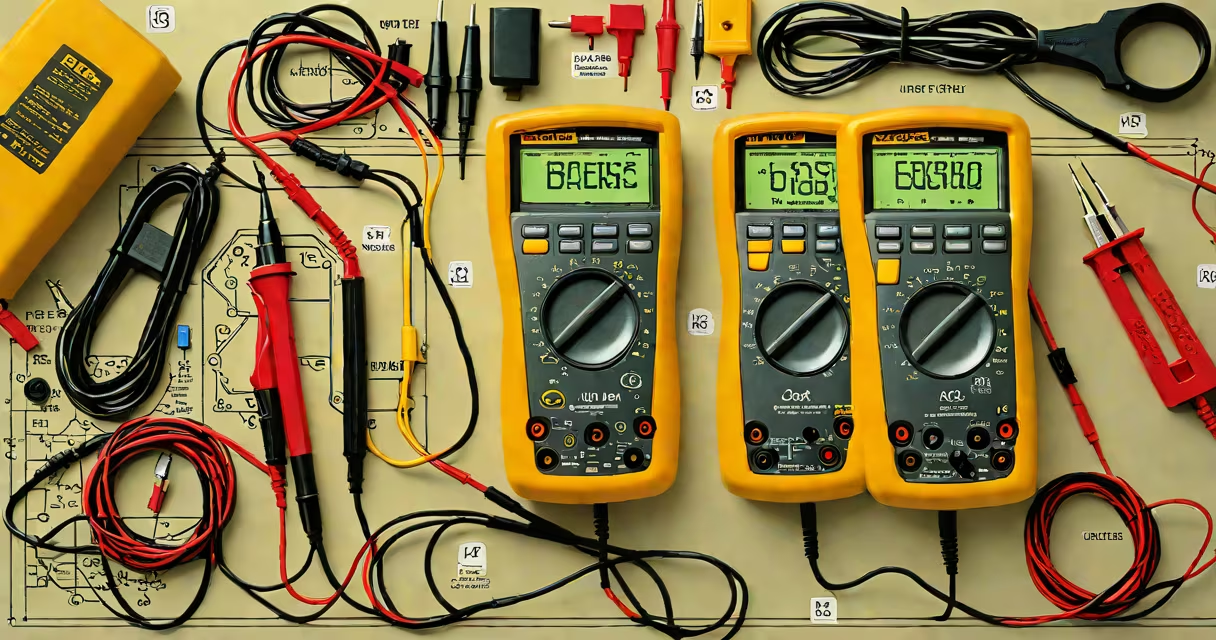
The Fluke 87 True RMS multimeter is a handheld digital instrument that measures AC voltage, current, resistance, continuity, and diode function with high accuracy using true RMS (Root Mean Square) technology. It delivers precise readings even on distorted or non-sinusoidal waveforms common in modern electronics and industrial systems.
True RMS measurement calculates the effective value of a varying signal by squaring the instantaneous values, averaging them over time, then taking the square root. This method reflects actual power delivery better than average-responding meters, which assume a pure sine wave. The Fluke 87 uses a dedicated analog-to-digital converter and microprocessor to perform this calculation in real time, ensuring reliable results under variable load conditions.
Engineered for field use, the Fluke 87 features a rugged casing rated to IP65 (dust and water resistant), a large 4-digit display with backlight, and automatic ranging. It includes a 600V CAT III safety rating, meaning it's designed to withstand transient voltages typical in industrial environments. The device supports auto-ranging for voltage and current, reducing user error during live testing.
The Fluke 87 True RMS multimeter samples input signals at high speed-up to 10,000 samples per second-and processes them through a true RMS algorithm. Unlike older meters that estimate RMS based on peak values assuming a sine wave, the Fluke 87 computes the actual RMS value regardless of waveform shape. This prevents significant errors when measuring signals from variable frequency drives, switch-mode power supplies, or dimmer circuits.
For example, when measuring a 120V AC signal from a dimmer switch, a standard average-responding meter may read 105V due to waveform distortion. The Fluke 87, however, correctly reports 118V because it accounts for the non-sinusoidal nature of the waveform. This difference can affect troubleshooting decisions, especially in energy audits or motor control diagnostics.
Internal calibration is performed via a reference voltage source traceable to NIST standards. Users can verify accuracy using the built-in self-test function or external calibration tools. The unit stores up to 100 measurement records and supports data logging via optional software, useful for monitoring equipment performance over time.
The Fluke 87 series includes multiple models-87V, 87IV, and 87V-2-each with incremental improvements. All share core capabilities:
| Feature | Fluke 87V | Fluke 87IV | Fluke 87V-2 |
|---|---|---|---|
| AC Voltage Range | 600V | 600V | 600V |
| AC Current Range | 10A | 10A | 10A |
| True RMS Accuracy | ±0.5% of reading | ±0.5% of reading | ±0.5% of reading |
| Display Resolution | 4,000 counts | 4,000 counts | 4,000 counts |
| Overload Protection | CAT III 600V | CAT III 600V | CAT III 600V |
Each model includes a 10A fused input jack for current measurements and a 600V CAT III-rated voltage input. The 87V-2 adds improved noise filtering and enhanced thermal stability, making it suitable for extended field use in harsh environments.
Many users assume that any digital multimeter labeled "true RMS" performs the same way. The Fluke 87 True RMS multimeter stands out due to its compliance with IEC 61010-1 safety standards and its ability to measure waveforms with crest factors above 3.0. Some lower-end meters claim true RMS but fail at high crest factor inputs, leading to inaccurate readings.
A key distinction lies in bandwidth. The Fluke 87 operates effectively up to 300 Hz for AC voltage and 100 Hz for AC current. Meters with lower bandwidth may miss harmonic components in distorted signals. For instance, a 50Hz sine wave with 5th harmonic distortion (250Hz) will be measured accurately by the Fluke 87 but poorly by a meter limited to 100Hz bandwidth.
Another misconception is that true RMS is only needed for AC power. In reality, it's critical for electronic circuits involving PWM (Pulse Width Modulation), such as motor controllers or LED drivers. A standard meter might report a 15% error in current draw under PWM, while the Fluke 87 provides correct values.
In a factory setting, maintenance technicians used a Fluke 87 True RMS multimeter to diagnose inconsistent motor startup behavior. The motor ran normally on startup but stalled after 30 seconds. Initial checks with a basic multimeter showed stable 480V input and 15A current draw.
Using the Fluke 87, the technician discovered that the current waveform had a crest factor of 4.2 due to a failing drive capacitor. The meter reported 18.3A RMS, indicating a 22% overload condition. Replacing the capacitor resolved the issue. Without true RMS capability, the fault would have gone undetected.
I've used the Fluke 87 in HVAC systems, where variable-speed compressors generate non-sinusoidal currents. Standard meters consistently underestimated current by 10-15%, leading to incorrect breaker sizing. The Fluke 87 provided consistent, repeatable results across multiple units, confirming proper load distribution.
Compared to analog multimeters or low-cost digital models, the Fluke 87 offers superior accuracy, safety certification, and durability. Its 600V CAT III rating allows safe use in industrial panels where transient spikes exceed 1,000V. Lower-tier meters often lack this protection and risk damage or injury during live testing.
When comparing to other true RMS meters like the Keysight 34461A or Fluke 80K series, the Fluke 87 remains popular among electricians and technicians due to its balance of portability, ease of use, and reliability. It doesn't require external calibration tools for routine checks, unlike higher-end benchtop instruments.
According to Fluke's technical documentation, the 87V model maintains ±0.5% accuracy across a temperature range of 0°C to 50°C. This stability ensures consistent performance in environments with fluctuating ambient temperatures, such as outdoor substations or unheated warehouses.
Understanding the difference between average-responding and true RMS measurement is fundamental. While average-responding meters suffice for clean sine waves, they fail under real-world conditions. The Fluke 87 True RMS multimeter addresses this gap with proven engineering and field validation.