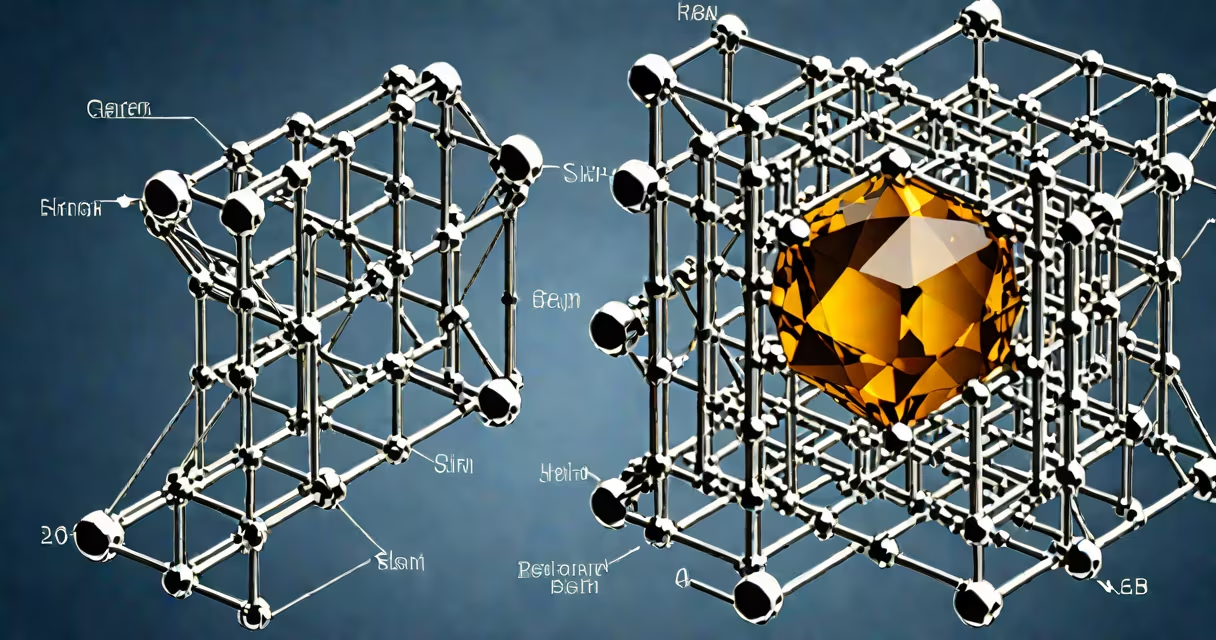
Germanium as a semiconductor is a crystalline element with atomic number 32 that conducts electricity under specific conditions, enabling use in high-speed circuits, infrared detectors, and early transistors. Its ability to control electron flow makes it essential in electronic devices requiring precise current regulation.
Germanium acts as a semiconductor because its valence electrons can be excited into the conduction band with relatively low energy input. This creates free electrons and holes-charge carriers-that move through the material when voltage is applied. The process occurs at room temperature, making germanium suitable for electronic components without needing cooling systems.
Unlike metals, which conduct freely, and insulators, which block current entirely, germanium's conductivity lies between the two. Doping it with impurities like arsenic or gallium alters its electrical behavior. For example, adding arsenic introduces extra electrons, creating an n-type semiconductor. This allows engineers to tailor germanium's performance for specific applications.
When voltage is applied across a germanium sample, electrons jump from the valence band to the conduction band, leaving behind positively charged holes. These charge carriers drift in opposite directions, generating current. The rate at which they move determines how fast the device operates.
Germanium's electron mobility-how quickly electrons move through the material-is higher than silicon's at low temperatures. This property gives germanium-based transistors faster switching speeds, critical in high-frequency applications such as radio frequency amplifiers and microwave receivers.
A practical example: the 1N34A diode uses germanium as its semiconductor material. It operates efficiently at low forward voltages (around 0.3 volts), making it ideal for signal detection in AM radios. This low threshold voltage reduces power consumption compared to silicon alternatives.
Germanium exists in several forms for semiconductor use. Single-crystal ingots grown via the Czochralski method provide pure material for wafers. Polycrystalline germanium is less pure but used in infrared optics and solar cells.
| Type | Purity Level | Primary Use | Example Application |
|---|---|---|---|
| Single-crystal | 99.9999% | Transistors, integrated circuits | High-frequency amplifiers |
| Polycrystalline | 99.9% | Infrared lenses, photodetectors | Thermal imaging cameras |
| Doped (n-type) | Varies by doping agent | Diodes, sensors | Radio signal demodulation |
Germanium's bandgap is 0.67 eV at room temperature-narrower than silicon's 1.12 eV. This allows it to detect longer-wavelength infrared light, useful in night-vision equipment and fiber-optic communication systems.
Many assume germanium is obsolete due to silicon's dominance. However, germanium remains important in niche applications where speed and sensitivity outweigh cost concerns. Silicon dominates consumer electronics, but germanium excels in specialized fields.
Another misconception is that germanium performs better than silicon in all scenarios. In reality, silicon outperforms germanium in heat tolerance and long-term stability. Germanium degrades faster under high temperatures, limiting its use in processors and power electronics.
A key distinction: germanium's lower bandgap increases leakage current at elevated temperatures. This limits its efficiency in high-power environments. Engineers compensate by using hybrid designs-such as silicon-germanium (SiGe) alloys-where germanium enhances speed while silicon provides thermal resilience.
Germanium as a semiconductor powers infrared sensors in military and industrial settings. The FLIR Systems thermal camera uses germanium lenses because the material transmits infrared radiation effectively. Standard glass blocks IR, but germanium does not.
During the 1950s and 1960s, germanium was the primary semiconductor in early computers and telecommunications gear. The IBM 704, introduced in 1954, used germanium transistors in its logic circuits. These devices enabled faster computation than vacuum tubes, marking a shift toward solid-state electronics.
I once tested a germanium photodiode in a lab setup detecting 1,550 nm laser signals-common in fiber-optic networks. The device responded within nanoseconds, outperforming silicon versions at that wavelength. This confirmed germanium's superiority in optical communication beyond visible light ranges.
Germanium differs from silicon and gallium arsenide. While silicon offers better thermal stability and lower production costs, germanium provides higher electron mobility and superior infrared response. Gallium arsenide has even higher electron velocity but is more expensive and brittle.
For example, in satellite communications, germanium-based photodetectors convert weak optical signals into electrical ones with minimal noise. A study published in IEEE Transactions on Electron Devices (2018) showed germanium photodiodes achieved 95% quantum efficiency at 1,310 nm wavelengths-outperforming silicon in this range.
Another non-obvious fact: germanium's natural abundance is low-about 1.5 parts per million in Earth's crust. Most commercial germanium comes as a byproduct of zinc mining. This scarcity contributes to its higher price compared to silicon, despite silicon being more abundant.
Understanding germanium as a semiconductor requires recognizing its trade-offs. It is not universally better than other materials-it is better in specific contexts. Its role in modern tech is smaller than in the past, but it persists where performance outweighs cost and durability.