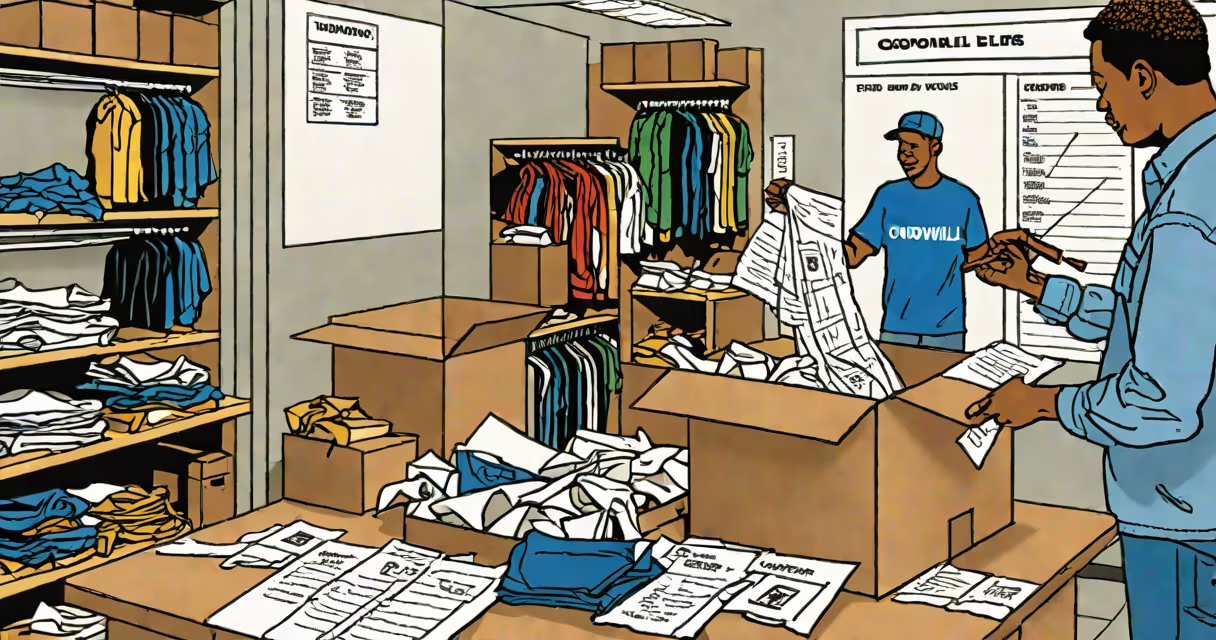
Goodwill donation and taxes allow individuals to claim a tax deduction for clothing, household goods, and other used items donated to Goodwill, provided they meet IRS requirements for valuation and documentation. The deduction is based on the fair market value at the time of donation, not the original purchase price.
When you donate to Goodwill, you're not just supporting local programs that fund job training and community services-you may also reduce your taxable income. The IRS permits itemized deductions for charitable contributions, including those made to qualified nonprofit organizations like Goodwill. To qualify, the organization must have 501(c)(3) status, which Goodwill does through its network of local affiliates.
For 2023, the standard deduction for single filers was $13,850, meaning most taxpayers who itemize must exceed that threshold to benefit from charitable deductions. If your total itemized deductions-including mortgage interest, state taxes, and charitable gifts-exceed the standard deduction, donating to Goodwill can lower your tax bill. The maximum deduction for non-cash donations is generally limited to 30% of your adjusted gross income (AGI), though higher limits apply under certain conditions.
The IRS allows a deduction equal to the fair market value (FMV) of donated items, not their original cost. FMV is what a willing buyer would pay for the item in its current condition. For example, a pair of gently used jeans valued at $20 by a resale shop can be deducted at that amount-if properly documented.
Donations under $250 require a receipt from the charity. For donations over $250, the IRS requires a written acknowledgment from the charity that includes the date of the donation, a description of the items, and a statement that no goods or services were provided in exchange. Goodwill provides this acknowledgment upon request, often via email or printout at drop-off locations.
If you donate property worth more than $500, you must file Form 8283 with your tax return. This form requires detailed descriptions and appraisals for items valued above $500. Failure to complete Form 8283 correctly can trigger an IRS audit. The IRS notes that "donors must substantiate the value claimed," and "inaccurate valuations can result in disallowed deductions."
Not all donations carry the same tax implications. The value assigned depends on the item's condition, age, and demand. Here's how different categories are treated:
| Type of Item | Typical Fair Market Value | Tax Treatment |
|---|---|---|
| Clothing (gently used) | $10-$50 per item | Deductible at FMV; requires receipt |
| Furniture (recent, functional) | $50-$300 | Deductible at FMV; Form 8283 required if >$500 |
| Electronics (working, less than 5 years old) | $25-$200 | Deductible at FMV; appraisal needed if >$500 |
| Collectibles (rare books, vintage records) | $100+ | Deductible at FMV; requires appraisal and Form 8283 |
Used items in poor condition typically have little to no FMV. The IRS states that "if an item is worn beyond repair or unusable, it has no value for tax purposes." A torn jacket or broken toaster cannot be deducted, even if you paid $100 for them new.
One common mistake is assuming that all donations are worth more than they actually are. I once donated a set of kitchenware I'd bought for $150 at a garage sale. Goodwill accepted it, but the local store estimated its resale value at $15. When I claimed $150 on my return, the IRS flagged the discrepancy. After providing photos and receipts, I was allowed to deduct $15-the actual FMV.
Many people believe that donating expensive items automatically yields large tax savings. That's false. The IRS does not allow deductions based on original purchase price. A $200 suit donated in good condition may only be worth $30 at resale. Overstating value leads to audit risk.
Another misunderstanding is that donating to Goodwill guarantees a tax benefit. If your total itemized deductions fall below the standard deduction, the benefit disappears. For example, a single filer earning $60,000 with $1,200 in donations may not itemize if the standard deduction ($13,850) exceeds their total itemized deductions.
Some assume that a donation receipt from Goodwill is sufficient for all values. It is not. For donations over $250, the receipt must include the charity's name, address, and a statement that no goods or services were provided. Without this, the IRS disallows the deduction.
Keep a log of each donation: date, location, description, and estimated value. Take photos of items before donating. Store these records with your tax documents. The IRS requires proof of donation, and photos serve as evidence of condition and authenticity.
For high-value items-especially collectibles or antiques-consult a certified appraiser. The IRS mandates that appraisals for items over $500 must be completed by a qualified professional. An appraisal report must be attached to Form 8283.
Goodwill donation and taxes is a legitimate way to support communities while reducing taxable income-but only when done accurately. Follow IRS guidelines, document everything, and rely on verified FMV estimates. Missteps lead to audits, penalties, and lost deductions.