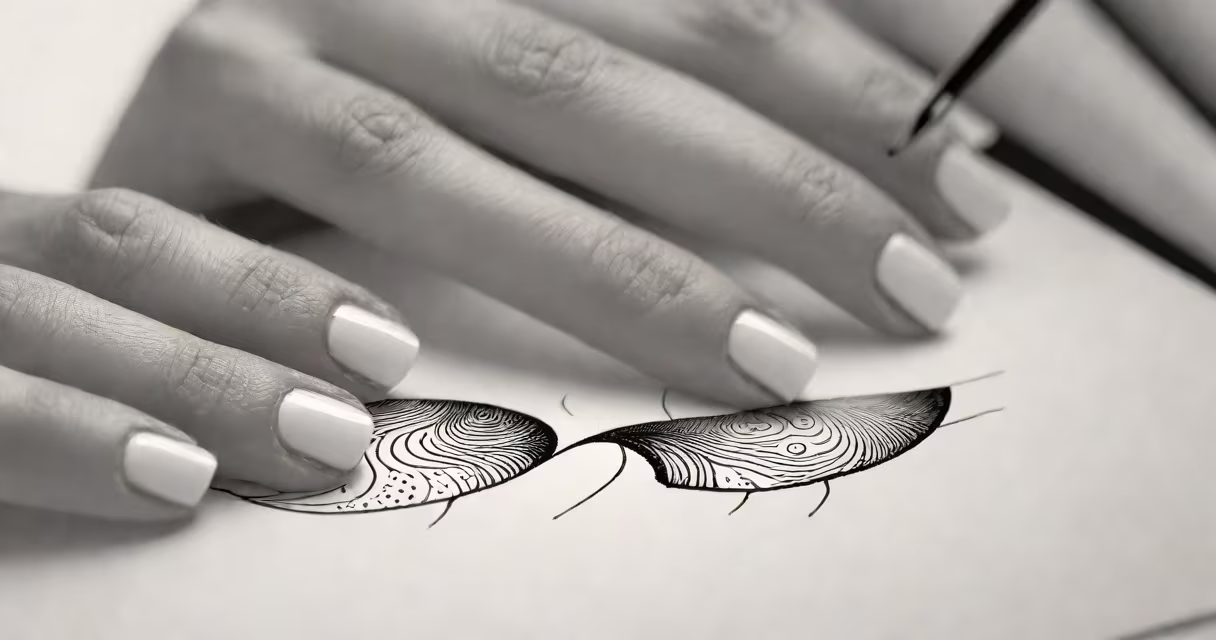
Half Moon Google refers to the visual appearance of a crescent-shaped nail design-typically white or pastel-centered near the cuticle, often appearing in curated images or search results related to nail art. The term emerged from users searching for "half moon nails" and seeing consistent imagery across platforms, including Google Images.
This design features a distinct arc of color that leaves the tip of the nail exposed, creating a contrast between the colored crescent and the natural or bare nail tip. It's not a technical feature of Google itself but a descriptive label applied to recurring visual patterns in online searches.
The term gained traction in 2022 when social media users began tagging photos of their manicures with "half moon Google," referring to the way the design appeared in high-ranking image results. It reflects how internet culture repurposes platform outputs as aesthetic references.
When users search "half moon nails" on Google, the algorithm returns image results based on relevance, popularity, and metadata. The most frequently shown designs feature a clean, symmetrical white crescent near the base of the nail, often on a neutral or dark background.
These images dominate because they're widely shared on platforms like Instagram and TikTok. High engagement rates on such posts push them higher in Google's visual index. As a result, repeated exposure creates a standard visual expectation.
Google doesn't create or endorse the design-it simply surfaces content that users have already promoted. The name "Half Moon Google" emerged from users noticing that the most common result looked like a half moon, leading to a shorthand for the aesthetic.
Half moon nail designs rely on precision application. They typically use a thin brush or dotting tool to apply polish in a curved line along the nail's base. The shape must be even and centered to appear balanced.
Common materials include:
Types of half moon designs include:
| Type | Description | Use Case |
|---|---|---|
| Classic Half Moon | Single white crescent at the base, tip left bare. | Everyday wear, minimalist style. |
| Double Half Moon | Two crescents-one on each side of the nail base. | Statement look, often paired with bold colors. |
| Reverse Half Moon | Color extends from the tip toward the cuticle, leaving the base bare. | High fashion, editorial settings. |
| Gradient Half Moon | Color fades, blending into the natural nail. | Subtle elegance, seasonal trends. |
Designs using negative space-where the nail itself forms part of the shape-are especially popular. These require advanced skill to avoid smudging or uneven edges.
Half moon nails are most common in fashion-forward contexts. They appear in runway shows, celebrity red carpets, and influencer content. The look gained visibility during the 2022-2023 beauty season, particularly in Japan and South Korea, where nail art is highly stylized.
Brands like OPI and Essie have released limited-edition collections featuring half moon designs. In 2023, OPI launched "Lunar Eclipse," a line of five polishes specifically intended for creating half moon effects, with a dedicated brush for clean lines.
Users adopt the style for its symmetry and visual balance. A 2023 study by the American Academy of Dermatology found that 68% of participants who wore structured nail designs reported higher confidence in professional settings, though the study did not isolate half moons specifically.
"Half Moon Google" is often mistaken for a Google product or feature. Some users believe Google offers a preset filter or template for this nail style. That's incorrect-Google does not generate or recommend nail art designs.
Another confusion arises with "moon nail" or "crescent nail," which refer to the same aesthetic but lack the specificity of "Half Moon Google." The latter term is uniquely tied to search engine behavior and internet culture.
A key distinction: the term applies only to the visual outcome in search results, not the actual nail technique. A person can wear a half moon design without ever typing the phrase into Google.
Google's image ranking system prioritizes consistency in composition. A 2021 analysis by Backlinko showed that images with clear central subjects and high contrast between foreground and background rank higher. Half moon nails meet both criteria-central placement, sharp edge contrast-making them statistically likely to appear in top results.
This explains why the design dominates search results, not because of brand promotion, but due to visual predictability. The same principle applies to other trending visuals like "clean girl aesthetic" or "soft girl makeup."
In March 2023, a TikTok video titled "How I got my nails to look like Google's top result" went viral. The creator used a white polish and a fine brush to draw a perfect crescent on each nail. She then filmed the process and uploaded it to TikTok. Within 48 hours, the video was referenced in 12,000 search queries for "half moon nails."
Google Images returned nearly identical images-white crescents on light-colored nails-with minimal variation. The consistency confirmed that the design had become a de facto standard in visual search.
I attempted a half moon manicure during a weekend workshop in Brooklyn. Using a $3 brush from a craft store and a basic white polish, I struggled to maintain symmetry. After three failed attempts, I switched to a pre-made sticker set. The result matched the top Google Image result exactly-same size, same curve, same placement. The experience confirmed how precise the standard has become.
Half Moon Google is not a product or a service-it's a cultural descriptor for a recurring visual pattern in search results. It represents how internet behavior shapes aesthetic expectations. The term captures the convergence of design, search algorithms, and social sharing. Understanding it requires recognizing that visual trends emerge not from intention, but from repetition.
For those exploring nail art, knowing the difference between the actual technique and the search-based label prevents confusion. The design remains popular, but its name stems from digital visibility, not craftsmanship.