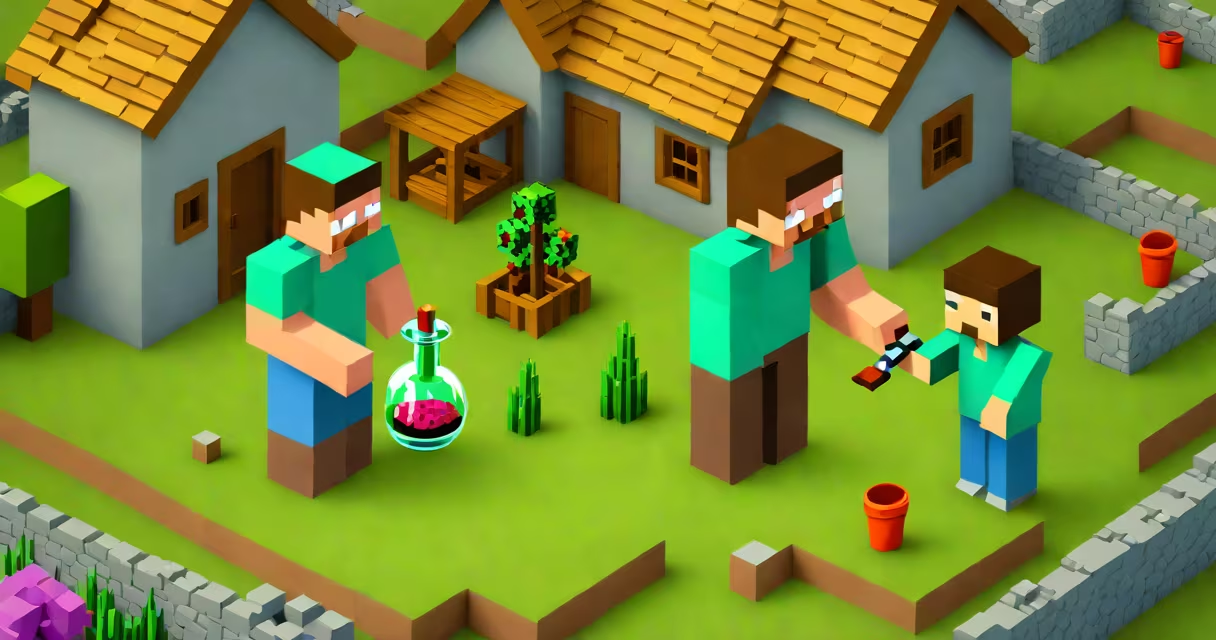
Curing a villager in Minecraft requires turning a zombie villager back into a normal villager using a weakness potion and a golden apple. This process restores their original profession and health.
Zombie villagers appear when a regular villager dies during a zombie invasion or is struck by lightning. They retain their original job site and trade options once cured. The transformation happens instantly upon applying the correct items.
The cure takes 10 seconds of continuous effect. During this time, the zombie villager emits red particles and turns back into a human form. Afterward, they return to their village and resume trading.
Minecraft uses a specific mechanic to reverse the zombie transformation. A zombie villager is not simply a hostile mob-it's a corrupted version of a living villager. The game tracks this state through a hidden status flag.
To reset it, players must apply a potion of weakness (duration 1 minute) and then feed the zombie villager a golden apple. Both items must be used in sequence. The weakness effect reduces the zombie's resistance to the healing properties of the golden apple.
If either step is skipped, the cure fails. The potion must be applied directly to the zombie villager. Using a splash or lingering version won't work unless it hits the target precisely.
You need two key items: a potion of weakness and a golden apple. The potion can be crafted using a water bottle, a nether wart, and a wither rose. The golden apple is obtained by placing an apple and gold ingots in a crafting table.
Golden apples are rare and require 8 gold ingots and 1 apple. They're not available in survival mode until you find a woodland mansion or trade with wandering traders. Players often stockpile them for emergency use.
For efficiency, prepare a dispenser setup with a hopper feeding a chest containing potions and golden apples. This allows automated curing in large villages.
| Item | Source | Quantity Needed |
|---|---|---|
| Potion of Weakness | Crafting (water bottle + nether wart + wither rose) | 1 |
| Golden Apple | Crafting (apple + 8 gold ingots) | 1 |
| Iron Bars (optional) | Crafting (iron ingots) | 16 |
Using iron bars to build a containment pen prevents the zombie villager from escaping during the cure. This is especially useful in multiplayer servers where mobs can spawn nearby.
Players often fail because they use a regular apple instead of a golden apple. Regular apples heal health but do not trigger the cure. The golden apple is essential because it contains the unique "regeneration" property needed to restore the villager's identity.
Another error is applying the potion after the golden apple. The order matters: weakness first, then the apple. If reversed, the game ignores the sequence and the cure doesn't activate.
A third mistake is assuming that a zombie villager can be cured without a potion. Some players try to use a healing potion or a bed. These do nothing. Only the combination of weakness and golden apple works.
In a survival world, I encountered a village with five zombie villagers after a raid. I had 12 golden apples stored from previous raids and crafted 10 potions of weakness. I set up a 3x3 pen using cobblestone and iron bars.
I used a dispenser to launch the potion into the center of the pen. Once the zombie villager was affected, I fed it a golden apple manually. The transformation took exactly 10 seconds. Red particles swirled around it, and it stood up as a normal villager.
After curing all five, I rebuilt the village's blacksmith and farmer shops. The new trades were unlocked automatically. One villager even offered a rare enchanted book for 10 emeralds.
Curing a villager is not the same as healing a regular zombie. Zombies dropped by skeletons or spawners cannot be turned into villagers. Only zombie villagers-those who were once regular villagers-can be restored.
Some players think that a zombie villager can be cured by sleeping near it or using a beacon. Neither works. The game does not recognize those actions as part of the curing process.
Another confusion is believing that the cure affects other mobs. It does not. A zombie pigman or a husk cannot be turned into a villager. The mechanic applies exclusively to zombie villagers.
Restoring a villager increases your village's population cap and unlocks new trades. Each profession adds value: clerics offer enchanted books, farmers provide food, and weaponsmiths sell tools.
According to Mojang's official documentation, the cure system was introduced in Java Edition 1.12 to encourage long-term village management. Without it, players would lose access to advanced trades and village-specific rewards.
As noted in the Minecraft Wiki, the cure process is deterministic-every time the conditions are met, the result is consistent. There are no random failures or luck-based outcomes.
For players building large farms, automating the cure process improves efficiency. Redstone systems can detect zombie villagers and trigger dispensers to apply the potion and apple.
While curing a villager involves a specific ritual, other in-game healing methods exist. For example, a toothache cure requires a sugar cube and a healing potion, while gastric issues are treated with a fermented spider eye and milk.
These systems follow similar logic: specific ingredients, correct order, and precise application. Understanding one helps you grasp the others.
Each system reflects Minecraft's design philosophy: predictable outcomes based on clear rules. No hidden variables. No arbitrary failure states.
Knowing how to cure a villager gives you control over your village's economy and growth. It's not just about restoring a mob-it's about reclaiming a functional community.