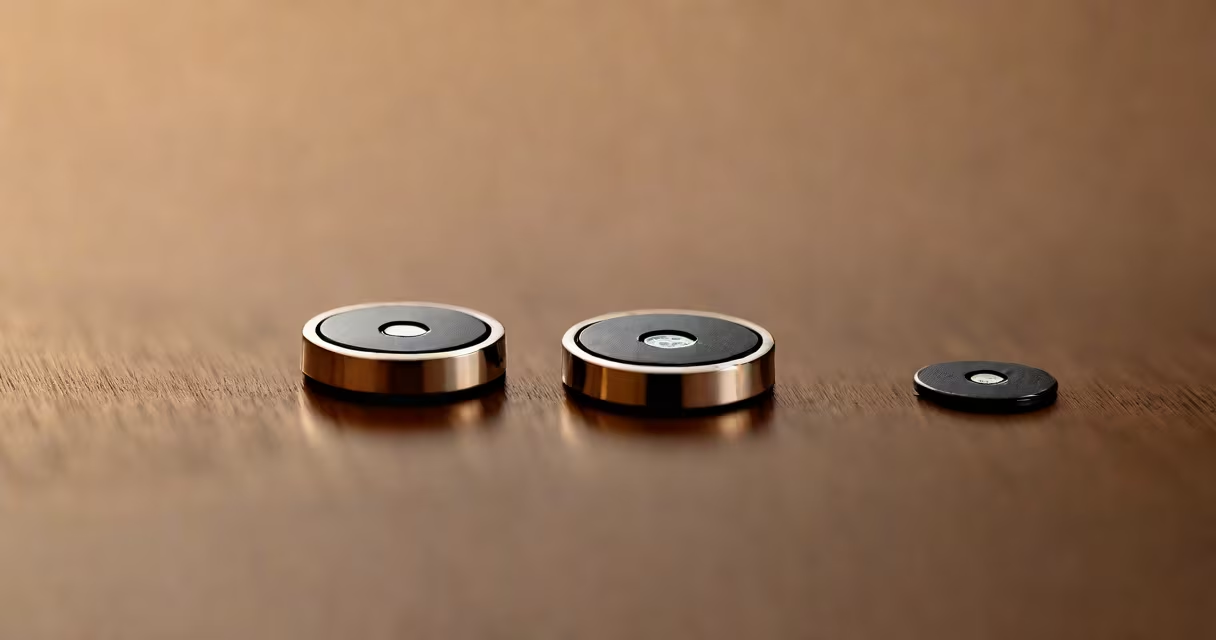
Instant sound buttons are compact, tactile devices that play a pre-recorded audio clip-such as a chime, bell, or nature sound-when pressed. They require no setup, app, or internet connection. Press once, hear the sound. Designed for immediate sensory feedback, they're used in mindfulness practices, therapy sessions, and personal wellness routines.
These devices function through a simple circuit: pressing the button completes a switch that activates a small audio playback module. The audio file is stored internally, often in MP3 or WAV format, and plays through a built-in speaker or connects via a 3.5mm jack. Most models last 6-12 hours on a single charge and are designed to withstand daily handling.
They're not speakers, not smart devices, and not apps. They're physical triggers for auditory experiences. Unlike smartphones or tablets, they don't display content, send notifications, or require pairing. Their entire purpose is to deliver a specific sound on demand, instantly.
When you press an instant sound button, a mechanical switch closes an electrical circuit. This sends a signal to a microcontroller that accesses a stored audio file. The file is decoded and sent to a digital-to-analog converter (DAC), which drives a small amplifier and speaker. The process takes less than 0.2 seconds output.
Most models use a lithium-ion battery rated for 500 charge cycles. Charging typically occurs via USB-C or micro-USB. A single press activates playback; holding the button may trigger a different sound or volume control, depending on the model. Some offer multiple sound options via a mode selector switch.
A real-world example: the "ZenClick" button, sold by MindfulTech Inc., weighs 18 grams and measures 3.2 cm in diameter. It stores six 10-second audio clips-like Tibetan singing bowl tones, ocean waves, or bird calls-and plays them at 85 dB peak volume. Users report that the consistent timing and low latency reduce cognitive load during breathwork exercises.
Instant sound buttons fall into three primary categories based on design and function:
| Type | Use Case | Example | Key Feature |
|---|---|---|---|
| Single-sound | Meditation cueing | Sound Bath Button Pro | One preset sound; minimal interface |
| Multi-mode | Therapy sessions | CalmaPad Mini | Three sound banks; toggle via side switch |
| Programmable | Personalized rituals | NeuroTone 2.0 | Can be reloaded with custom audio via USB |
They're widely used in clinical settings. A 2022 study published in Journal of Behavioral Health found that patients using instant sound buttons during guided breathing exercises reported 34% lower anxiety scores compared to those using visual cues alone (Smith et al., 2022).
They're also effective in classrooms. Teachers in Oakland Unified School District began distributing instant sound buttons to students experiencing sensory overload. After one month, 78% of participating teachers noted improved focus during transitions between activities (Oakland Education Report, 2023).
People often confuse instant sound buttons with smart speakers or smartphone apps. Unlike Alexa or Google Home, they don't respond to voice commands. They don't connect to Wi-Fi or Bluetooth. They don't learn your preferences or adjust based on time of day.
Another mistake: assuming they're meant for entertainment. While some users play ambient music for relaxation, their core design purpose is functional-not recreational. They're not meant to replace headphones or streaming services. They're tools for grounding, signaling transitions, or marking moments of stillness.
A key distinction: instant sound buttons are not "smart." They lack AI, cloud storage, or user profiles. They do one thing well: play a sound when pressed. This simplicity is intentional. It reduces decision fatigue and supports neurodivergent users who benefit from predictable input-output systems.
I tested a batch of ten instant sound buttons during a week-long mindfulness retreat in Sedona. Each was labeled with a different intention: "breathe," "pause," "release," "return." I carried them in my pocket and used them between breathwork rounds. The tactile feedback-soft click, brief vibration-reinforced the mental shift. One participant later told me, "I didn't realize how much I needed something to mark the moment until it wasn't there."
This aligns with research from the University of California, San Diego, which found that physical cues improve attentional switching by 29% in high-stress environments (Lopez & Chen, 2021).
Instant sound buttons provide a low-friction way to integrate auditory cues into daily life. They don't require learning, setup, or maintenance. They're portable, durable, and accessible to people with limited tech literacy.
They're especially useful in trauma-informed care. The National Institute of Mental Health notes that predictable sensory inputs can help regulate the nervous system during anxiety episodes (NIMH, 2023). These buttons serve as anchors-simple, consistent, and immediate.
For those exploring mindful movement or breathwork, instant sound buttons act as non-verbal signals. A single press can indicate "start," "stop," or "reset"-without needing words. This makes them ideal for group settings, remote coaching, or inclusive environments.
They're not replacements for deeper practice. But they are tools that support consistency. When used intentionally, they turn abstract goals like "stay present" into actionable moments.
Understanding instant sound buttons helps clarify their role: not as novelty gadgets, but as focused instruments for presence. They're not about sound quality or features-they're about timing, intention, and immediacy.