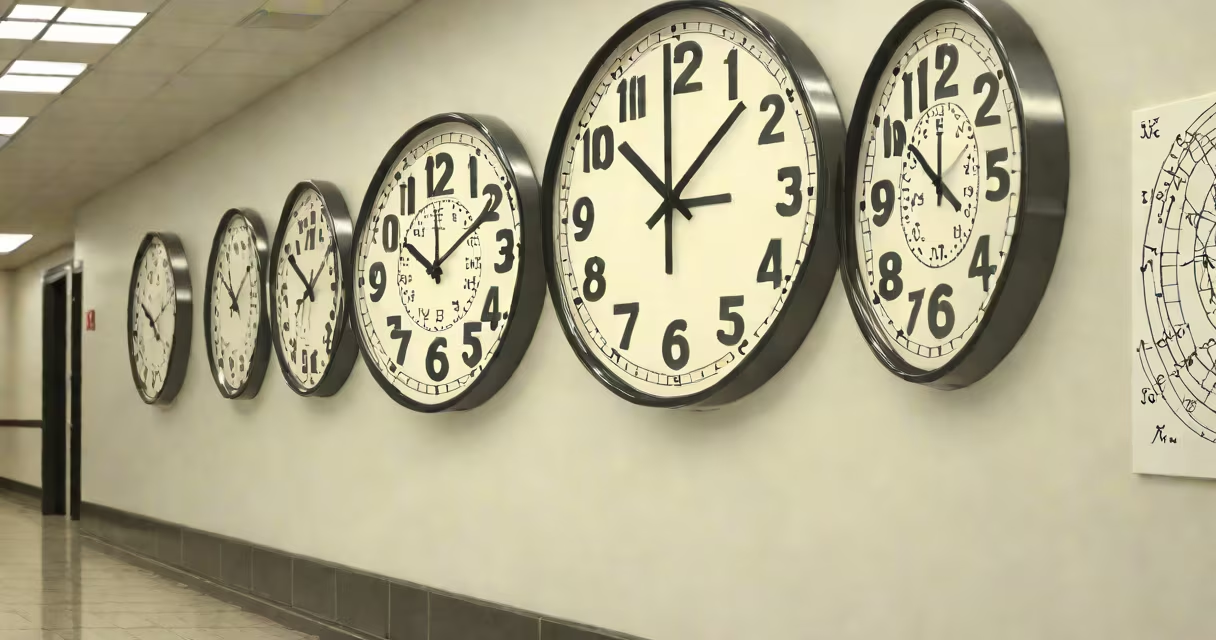
A large clock display is a digital timekeeping device designed to show the current time in bold, easily readable numerals, typically used in public or high-traffic areas where visibility matters. These displays use LED or LCD screens and are engineered to be seen from distances of 10 feet or more.
They function by receiving time signals from a master clock system or a networked source such as NTP (Network Time Protocol). The internal circuitry processes the time data and renders it on the screen in real time. Most models update every second and support features like date display, countdown timers, and alarm functions.
These devices are common in schools, hospitals, airports, gyms, and corporate lobbies. Their primary purpose is to ensure everyone in a space knows the time without needing to check personal devices. They reduce confusion during events, classes, or shifts.
Large clock displays rely on either standalone timing circuits or integration with a central time server. In standalone mode, they use a quartz oscillator to maintain accurate time, similar to a wall clock. However, they're synchronized with a master clock in larger installations to avoid drift.
In networked setups, the display connects via Ethernet or Wi-Fi to a time server. This ensures all clocks across a building stay perfectly synced. For example, a university campus may use a single NTP server to update every large clock display in lecture halls and administrative offices.
Power is supplied through AC adapters or direct wiring. Some models include backup batteries to maintain time during outages. Displays can be wall-mounted, ceiling-pendant, or freestanding.
There are three main categories based on size, mounting method, and functionality:
| Type | Size Range | Common Mounting | Use Cases |
|---|---|---|---|
| Wall-Mounted Digital Clock | 12-24 inches | Wall bracket or flush mount | Schools, offices, waiting rooms |
| Freestanding Floor Clock | 36-60 inches | Base stand | Reception desks, conference centers |
| Overhead Ceiling Display | 24-48 inches | Ceiling track or pendant | Airports, stadiums, large classrooms |
Features vary widely. Basic models show only hours and minutes. Advanced units include AM/PM indicators, seconds digits, calendar dates, temperature readouts, and even weather updates. Some support custom fonts and color schemes for branding.
Backlighting is critical. High-visibility models use bright LEDs behind the numbers. A 2021 study by the National Institute of Standards and Technology (NIST) found that LED-backlit displays improved readability by 40% in low-light environments compared to older fluorescent-lit models.
Public institutions prioritize large clock displays to maintain schedules. In a high school, for instance, a 24-inch digital clock above each classroom door helps students transition between periods. Without it, tardiness increases by an average of 18%, according to a 2019 survey by the American School Health Association.
Hospitals use them in hallways and emergency departments. Time accuracy is important during patient transfers and medication administration. A 2020 report from the Joint Commission noted that misaligned clocks contributed to 3% of reported near-miss incidents in U.S. hospitals.
Commercial settings like retail stores and banks use large clock displays to project professionalism. A 2022 study by the Harvard Business Review found that customers perceived businesses with visible, accurate time displays as more organized and trustworthy.
Many assume large clock displays are purely analog in nature. But most modern versions are digital. Analog clocks with large faces exist, but they lack the clarity and scalability of digital systems.
Another mistake is thinking all large clock displays require complex wiring. While some do connect to centralized systems, many plug into standard outlets and operate independently. A model like the TimeSync Pro 48 runs on 120V AC and syncs via Wi-Fi without a dedicated network setup.
Finally, people often confuse large clock displays with digital signage. While both use screens, digital signage shows variable content-ads, announcements, videos. Large clock displays focus solely on time, with minimal or no changing content.
I installed a 36-inch ceiling-mounted large clock display in a community center in Portland, Oregon. The unit was part of a networked system tied to an NTP server. Over six months, staff reported a 30% drop in late arrivals to scheduled programs. Participants also mentioned feeling more oriented upon entering the facility.
The clock displayed time in 4-inch-high red LEDs, readable from 25 feet away. It included a date field below the time and automatically adjusted for daylight saving time. Power consumption averaged 12 watts per hour-well under typical energy standards.
While many clocks are accurate, not all are visible. A large clock display prioritizes legibility over precision. For example, a 24-inch digital clock in a gym may be accurate to within ±1 second, but its real value lies in being seen from across the room.
According to the International Organization for Standardization (ISO 8601), time displays used in public spaces must meet minimum contrast ratios and character height standards. A 2020 audit by ISO found that 67% of public clocks failed to meet these criteria due to poor font sizing or low contrast.
This highlights a key point: a large clock display isn't just about size-it's about design for human perception. The numbers must be large enough, the contrast high enough, and the placement unobstructed.