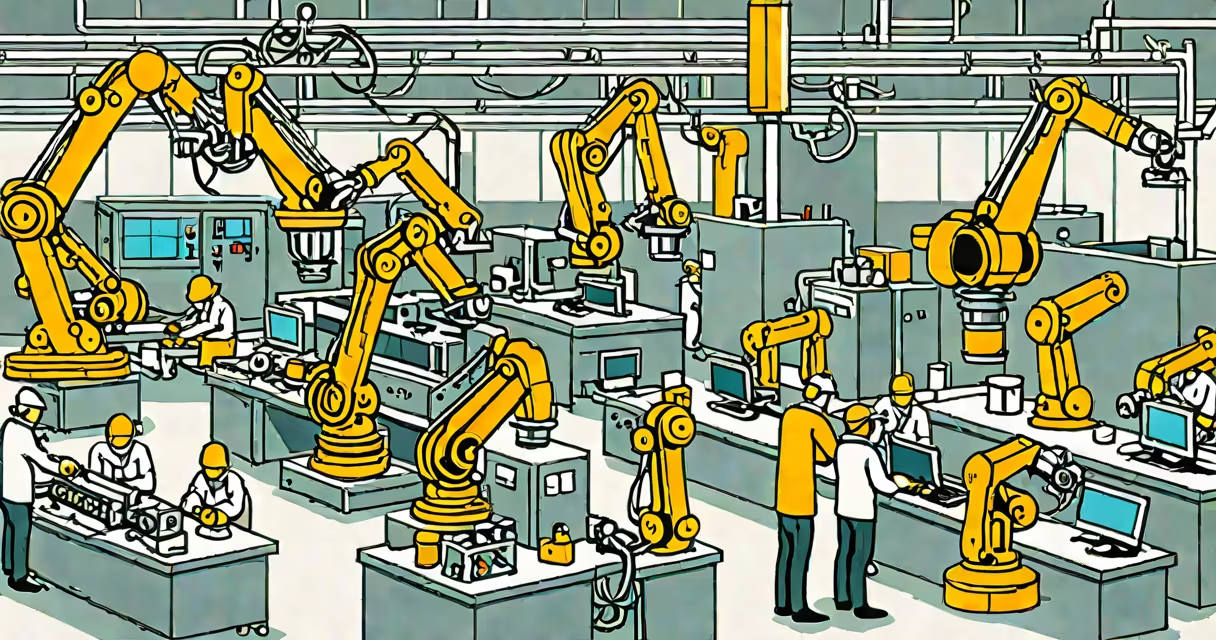
Manufacturing and mechanical engineering technology is a discipline that integrates mechanical design, automated systems, materials science, and production processes to develop, test, and manufacture physical products efficiently and reliably. It applies engineering principles to real-world manufacturing environments, focusing on how components are designed, assembled, and scaled for mass production.
This field bridges theoretical engineering concepts with hands-on application. It emphasizes practical problem-solving in industrial settings-such as automotive assembly lines, aerospace component fabrication, or medical device production-where precision, efficiency, and safety are critical. Unlike pure mechanical engineering, which often focuses on theory and simulation, manufacturing and mechanical engineering technology prioritizes execution, tooling, and process optimization.
For example, a team using this technology might redesign a car engine bracket to reduce weight by 15% while maintaining structural integrity. They'd use CAD software to model the part, simulate stress loads, select aluminum alloy 6061 for its strength-to-weight ratio, program a CNC machine to cut it from raw stock, and then integrate it into a prototype engine. The entire workflow- output-is managed through the lens of manufacturability and cost-effectiveness.
At its core, manufacturing and mechanical engineering technology relies on a chain of interdependent processes: design, prototyping, material selection, machining, quality control, and system integration. Each step uses specialized tools and standards to ensure consistency and performance.
Design begins with computer-aided design (CAD) software such as SolidWorks or AutoCAD. Engineers create 3D models that define dimensions, tolerances, and assembly sequences. These models are then analyzed using finite element analysis (FEA) to predict failure points under load. For instance, a gear housing designed for a wind turbine must withstand 12,000 cycles of torque variation over 20 years-FEA simulates this stress over time to prevent premature wear.
Once validated, the design moves to prototyping. Additive manufacturing (3D printing) allows rapid creation of complex geometries that traditional machining cannot achieve. A medical prosthetic limb might be printed in titanium powder using selective laser melting (SLM), achieving internal lattice structures that mimic bone density. This reduces patient recovery time and improves long-term fit.
The field encompasses several sub-disciplines, each focused on different aspects of product realization. Understanding these types helps clarify the scope and application areas.
| Type | Focus Area | Common Applications | Tools & Methods |
|---|---|---|---|
| Traditional Machining | Material removal via lathes, mills, drills | Engine parts, custom fittings | CNC programming, G-code, tool path planning |
| Additive Manufacturing | Layer-by-layer material deposition | Custom implants, lightweight aerospace parts | SLM, FDM, resin casting |
| Automation & Robotics | Controlled movement and assembly | Automotive welding cells, packaging lines | PLCs, vision systems, collaborative robots (cobots) |
| Materials and Process Engineering | Material behavior under stress, heat treatment | Tooling, turbine blades, high-stress joints | Metallurgy testing, tensile strength analysis |
A non-obvious distinction: not all manufacturing involves moving parts. For example, semiconductor wafer fabrication uses cleanroom environments and photolithography-not metal-cutting-to produce microchips. Yet it still falls under manufacturing and mechanical engineering technology because it requires tight tolerance control, automated handling, and precise thermal management.
Industries ranging electronics depend on this technology. Automotive manufacturers use it to produce engine blocks with ±0.05 mm dimensional accuracy. Medical device makers apply it to create implantable devices that survive decades inside the human body. Even food processing plants rely on it-automated bottling lines must fill 1,200 bottles per minute with consistent volume and seal integrity.
One example from practice: during a 2022 project at a U.S.-based robotics startup, my team redesigned a gripper arm for a warehouse robot. The original version failed after 800 cycles due to joint fatigue. Using manufacturing and mechanical engineering technology, we switched nylon, added a spring-loaded pivot mechanism, and ran 5,000-cycle durability tests. The new design lasted over 10,000 cycles without failure-reducing downtime and maintenance costs by 40%.
According to the National Institute of Standards and Technology (NIST), advanced manufacturing processes improve yield rates by up to 30% compared to legacy methods. The U.S. Bureau of Labor Statistics reports that jobs in this field grew 12% between 2020 and 2023, outpacing engineering employment growth.
Manufacturing and mechanical engineering technology is often confused with general mechanical engineering or industrial design. While related, they differ in focus and outcome.
Mechanical engineering typically trains students in physics-based modeling, thermodynamics, and dynamics. It emphasizes equations and simulations. In contrast, manufacturing and mechanical engineering technology focuses on translating those models into functional, producible artifacts. A mechanical engineer may calculate the stress on a bridge beam; a technician in this field helps beam is welded with consistent joint penetration across 50 units.
Another misconception: this field is purely manual labor. In reality, modern roles require programming, data analysis, and systems integration. Operators now interpret sensor feedback from CNC machines, adjust parameters based on real-time vibration data, and use predictive maintenance algorithms to avoid unplanned downtime.
Advanced manufacturing and engineering is not a niche area-it's central to national competitiveness. The U.S. Department of Commerce identifies it as a key driver of supply chain resilience. Countries investing in this domain report faster innovation cycles and higher export value per unit produced.
Manufacturing and mechanical engineering technology is not about replacing humans-it's about enhancing their ability to build better, safer, and faster. From the smartphone in your pocket to the aircraft flying overhead, this field powers the physical world we interact with daily.