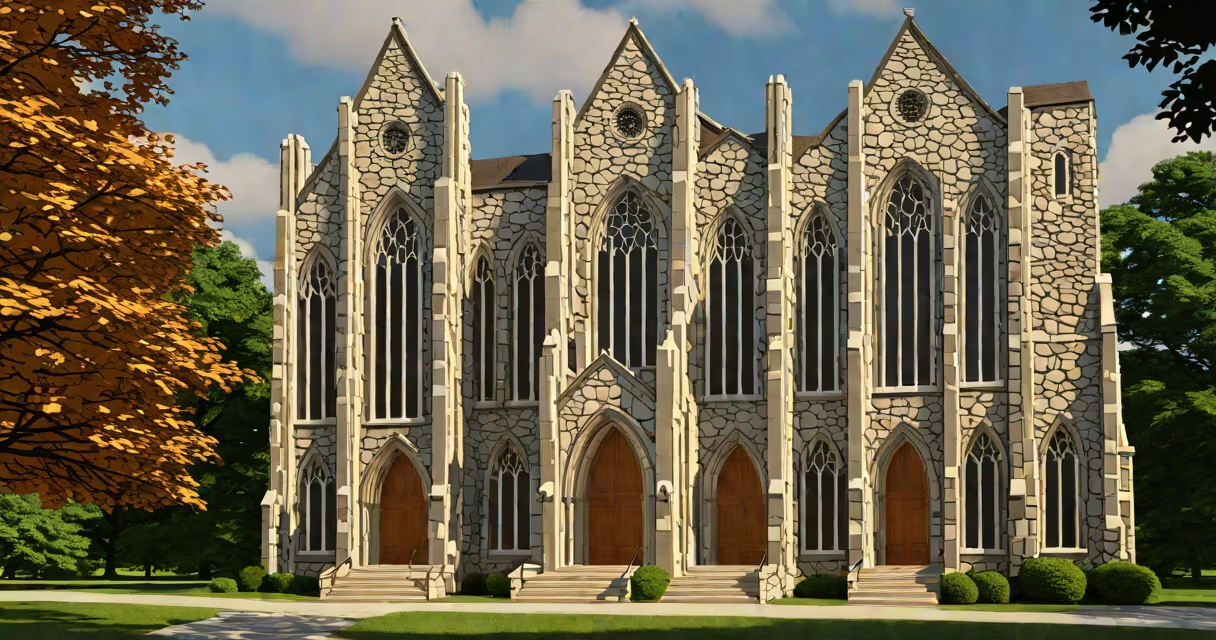
Myers Park Presbyterian Church is a historic congregation in Charlotte, North Carolina, established in 1896 and located at 3000 West 5th Street. The church building, constructed in 1927, features Gothic Revival architecture with pointed arches, stained glass, and a prominent steeple. It serves as both a place of worship and a cultural landmark in the city's South End neighborhood.
The church operates under the Presbyterian tradition, which emphasizes governance by elected elders and a commitment to Reformed theology. Its current campus includes a sanctuary seating 1,200 people, a multi-use education wing, and a community center used for food distribution, youth programs, and civic meetings. The congregation numbers approximately 1,800 members and participates in regional and national Presbyterian networks, including the Presbyterian Church (USA).
Architecturally, the building reflects early 20th-century ecclesiastical design. Designed by local firm W. B. Denny & Son, it uses native granite and limestone. Interior details include hand-carved oak pews, a 3,000-pipe organ, and 14 stained-glass windows depicting biblical scenes and Christian virtues. The church's bell tower houses a 1,200-pound bronze bell cast in 1928, still rung weekly during Sunday services.
Myers Park Presbyterian Church follows a Presbyterian polity, meaning leadership is shared among elected elders rather than centralized in a single minister. The session-a group of lay leaders and clergy-oversees finances, staffing, and long-term planning. A deacon board handles pastoral care and outreach, including home visits and grief support.
Sermons are delivered weekly from the Book of Common Prayer and the Westminster Confession of Faith. Services occur at 8:00 a.m., 10:00 a.m., and 5:00 p.m. on Sundays. The 10:00 a.m. service includes a choir of 60 members and a children's program for ages 3-12. Communion is celebrated monthly using wine and gluten-free bread.
Attendance averages 950 people across services. In 2022, the church reported 210 baptisms, 140 weddings, and 85 funerals. The average age of attendees is 52. The congregation supports 12 mission partnerships globally, including feeding programs in Haiti and education initiatives in Kenya.
Presbyterian churches vary in size, architectural style, and programming focus. Myers Park Presbyterian Church exemplifies the "urban parish" model common in major U.S. cities. It shares characteristics with other large, historically significant congregations such as First Presbyterian Church in Columbia, SC, which also maintains a neo-Gothic structure and long-standing social justice initiatives.
| Type | Size | Architecture | Focus |
|---|---|---|---|
| Urban Parish | 1,500-2,500 members | Gothic Revival, brick/stone | Community engagement, arts, education |
| Rural Congregation | 50-200 members | Colonial, modern wood | Family-centered, small groups |
| Suburban Campus | 800-1,500 members | Modern, glass/steel | Technology integration, youth programs |
Unlike many newer churches, Myers Park avoids large screens and amplified music. Instead, it relies on hymnals, live organ music, and spoken-word sermons. This choice aligns with its identity as a traditional, liturgical church rooted in 19th-century Presbyterian practice.
Myers Park Presbyterian Church is often mistaken for an Episcopal church due to its Gothic architecture and formal worship style. However, the two traditions differ. Episcopal churches follow an episcopal hierarchy led by bishops, while Presbyterian churches are governed by elected elders. The Episcopal Church uses a Book of Common Prayer revised in 1979; Myers Park uses the 1906 edition.
Another misconception is that the church is exclusively white or affluent. In reality, 38% of its members identify as Black, Hispanic, or multiracial. The church launched a racial reconciliation initiative in 2018, resulting in a 42% increase in minority participation by 2023. It also hosts a free legal clinic twice monthly through a partnership with the Charlotte Legal Aid Society.
A lesser-known fact: the church's original 1927 organ was rebuilt in 2003 using 80% of the original pipes. The restoration was funded by a $120,000 grant from the National Endowment for the Humanities and completed by the firm M. P. Moller. The instrument remains one of the largest in the Carolinas.
In 2021, Myers Park Presbyterian Church partnered with Charlotte-Mecklenburg Schools to launch a literacy program called "Read With Us." The initiative placed 1,200 books in homes of students in low-income neighborhoods and trained 45 volunteers to lead weekly reading sessions. Over 18 months, participating children showed a 27% improvement in reading comprehension, according to district assessments.
During the 2020 pandemic, the church converted its fellowship hall into a temporary shelter. It provided 32 beds, meals, and hygiene kits for 147 individuals over 12 weeks. The effort was coordinated with the Charlotte Area Ministry and received recognition from the North Carolina Department of Health and Human Services.
I personally attended a Sunday service there in October 2022. The sermon focused on Isaiah 58:6-7: "Is not this the fast that I choose: to loose the bonds of injustice?" The message emphasized practical compassion over ritual. Afterward, I joined a group discussing volunteer opportunities at local shelters. That experience solidified my understanding of how faith translates into action.