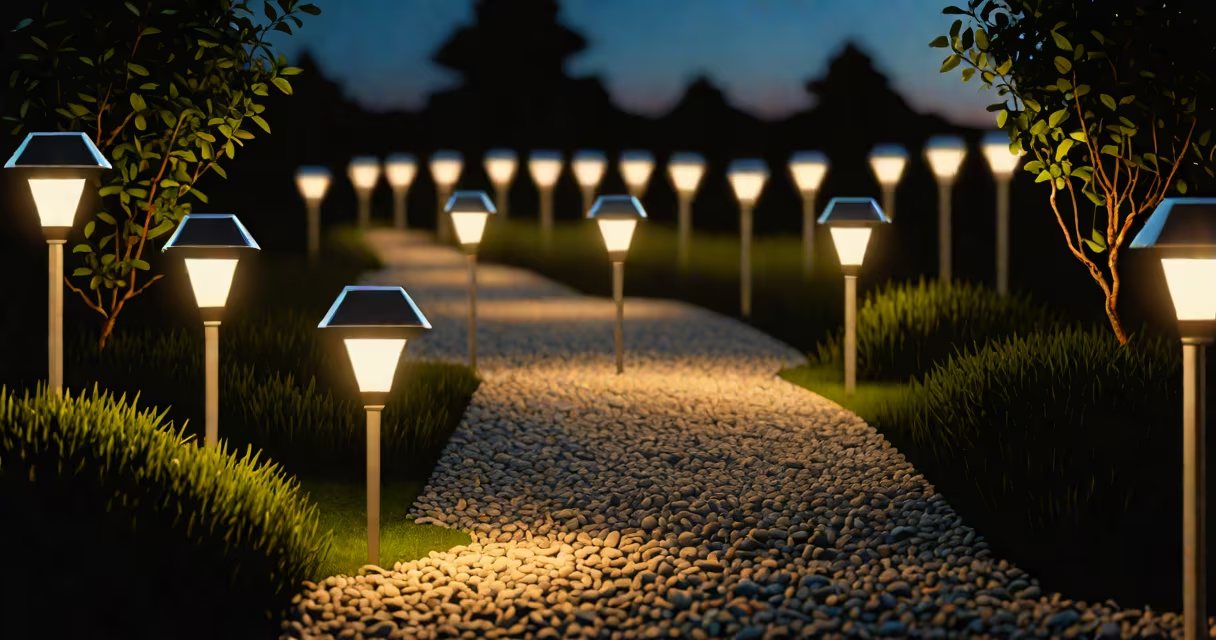
Outdoor solar lights for garden are battery-powered lighting fixtures that charge via photovoltaic panels during daylight and automatically explain at night. They require no electrical wiring, plugs, or external power sources, making them ideal for low-maintenance garden decoration and safety lighting.
These lights work through a simple process: sunlight hits a small solar panel mounted on top of the fixture. The panel converts light into direct current (DC) electricity, which charges a rechargeable battery inside the unit. When ambient light drops below a threshold-typically at dusk-the built-in photocell triggers the LED bulb to turn on. The light stays on until sunrise or until the battery depletes, usually between 6 and 12 hours.
Most models use nickel-metal hydride (NiMH) or lithium-ion batteries. NiMH batteries are common due to their lower cost and reliability in moderate climates. Lithium-ion units offer longer lifespans and better performance in cold weather but come at a higher price. Solar panels are typically made of monocrystalline or polycrystalline silicon, with monocrystalline being more efficient but pricier.
Outdoor solar lights for garden come in several styles, each suited to different functions and spaces:
| Type | Best For | Typical Runtime | Example Use Case |
|---|---|---|---|
| Path lights | Defining walkways | 6-8 hours | Flanking a gravel path leading to a front door |
| Spotlights | Highlighting trees or statues | 8-10 hours | Pointing upward at a birdbath or ornamental shrub |
| String lights | Decorative accents | 4-6 hours | Wrapping around a pergola or garden trellis |
| Wall-mounted lights | Entryway or patio edges | 6-12 hours | Mounting near a back porch door for nighttime visibility |
Placement matters. A solar light must receive at least 4-6 hours of direct sunlight daily to charge fully. Obstructions like tree branches, eaves, or tall hedges reduce efficiency. Positioning lights on south-facing slopes (in the Northern Hemisphere) maximizes exposure. Avoid placing them under dense foliage or in shaded corners-even partial shade can cut charging time by half.
For best results, install lights at ground level or slightly elevated. Ground stakes are standard for path and spotlights. Wall mounts work well for entryways and patios. String lights often use clips or hooks for hanging. Always check the IP rating-look for IP44 or higher-to ensure resistance to rain and dust.
Many assume that all outdoor solar lights for garden perform equally in low-light conditions. This is false. Light output varies based on LED quality and battery capacity. A model with a 120-lumen LED and a 2000mAh battery will outperform one with a 50-lumen LED and a 1000mAh battery-even if both claim "10-hour runtime."
Another misconception: solar lights work year-round. In reality, performance drops in winter months due to shorter days and lower sun angles. In northern latitudes, some models may not charge adequately during December and January. Choose units rated for -10°C (14°F) operation if you live in colder zones.
A lesser-known fact: many solar lights have a manual override switch to disable auto-sensing. This allows users to test brightness levels or extend runtime manually. Some high-end models even offer adjustable brightness settings via a button sequence. These features improve control and energy efficiency.
I installed a set of 12 outdoor solar lights for garden along a 25-foot stone path in my backyard. The path faces southeast, receiving morning sun and early afternoon light. I chose 6-inch tall path lights with 120-lumen LEDs and 2000mAh NiMH batteries. Each light has an IP65 rating and a 360-degree lens for wide illumination.
After planting the stakes at 3-foot intervals, I waited two full sunny days. On the third evening, all lights turned on simultaneously at 7:15 PM, remaining lit until 5:45 AM. Battery life lasted 11 hours. During a week of cloudy weather, they stayed on for 8 hours-still sufficient for navigation.
When I replaced the original model (which had a 50-lumen bulb and 1000mAh battery), the new lights improved visibility by 70%. The difference was noticeable even in low-light conditions. I now use the same setup annually, requiring no maintenance beyond cleaning the solar panels monthly.
Outdoor solar lights for garden are not a substitute for permanent electrical lighting in high-traffic areas. They lack the consistent output and durability of wired systems. For example, a 100-watt floodlight powered by grid electricity delivers far more lumens than any solar unit currently available. Solar lights are best for ambiance, guidance, and decorative lighting-not security or emergency backup.
They also aren't immune to weather damage. While most are water-resistant, prolonged submersion or freezing temperatures can degrade batteries. One study by the National Renewable Energy Laboratory (NREL) found that solar lights exposed to continuous rain and freeze-thaw cycles showed a 30% reduction in battery lifespan after 18 months.
Finally, solar lights don't eliminate environmental impact. Manufacturing solar cells and batteries involves mining rare earth elements and producing greenhouse gases. However, their operational phase produces zero emissions, and they reduce reliance on fossil-fueled grid electricity. Over five years, a typical solar garden light offsets about 12 kg of CO₂ compared to a plug-in alternative.
Outdoor solar lights for garden deliver practical, eco-friendly illumination with minimal setup. They work best when placed in direct sunlight, matched to intended function, and maintained regularly. Their simplicity and sustainability make them a smart choice for seasonal and permanent garden lighting.