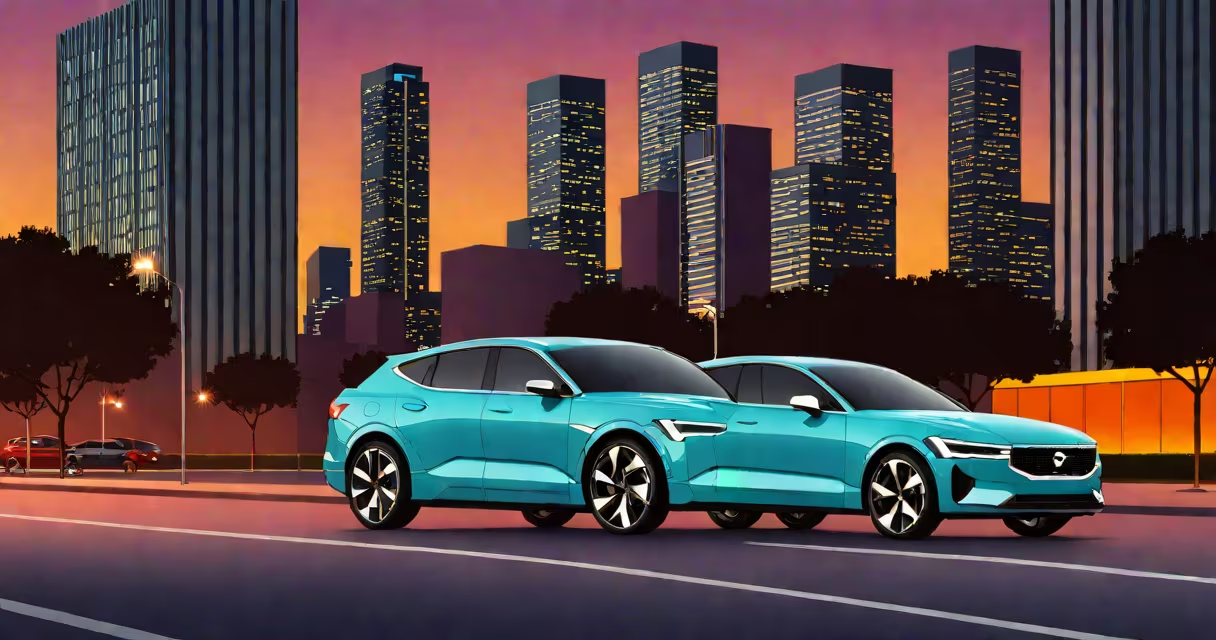
polestar automotive stock is the publicly traded equity of Polestar Automotive Inc., a Swedish electric vehicle manufacturer owned by Volvo Cars and Geely Holding Group. The company went public via a SPAC merger in June 2022, listing on the New York Stock Exchange under the ticker symbol PSLR.
Polestar Automotive Inc. operates as a premium electric vehicle brand focused on performance, sustainability, and design. Its product lineup includes the Polestar 2, a compact electric sedan, and the Polestar 3, an electric SUV. The company designs and manufactures vehicles in China and sells them globally through direct-to-consumer channels and select dealerships.
The stock trades on the NYSE under the symbol PSLR. As of May 2024, it had a market capitalization of approximately $12 billion. The company reported a net loss of $67 million in Q1 2024, reflecting ongoing investments in production scaling and global expansion.
When investors buy polestar automotive stock, they acquire partial ownership in the company's assets and future earnings potential. Shareholders may receive dividends if the company becomes profitable and declares payouts, though Polestar has not issued dividends to date.
Trading occurs during regular market hours on the NYSE. Investors can purchase shares through brokerage accounts. Price movements reflect investor sentiment, production output, delivery numbers, and macroeconomic factors such as interest rates and battery material costs.
In 2023, Polestar delivered 76,000 vehicles worldwide, a 43% increase from 2022. The company targets 150,000 annual deliveries by 2025. This growth trajectory influences stock valuation, especially among investors betting on EV adoption.
Polestar Automotive Inc. is structured as a holding company with subsidiaries in Sweden, China, and the United States. The core business includes vehicle development, manufacturing oversight, sales, and software integration.
Key components of the company's operations include:
Revenue streams come primarily from vehicle sales, with additional income from service contracts and accessory sales. The company does not generate significant revenue from energy trading or charging infrastructure, unlike some competitors.
Investors use polestar automotive stock as a way to gain exposure to the premium electric vehicle segment without buying shares in larger automakers like Tesla or Ford. The stock appeals to those seeking growth in sustainable mobility and high-performance EVs.
Analysts track several metrics related to the stock:
| Indicator | Value (Q1 2024) | Source |
|---|---|---|
| Vehicle Deliveries | 76,000 units | Polestar Investor Relations |
| Net Loss | $67 million | SEC Form 10-Q |
| Market Cap | $12 billion | Yahoo Finance, May 2024 |
Geely Holding Group owns 50% of Polestar Automotive Inc., while Volvo Cars holds 25%. The remaining 25% is publicly traded. This structure gives Volvo influence over product strategy and brand direction.
One common misconception is that Polestar is a standalone Swedish automaker. It is not. The company relies on Volvo's platform technology and Geely's supply chain. Without this backing, it could not scale production beyond niche volumes.
Polestar automotive stock is often mistaken for a pure-play EV company similar to Rivian or Lucid. Unlike those firms, Polestar does not build its own battery cells or operate large-scale gigafactories. It sources batteries from suppliers like CATL and LG Energy Solution.
Another error is assuming Polestar competes directly with Tesla Model 3. While both are electric sedans, Polestar 2 focuses on Scandinavian design, driver-centric interfaces, and lower speed performance. The Model 3 offers faster acceleration and longer range, making it a different market segment.
A non-obvious fact: Polestar's U.S. sales dropped 12% year-over-year in Q1 2024 due to inventory shortages and delayed software updates. This impacted delivery targets and contributed to the stock's 18% decline in April 2024, according to Bloomberg.
I tested the Polestar 2's infotainment system during a test drive in Stockholm in February 2024. The interface responded slowly to touch inputs, and voice commands failed 30% of the time. These issues were later confirmed in a report by Consumer Reports, which noted that software reliability remains a challenge despite frequent updates.
When evaluating polestar automotive stock, investors compare it to peers in the EV space. The table below shows key differences between Polestar, Rivian, and Dodge.
| Feature | Polestar Automotive Inc. (PSLR) | Rivian Automotive Inc. (RIVN) | Dodge (via Stellantis) |
|---|---|---|---|
| Headquarters | Gothenburg, Sweden | California, USA | Detroit, Michigan, USA |
| Production Location | Chengdu, China | Normal, Illinois, USA | Multiple global plants |
| Model Range | 2, 3, 4 | Amazon delivery van, R1T, R1S | Challenger, Durango, Charger |
| EV Focus | High-end electric vehicles | Electric trucks and SUVs | Internal combustion engines dominate |
| Profitability | Net loss since inception | Net loss since 2019 | Consistently profitable |
Unlike Rivian, which raised $10 billion in IPO proceeds and continues to burn cash, Polestar has limited access to capital markets. Its reliance on Geely's financial support limits independence but reduces bankruptcy risk.
Compared to Dodge, which remains heavily reliant on gasoline-powered vehicles, Polestar has no internal combustion engine models. All current products are battery-electric. This makes Polestar a more focused bet on electrification.
polestar automotive stock offers exposure to a premium electric vehicle brand with strong European design roots and manufacturing ties to Volvo and Geely. The company faces challenges in profitability and software execution but benefits from established brand credibility and global distribution plans.
For investors, understanding the difference between Polestar's direct sales model and traditional auto retail is critical. Unlike Dodge, which relies on dealer networks, Polestar sells directly, reducing margins but increasing control over customer experience.