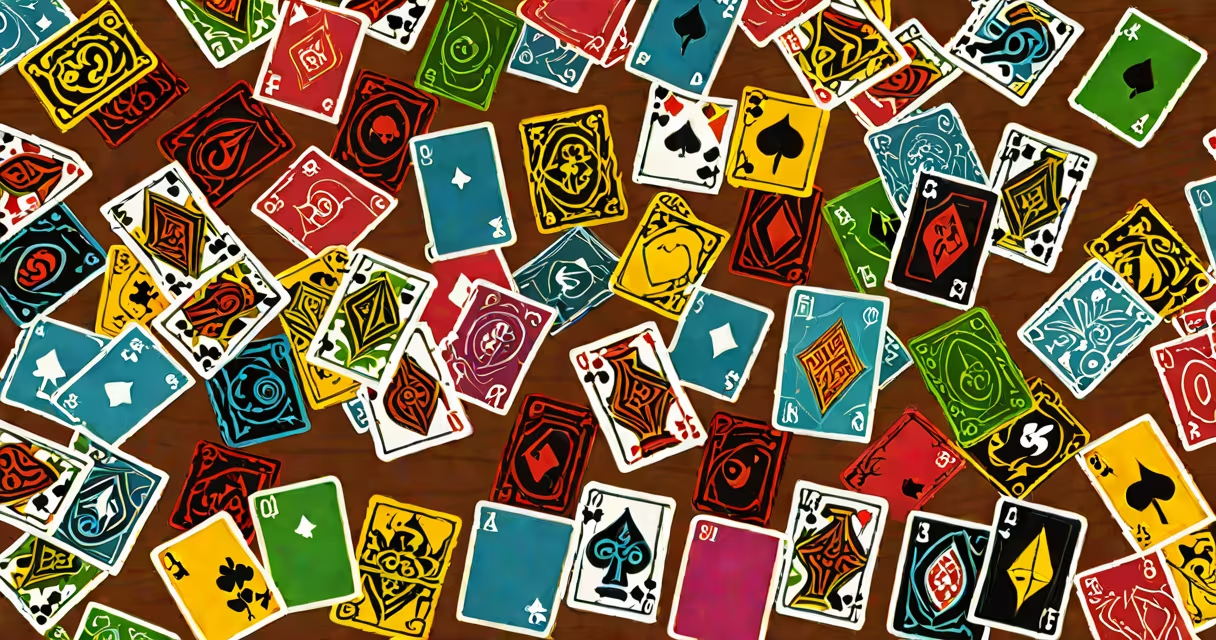
Popular card games are tabletop or digital games using standardized decks of cards to determine outcomes through rules, strategy, and chance. They range from quick social games like Uno to complex competitive formats such as Magic: The Gathering. These games thrive on accessibility, replayability, and shared experiences.
Most popular card games rely on a standard 52-card deck, though some use custom or expanded sets. Gameplay revolves around turn-based actions-drawing, playing, discarding, or trading cards-guided by specific objectives. Winning conditions vary: being the first to discard all cards, accumulating points, or achieving a strategic goal like capturing territory or controlling a game state.
Games like Uno emphasize speed and bluffing, while others such as Set require pattern recognition under time pressure. Competitive titles like Hearthstone and Pokémon Trading Card Game blend digital mechanics with physical card collection systems. All share a core trait: they're easy to learn but hard to master, enabling broad appeal across ages and skill levels.
Each game operates on a set of rules that define card functions, turn structure, and win conditions. For example, in Uno, players match cards by color or number. A wild card allows a player to switch the current color, adding strategic flexibility. When a player has one card left, they must call "Uno"-failing to do so results in a penalty draw.
Other games introduce resource management. In Magic: The Gathering, players build decks of 60 cards, including creatures, spells, and lands. Each turn, players generate mana (a resource) to cast spells. Combat occurs when creatures attack and defend. The game ends when one player reduces their opponent's life total to zero-or achieves a winning condition via a combo.
Some games use hidden information. In Cards Against Humanity, players fill in blanks on black cards using white cards with humorous phrases. The host picks the funniest combination. This design encourages improvisation and social bonding, making it ideal for parties.
Popular card games fall into distinct categories based on mechanics and purpose. The table below outlines major types, their defining features, and representative examples.
| Type | Core Mechanic | Example Games | Player Count |
|---|---|---|---|
| Social/Party | Humor, improvisation, bluffing | Cards Against Humanity, Apples to Apples | 4-10 |
| Strategy/Luck | Matching, sequencing, point scoring | Uno, Skip-Bo, Phase 10 | 2-10 |
| Collectible (CCG) | Deck building, rare cards, progression | Magic: The Gathering, Pokémon TCG | 2 |
| Cooperative | Shared goals, limited resources | Forbidden Island, Pandemic: The Cure | 2-4 |
Not all games labeled "card games" follow the same model. For instance, Set uses a grid of 12 cards with geometric symbols. Players identify sets of three cards where each feature (color, shape, shading, count) is either all the same or all different. This game requires rapid visual processing and pattern recognition, not memory or hand management.
A common misconception is that all popular card games are competitive. That's false. Cooperative games like Forbidden Island require players to work together to escape a sinking island. Each player controls a unique character with special abilities. The group loses if the island sinks completely or if all players are captured. Success depends on communication and shared decision-making, not individual dominance.
These games succeed because they deliver immediate feedback, low entry barriers, and high replay value. A single game of Uno lasts 10-15 minutes. It requires no prior knowledge beyond basic numbers and colors. Yet, the risk of drawing penalty cards creates tension. This balance makes it ideal for casual gatherings.
Collectible card games like Magic: The Gathering have deeper systems. Players spend hours researching card interactions, building decks, and testing strategies. The game supports over 20,000 unique cards. New sets release annually, introducing new mechanics like "flash" or "undying." This constant evolution keeps players engaged long-term.
I once played a multiplayer session of Exploding Kittens with friends who had never touched a card game before. Within five minutes, everyone was shouting "I'm not dying!" during the "explode" phase. The game's absurd humor and simple rules created instant connection. We played six rounds in under an hour. That moment confirmed what research shows: social card games reduce anxiety and increase group cohesion.
According to the American Psychological Association, engaging in light social games improves mood and cognitive function in adults. A 2021 study published in *Computers in Human Behavior* found that participants who played cooperative card games reported higher levels of trust and emotional well-being compared to those who played solo video games.
Many assume that all popular card games are digital. That's incorrect. While apps like Hearthstone and Gwent dominate mobile and PC markets, physical card games remain widespread. Over 10 million copies of Magic: The Gathering were sold in 2023 alone, according to Wizards of the Coast. Physical tournaments still draw tens of thousands of attendees annually.
Another misunderstanding is equating collectible card games with gambling. While both involve acquiring rare items, the key difference lies in ownership and intent. In a CCG, players buy booster packs to collect cards for personal use. There's no financial return on investment. In contrast, gambling involves betting money on uncertain outcomes. Regulatory bodies like the U.S. Department of Justice classify CCGs as games of skill, not chance.
Finally, some confuse "popular card games" with "best card games." Popularity doesn't equal quality. A game may trend due to marketing or viral content but lack depth. Conversely, a lesser-known game like Mysterium offers rich narrative and teamwork mechanics but hasn't reached mass audiences. Popularity reflects reach, not merit.
Understanding what makes a card game popular helps separate fleeting fads from enduring formats. Whether it's the laughter sparked by Cards Against Humanity or the intense focus during a Magic: The Gathering tournament, the appeal lies in shared moments, accessible rules, and meaningful choices. These elements define the category of popular card games.