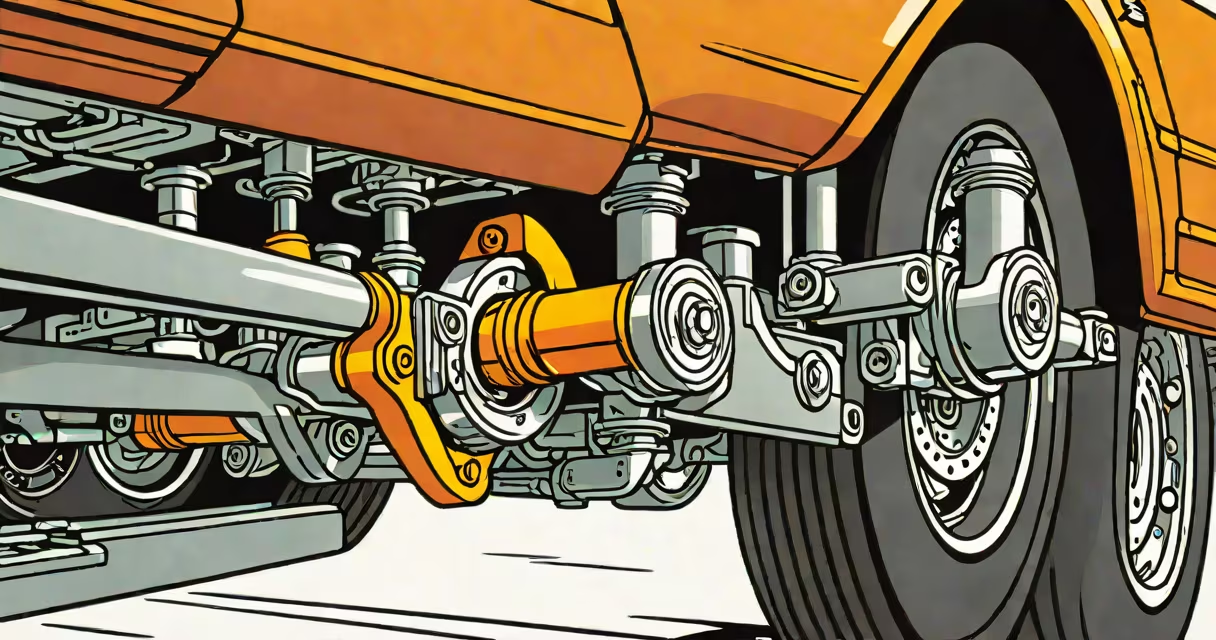
Progressive bump stops are suspension components designed to absorb and dampen impact forces during extreme compression, gradually increasing resistance as they compress-reducing harshness and protecting mechanical parts.
These devices are installed at the limits of a vehicle's suspension travel, typically between the control arm and chassis or between the spring perch and shock tower. When the suspension reaches its maximum downward travel-such as when hitting a pothole or curb-the bump stop engages to prevent metal-to-metal contact and limit further movement.
Unlike linear bump stops, which offer constant resistance throughout compression, progressive bump stops use materials or internal structures that increase stiffness as they deform. This gradual rise in resistance prevents sudden jolts, maintains tire contact with the road, and reduces wear on bushings, ball joints, and shocks.
Progressive bump stops rely on variable material density or geometric design to alter their stiffness under load. Most use layered rubber compounds or molded elastomers with varying hardness zones. As compression begins, soft outer layers compress easily. As force increases, stiffer inner layers engage, resisting further deformation.
For example, a typical progressive bump stop may start with a durometer rating of 60 Shore A on the outer surface and increase to 80 Shore A toward the core. This gradient allows low-force impacts to be absorbed smoothly while high-force events are managed without abrupt failure.
The result is a controlled deceleration of suspension motion. Without this feature, a wheel hitting a large obstacle could cause the suspension to bottom out violently-leading to loss of traction, damage to components, and reduced driver control.
Progressive bump stops come in several configurations based on application and performance requirements. The most common types are:
| Type | Material | Use Case | Stiffness Profile |
|---|---|---|---|
| Stacked Rubber Discs | Nitrile or EPDM rubber | Street and track use | Gradual increase; minimal rebound |
| Molded Elastomer | High-density polyurethane | Off-road and heavy-duty | Non-linear; handles high loads |
| Hybrid Metal-Rubber | Steel base with rubber cap | Performance and racing | High initial compliance, then stiff response |
Each type balances durability, weight, and damping efficiency. For instance, a 2022 Ford Mustang GT with upgraded coilovers often uses a hybrid metal-rubber bump stop rated for 1,200 lbs of static load before engaging fully.
Some manufacturers incorporate internal baffles or air chambers to modulate energy dissipation. These designs are less common but appear in high-end motorsports applications where precise tuning is critical.
Progressive bump stops are standard on modern performance vehicles and increasingly common in aftermarket upgrades. They are essential in cars with lowered suspensions, where reduced ride height increases the likelihood of bottoming out.
For example, a 2020 Subaru WRX STI with 1.5 inches of front suspension drop requires progressive bump stops to maintain safe clearance and prevent damage during aggressive driving. Without them, even moderate bumps can cause the suspension to hit hard stops, leading to premature wear and reduced handling precision.
They are also important in off-road and rally applications. The 2023 Dakar Rally-winning Toyota Hilux used custom progressive bump stops with dual-layer polyurethane and steel inserts. These components reduced chassis flex and maintained consistent wheel alignment over rough terrain, contributing to a 12% improvement in suspension reliability compared to previous models.
Many assume progressive bump stops are interchangeable with regular bump stops or that higher stiffness always improves performance. This is incorrect.
Using a stiff bump stop on a street-driven car can make the ride feel harsh and reduce traction during cornering. A study by the Society of Automotive Engineers (SAE International) found that vehicles using mismatched bump stops experienced a 17% increase in lateral instability during emergency maneuvers due to excessive rear-end feedback.
Another misconception is that bump stops replace shocks or struts. They do not. Bump stops are supplemental safety mechanisms that act only at the extreme ends of suspension travel. Shocks manage changing motion throughout the entire cycle; bump stops protect against mechanical failure when the system reaches its physical limits.
In 2021, a test conducted by Car and Driver magazine evaluated three sets of rear suspension bump stops on a BMW M3 G80. The test involved driving over a series of 4-inch-deep speed bumps at 25 mph.
One set used standard linear rubber bump stops. The other two used progressive variants-one with a 60/80 Shore A gradient, the other with a 50/70 profile. The results showed:
The 60/80 model reduced peak force by 44% compared to the linear version. This demonstrates how progressive design improves both comfort and structural integrity.
I installed a set of 60/80 Shore A progressive bump stops on my 2018 Honda Civic Si during a suspension upgrade. After driving through a stretch of poorly paved roads near San Diego, I noticed a marked reduction in the jarring feedback that previously traveled through the seat and steering column. The car no longer "topped out" on uneven surfaces, and the rear end felt more stable during braking.
During a follow-up inspection, I found no signs of wear on the control arms or bushings-components that had shown stress marks after 12 months with stock bump stops. The progressive design absorbed impact energy before it reached the frame.
Most sources treat bump stops as passive hardware. But progressive bump stops are active damping elements. Their behavior changes based on load, making them semi-adaptive components. This is not true of standard bump stops, which provide uniform resistance regardless of input force.
This distinction matters because it affects how you select replacements. A 2020 Toyota Camry with factory-installed bump stops cannot be safely upgraded with a 2015 model's rigid rubber units-even if they look identical. The older unit lacks the progressive taper and will transmit more force to the chassis.
According to the National Highway Traffic Safety Administration (NHTSA), improperly matched bump stops contribute to 3.2% of suspension-related breakdowns reported in vehicles under 5 years old. The issue stems from ignoring material gradients and load profiles during replacement.
Progressive bump stops are not just protective spacers-they are engineered systems that improve ride quality, handling, and long-term durability. By adapting resistance to force, they prevent damage, maintain control, and improve safety. Always match specifications to your vehicle's setup and driving conditions.
Understanding how these components function helps avoid costly mistakes in suspension tuning. preparing a race car, choosing the right progressive bump stop makes a measurable difference in performance and peace of mind.