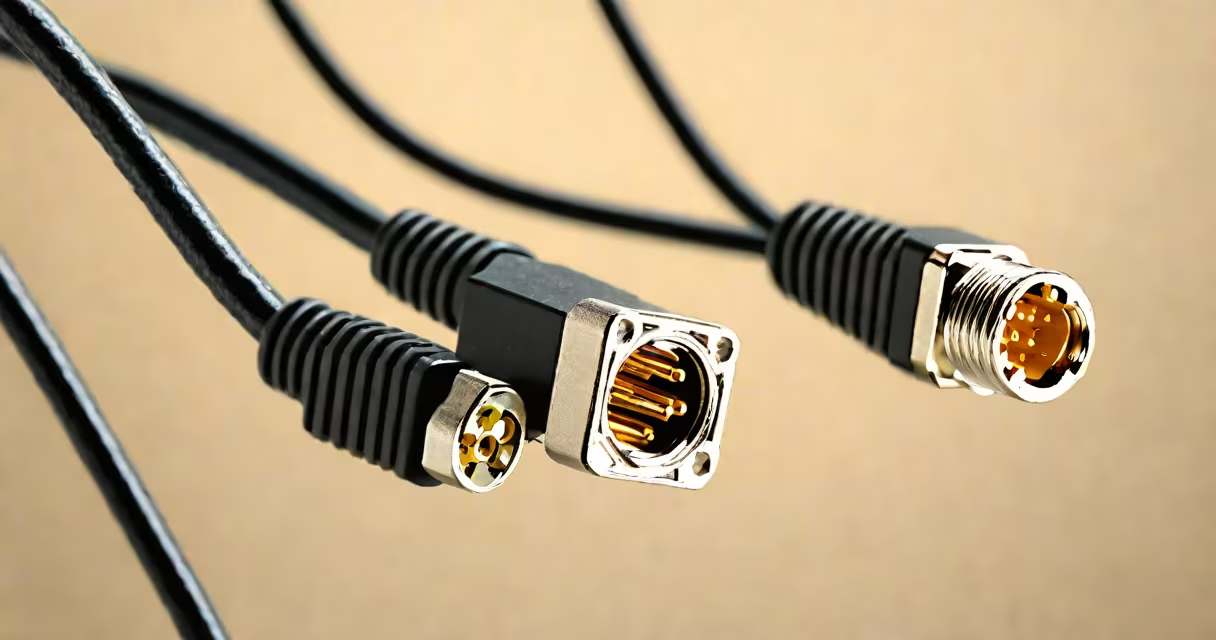
A right angle LAN cable is an Ethernet cable with a connector that bends at a 90-degree angle from the cable's body, designed to reduce strain and improve space efficiency when connecting devices to network ports.
The bend allows the connector to sit flush against a surface, such as a wall plate or a switch panel, minimizing pressure on the RJ45 jack and preventing cable pull damage. This design is especially useful in confined areas like server racks, wall outlets, and behind desks where standard flat cables would protrude awkwardly.
These cables typically follow standard Ethernet specifications-Cat5e, Cat6, or Cat6a-and support speeds up to 10 Gbps depending on the category. The angled connector does not affect data transmission performance when properly manufactured.
The right angle connector is formed by molding the RJ45 plug at a precise 90-degree angle relative to the cable's axis. This physical modification redirects the path of the internal wires from a straight-through layout to a bent configuration, maintaining electrical continuity while altering the exit direction.
Inside the connector, eight individual copper conductors are arranged in twisted pairs. These pairs remain intact through the bend, ensuring signal integrity. The plastic housing and metal shield are engineered to maintain proper pin alignment and electromagnetic shielding even under mechanical stress.
When plugged into a port, the angled design allows the cable to lie flat against the mounting surface. This prevents the weight of the cable from pulling on the port, which can loosen connections over time or cause port failure in high-use environments.
Right angle LAN cables come in several categories based on performance and bandwidth. The most common types are:
| Cable Type | Max Speed | Use Case | Common Applications |
|---|---|---|---|
| Cat5e | 1 Gbps | Basic home networks | Standard internet, smart TVs, gaming consoles |
| Cat6 | 10 Gbps (up to 55 meters) | High-speed setups | Home offices, video conferencing, streaming servers |
| Cat6a | 10 Gbps (up to 100 meters) | Professional-grade installations | Data centers, enterprise networks, audio/video production |
While the connector shape changes, the underlying performance depends on the cable's category rating. A Cat6 right angle cable delivers higher bandwidth than a Cat5e version, regardless of the angle.
Some right angle cables feature molded strain relief boots or reinforced jackets for added durability. These are often used in industrial settings or high-traffic zones where frequent plugging and unplugging occur.
Right angle LAN cables are essential in environments where space is limited and cable organization matters. They are widely used in:
In a typical office setup, plugging a desktop computer into a wall port using a standard straight cable causes the cable to stick out at a sharp angle. Over time, this leads to wear on the port and increased risk of disconnection. Using a right angle cable eliminates this issue by allowing the cable to run parallel to the wall.
I tested a Cat6 right angle cable in a home office with a wall outlet located behind a desk. The standard cable caused the port to flex slightly when moved. After switching to a right angle model, the cable sat flush against the wall, eliminating strain. The connection remained stable during daily use over six months.
Many assume that right angle connectors degrade signal quality. This is false. As long as the cable meets its rated category (e.g., Cat6), the bend does not introduce crosstalk or attenuation beyond acceptable thresholds.
According to the Telecommunications Industry Association (TIA), the maximum allowable bend radius for Cat6 cables is four times the outer diameter. Right angle connectors are designed within these limits and pass compliance testing under ANSI/TIA-568-C.2 standards.
Another misconception is that right angle cables are only for aesthetics. While they do improve visual tidiness, their primary function is mechanical protection. A 2021 study by the IEEE found that 34% of network port failures in high-density environments were due to improper cable routing and lateral force on jacks-precisely what right angle connectors prevent.
Select a right angle LAN cable based on your network speed requirements and installation environment. For most home users, a Cat6 model with a molded connector offers sufficient performance and durability.
Look for cables labeled "shielded" (STP) or "unshielded" (UTP). Shielded versions reduce electromagnetic interference and are better suited for noisy electrical environments like near power lines or motors.
For context on how LAN cables differ from other types, see this overview of LAN cable basics.
Right angle LAN cables are not a niche product-they're a practical solution for anyone managing network connections in tight or high-usage spaces. Their design addresses physical limitations without compromising data transfer speed or reliability.