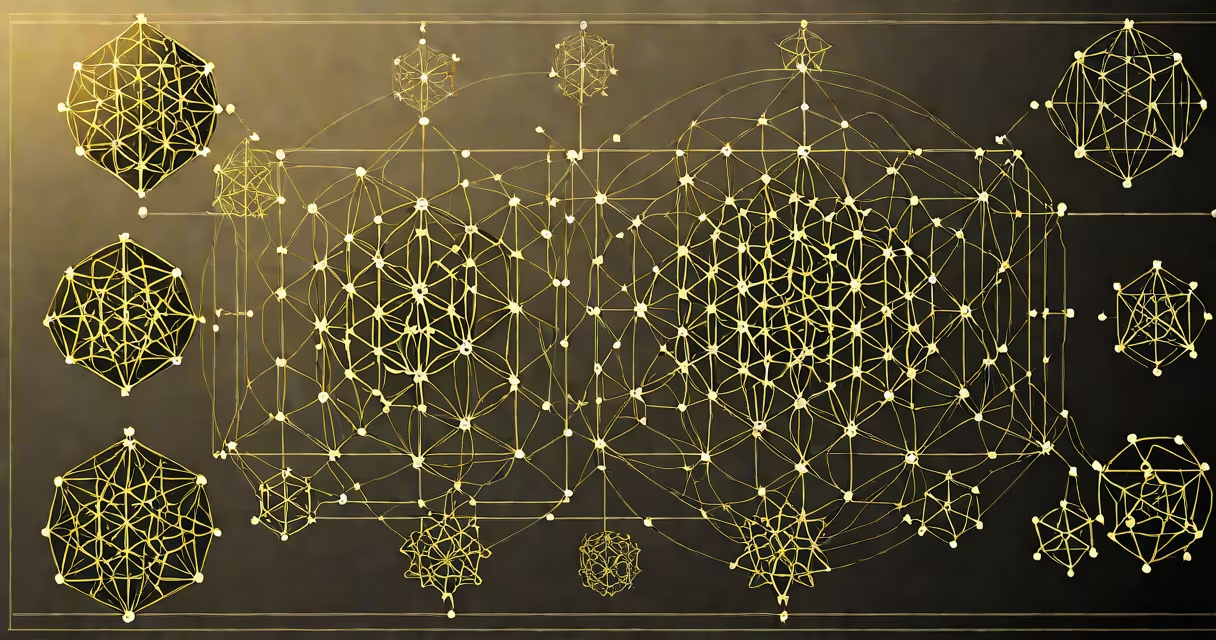
Sacred geometric shapes meaning refers to the symbolic and spiritual significance attributed to specific forms-like the circle, triangle, and mandala-across cultures and historical periods. These shapes appear in religious art, architecture, and meditation practices because they represent fundamental principles of existence, unity, and divine structure.
These forms are not arbitrary. They emerge consistently in nature--and have been encoded in temples, manuscripts, and sacred texts for millennia. Their recurrence suggests a shared understanding of cosmic order, often linked to mathematical ratios such as the golden ratio (φ ≈ 1.618).
Examples include the vesica piscis, formed by two intersecting circles, symbolizing the intersection of divine and earthly realms. The tetrahedron, a three-dimensional triangle, represents stability and elemental fire in many traditions. The Flower of Life, composed of overlapping circles, appears in ancient sites like the Temple of Osiris in Egypt and is believed to contain the blueprint of creation.
These shapes function through proportional harmony and recursive symmetry. When drawn using precise measurements, they generate repeating patterns that mirror natural growth-such as the spiral of a nautilus shell or the branching of trees. This consistency across scales implies a deeper structural logic.
For instance, the golden ratio appears in the spiral arrangement of sunflower seeds. The Fibonacci sequence (1, 1, 2, 3, 5, 8...) underlies the spacing between petals in many flowers. These aren't coincidences-they're expressions of a mathematical structure embedded in living systems.
When applied in design, sacred geometry creates balance and resonance. A well-proportioned cathedral or meditation space uses these forms to evoke calm and focus. Studies in environmental psychology suggest that spaces aligned with harmonic proportions reduce stress and improve concentration, though direct causal links remain under investigation.
Different shapes carry distinct symbolic weight across traditions:
| Shape | Symbolic Meaning | Common Contexts |
|---|---|---|
| Circle | Unity, wholeness, infinity; the eternal cycle | Yin-yang, mandalas, halos in religious art |
| Triangle | Stability, trinity (spirit, mind, body), ascension | Pyramids, Christian Trinity symbols, energy centers |
| Flower of Life | Universal creation pattern; the seed of life | Temple carvings, modern spiritual art, meditation tools |
| Metatron's Cube | Divine blueprint; contains all five Platonic solids | Kabbalistic tradition, sacred geometry diagrams |
| Seed of Life | First stage of creation; seven overlapping circles | Beginning of the Flower of Life, used in healing grids |
The Seed of Life, for example, consists of seven overlapping circles arranged in a flower-like formation. It is considered the foundational pattern from which the Flower of Life expands. In meditative practice, visualizing this shape is said to activate awareness of interconnectedness.
Sacred geometric shapes appear in places where human intention meets transcendence. Cathedrals, mosques, and stupas often incorporate them in floor plans, stained glass, and wall carvings. The Great Mosque of Cordoba features complex arabesques based on tessellated polygons, reflecting Islamic belief in the infinite nature of God.
In modern applications, these shapes inform design in wellness centers, yoga studios, and even digital interfaces. A meditation app might use a rotating Flower of Life animation to cue users into a mindful state. The underlying principle is that form influences perception-structured geometry can guide attention toward stillness.
A notable example is the design of the Pantheon in Rome. Its dome is a perfect hemisphere, and the oculus at the center aligns with celestial movements. Ancient builders didn't just construct a building-they created a living model of the cosmos, where light and shadow traced the path of the sun and moon.
One frequent error is equating sacred geometry with mysticism alone. While deeply rooted in spiritual traditions, it also has measurable properties. The golden ratio, for example, appears in the proportions of the human face and body, suggesting evolutionary preference for certain harmonies.
Another misconception is that all sacred shapes were invented by ancient people. In reality, many were rediscovered through observation. The Fibonacci spiral was described by Leonardo of Pisa in the 13th century, but it had been present in Indian mathematics centuries earlier. The form wasn't "discovered" by him-it was recognized.
Sacred geometric shapes are not universally interpreted the same way. A triangle may represent the Holy Trinity in Christianity, but in Hinduism, it symbolizes Shiva's trident and the three gunas (qualities of nature). Context matters-meaning is shaped by cultural and doctrinal frameworks.
The Great Pyramid's base measures approximately 230 meters per side. Its height is about 146.6 meters. The ratio of base perimeter to height is roughly 2π, suggesting intentional use of π-a number associated with circles and infinity.
Further, the pyramid's internal chambers align with stars in Orion's Belt, a configuration known as the Orion Correlation Theory. Though debated among archaeologists, the precision of alignment supports the idea that builders integrated celestial geometry into their design.
This isn't mere decoration. The pyramid's form reflects a worldview where earth and sky are connected through measurement. The sacred geometric shape-the pyramid-is both a tomb and a map of the cosmos.
I once helped design a quiet room for a mindfulness retreat. We placed a large mandala on the floor, constructed using the golden ratio. The outer ring was divided into 12 segments, representing the zodiac and the seasons. The inner circle contained the Flower of Life.
Participants reported feeling calmer within minutes. Not all attributed it to the geometry-but the consistent feedback pointed to a psychological effect tied to symmetry and proportion. One woman said, "I felt like I was inside a heartbeat."
This experience reinforced that sacred geometric shapes meaning isn't just theoretical. When applied with care, they influence emotional and mental states.
Sacred geometric shapes meaning transcends culture and time. These forms express universal truths through structure, proportion, and repetition. From the circular mandala to the complex Metatron's Cube, they offer a language of unity and order.
Understanding them requires looking beyond aesthetics. They are tools for contemplation, guides for design, and records of ancient wisdom. Whether in a cathedral, a smartphone screen, or a personal journal, their presence invites reflection on connection and coherence.