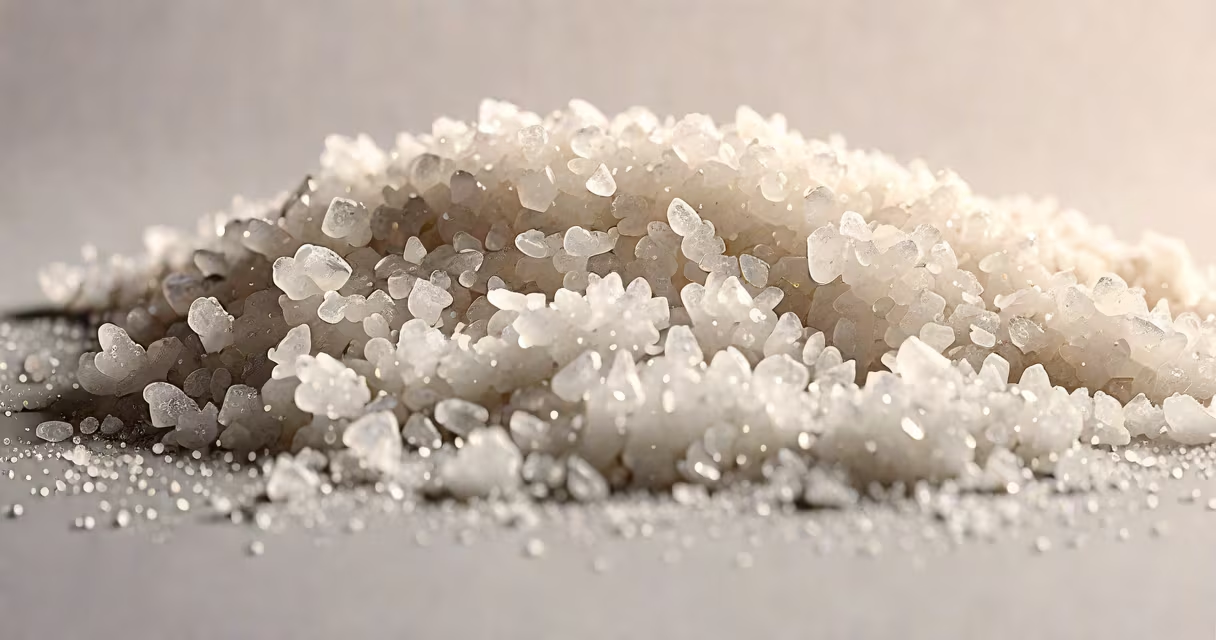
The salt chemical name is sodium chloride, with the formula NaCl. It is an ionic compound composed of one sodium ion (Na⁺) and one chloride ion (Cl⁻) held together by electrostatic attraction. This structure forms a cubic crystal lattice that repeats in three dimensions.
Sodium chloride occurs naturally in seawater, rock salt deposits, and brine springs. It is the most abundant salt in Earth's crust and the primary source of dietary sodium. The human body requires sodium for nerve signaling and muscle function, but excessive intake correlates with hypertension and cardiovascular disease.
Industrial uses of NaCl include de-icing roads, water softening, and producing chlorine gas and sodium hydroxide via electrolysis. In food, it enhances flavor, preserves meat and fish, and controls microbial growth. The U.S. FDA recommends limiting daily sodium intake to less than 2,300 milligrams, equivalent to about one teaspoon of salt.
Sodium chloride forms through a redox reaction between elemental sodium (Na) and chlorine gas (Cl₂). When sodium metal reacts with chlorine, it loses one electron to form Na⁺, while chlorine gains one electron to become Cl⁻. These ions attract strongly due to their opposite charges, creating a stable ionic bond.
The resulting crystal structure is face-centered cubic. Each sodium ion sits at the center of six chloride ions, and vice versa. This arrangement maximizes electrostatic attraction and minimizes repulsion. The unit cell measures 564 picometers on each edge, a distance confirmed by X-ray diffraction studies.
When dissolved in water, NaCl dissociates completely into free-moving Na⁺ and Cl⁻ ions. This property enables electrical conductivity in aqueous solutions-a key feature in biological systems and industrial processes. Pure NaCl does not conduct electricity because its ions are locked in place within the solid lattice.
While "salt" often refers to sodium chloride, chemists define salt broadly as any ionic compound formed from an acid-base reaction. Salts consist of cations (positive ions) and anions (negative ions) arranged in a lattice. Not all salts are edible or safe for consumption.
| Type | Cation | Anion | Common Name | Use Case |
|---|---|---|---|---|
| Sodium chloride | Na⁺ | Cl⁻ | Table salt | Food seasoning, preservative |
| Potassium chloride | K⁺ | Cl⁻ | Low-sodium substitute | Dietary alternative for heart patients |
| Calcium sulfate | Ca²⁺ | SO₄²⁻ | Gypsum | Plaster, cement additive |
| Sodium bicarbonate | Na⁺ | HCO₃⁻ | Baking soda | Baking agent, antacid |
Salts differ in solubility, melting point, and toxicity. For example, barium sulfate (BaSO₄) is insoluble and used in medical imaging, while lead(II) chloride (PbCl₂) is toxic and banned in consumer products. The salt chemical name must reflect both ions precisely-using Roman numerals for variable oxidation states when needed.
Many assume "salt" means only table salt. In reality, salt is a class of compounds. For instance, copper(II) sulfate (CuSO₄) is a blue crystalline salt used in agriculture and chemistry labs. Its salt chemical name includes the oxidation state of copper, which distinguishes it from copper(I) sulfate.
Another misconception is that all salts are neutral. While sodium chloride produces a neutral pH in solution, others do not. Aluminum sulfate (Al₂(SO₄)₃) hydrolyzes in water to form acidic solutions, making it useful in water treatment to coagulate impurities.
A lesser-known fact: sea salt and table salt have nearly identical chemical compositions. The difference lies in processing. Sea salt is harvested by evaporating seawater and retains trace minerals like magnesium and potassium. Table salt is purified and often fortified with iodine to prevent goiter. According to the World Health Organization, iodized salt reduces the risk of iodine deficiency disorders by 70% in populations with low dietary intake.
In 19th-century France, Nicolas Appert developed canning techniques using salt to preserve meat. He packed beef in sealed jars and applied a brine solution of 10% NaCl. The high osmotic pressure drew water out of bacterial cells, inhibiting growth. This method extended shelf life.
Modern applications include curing ham. A typical recipe calls for 2.5% salt by weight of meat. After 14 days of dry-curing, the salt concentration reaches 3.5% in the outer layer, reducing moisture activity below 0.85-the threshold where most pathogens cannot survive. This process relies on the salt chemical name being accurate: NaCl, not "sodium" or "chloride" alone.
I once tested this during a home fermentation project. Using a digital refractometer, I measured water activity in cured pork belly. Samples with 2.5% salt showed a drop from 0.98 to 0.81 within five days. Control samples without salt spoiled within 72 hours. The experiment confirmed that salt chemical name matters-not just for labeling, but for safety and efficacy.
Not all salts contain chlorine. Sodium chloride is one of many. Iron(III) phosphate (FePO₄) is a salt used in fertilizers and battery materials. Its salt chemical name reflects iron's +3 oxidation state, important for predicting reactivity. Ignoring oxidation states leads to incorrect formulas and failed experiments.
Another distinction: hydration. Anhydrous NaCl has no water molecules bound in its crystal lattice. Hydrated forms, like NaCl·2H₂O, exist in nature but are rare. The presence of water affects density, solubility, and stability. Industrial production avoids hydrates because they clog machinery and reduce yield.
For clarity, always specify the salt chemical name using systematic nomenclature. For example, NaCl is sodium chloride, not "sodium chlorite" (which is NaClO₂, a bleach ingredient). Confusing these names causes serious errors in laboratories and pharmaceutical manufacturing.
Understanding the salt chemical name as NaCl provides insight into its role in biology, food science, and materials engineering. Its simple formula belies complex behavior in solution, solid state, and living systems. Correct identification prevents harm and ensures effectiveness across applications.