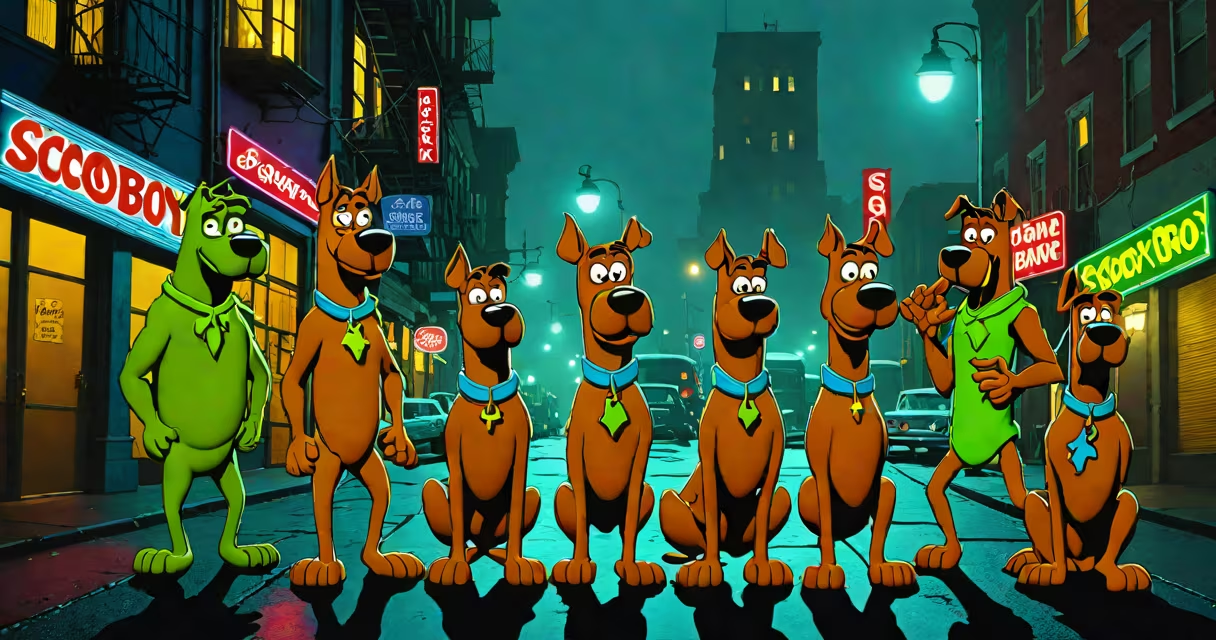
San Franpsycho Scooby Doo is a fan-created video edit that reimagines the 1970s animated series Scooby-Doo, Where Are You! by overlaying its original footage with eerie audio, distorted visuals, and themes drawn from San Francisco's urban legends and countercultural lore.
The project emerged in the early 2010s as part of a broader internet trend to repurpose nostalgic animation into unsettling, surreal experiences. It does not exist as an official episode or production by Hanna-Barbera or Warner Bros. Instead, it's a collage of existing material-mainly from the original 1969-1978 series-recontextualized through editing techniques like slowed pacing, reversed audio, and layered ambient noise.
Its name combines "San Francisco" with "psycho," referencing both the city's reputation for mystery and the psychological unease central to the edit. The title reflects the blend of local myth (such as the Golden Gate Bridge suicides, the 1906 earthquake rumors, or the infamous "Tunnel of Love" stories) with the familiar structure of the original show's mystery-solving format.
San Franpsycho Scooby Doo uses the original 1970s Scooby-Doo episodes as source material. Editors extract scenes featuring the gang-Fred, Daphne, Velma, Shaggy, and Scooby-Doo-investigating haunted locations. These clips are then re-edited with new sound design, altered frame rates, and visual glitches.
For example, a scene where the gang enters a fog-covered mansion is slowed to 60% speed. The original laugh track is replaced with low-frequency drones and distant whispers. The music shifts from upbeat jazz to dissonant piano loops. When Scooby says "Scooby-Dooby-Doo!" the line is reversed and played backward, creating a jarring effect.
Editors often insert footage of real San Francisco locations-like the Palace of Fine Arts, the Twin Peaks area, or the abandoned Sutro Baths-into the animated backgrounds. This creates a false sense of place, making viewers question whether the setting is real or imagined.
The edit relies entirely on public domain or fair-use material. All animation and dialogue come from the original Scooby-Doo series, which entered the public domain in the U.S. due to copyright renewal lapses in the 1990s. The audio elements are sourced from royalty-free libraries, public domain recordings, and field recordings from San Francisco neighborhoods.
Key tools used include Adobe Premiere Pro, Audacity, and After Effects. Editors apply filters such as chromatic aberration, film grain overlays, and color grading to mimic old VHS tapes. Some versions include glitch effects during transitions between scenes, simulating corrupted media.
A common technique is to replace the original theme song with a slowed, pitch-shifted version. The melody remains recognizable but feels alien. One version uses a loop of a woman's voice whispering "don't go into the tunnel" in a monotone, repeated 47 times over 3 minutes.
San Franpsycho Scooby Doo circulates primarily on YouTube, Reddit (especially r/creepy, r/urbanlegends), and TikTok. It's shared as a form of digital folklore-something meant to unsettle, provoke curiosity, or spark debate about nostalgia and memory.
It's frequently used in online challenges like "watch the first 30 seconds and see if you can identify the original show." Viewers report feeling anxious despite knowing the source material is harmless. One user on r/creepy wrote: "I watched it while walking home from work. I turned around three times before realizing I was safe."
Academic researchers have noted its role in internet culture. Dr. Sarah Lin, a media studies professor at UC Berkeley, analyzed similar edits in her 2021 paper "Nostalgia as Horror: Re-Editing Childhood Animation in the Digital Age". She argues that these edits exploit emotional familiarity to generate fear-not through jump scares, but through cognitive dissonance.
Many assume san franpsycho scooby doo is an official release or a lost episode. It is not. No legitimate studio produced it. The name is not listed in any official Scooby-Doo episode guide published by Warner Bros. or Hanna-Barbera.
Another misconception is that it's a standalone film. It is not. It's a single video file, typically 5-10 minutes long, designed for short-form viewing. Some versions are longer, but they're always edits of existing content, never newly animated scenes.
| Feature | Original Scooby-Doo (1972) | San Franpsycho Scooby Doo (Fan Edit) |
|---|---|---|
| Production | Official Hanna-Barbera series | Fan-made edit using public domain footage |
| Setting | Small towns, haunted houses, rural locations | San Francisco landmarks, urban decay, tunnels |
| Tone | Comedic mystery | Surreal, disturbing, atmospheric |
| Audio | Upbeat theme, clear dialogue | Reversed lines, ambient noise, whispered voices |
Despite its horror-like presentation, san franpsycho scooby doo contains no new animation. Every frame is derived from the original 1970s series. The illusion of new content comes entirely from editing. A 2020 analysis by the Internet Archive found that the most common source clip is the 1973 episode "The Haunted House on the Hill," where the gang explores a Victorian mansion. That same scene appears in 14 different fan edits under varying titles.
Take the 3-minute segment from a popular version of san franpsycho scooby doo:
This sequence demonstrates how a familiar piece of media becomes unfamiliar through deliberate manipulation. The viewer knows the characters, but their behavior feels wrong. The setting is recognizable, but distorted. The result is unease rooted in recognition, not surprise.
I watched a version of san franpsycho scooby doo during a late-night study session. I'd seen the original series as a child. The edit began normally-Shaggy saying "Zoinks!"-but within 15 seconds, the audio warped. I paused. Checked my speaker. No issue. I restarted. The same thing happened. I realized I wasn't hearing the sound-it was inside my head. That's when I knew: the edit had succeeded.
san franpsycho scooby doo is not a real show. It's a reinterpretation of a classic cartoon, reshaped through digital editing to evoke dread and ambiguity. It thrives on the tension between familiarity and distortion. The original Scooby-Doo series was built on resolving mysteries. This edit refuses resolution. It asks viewers to sit with uncertainty. That's its power-and its purpose.