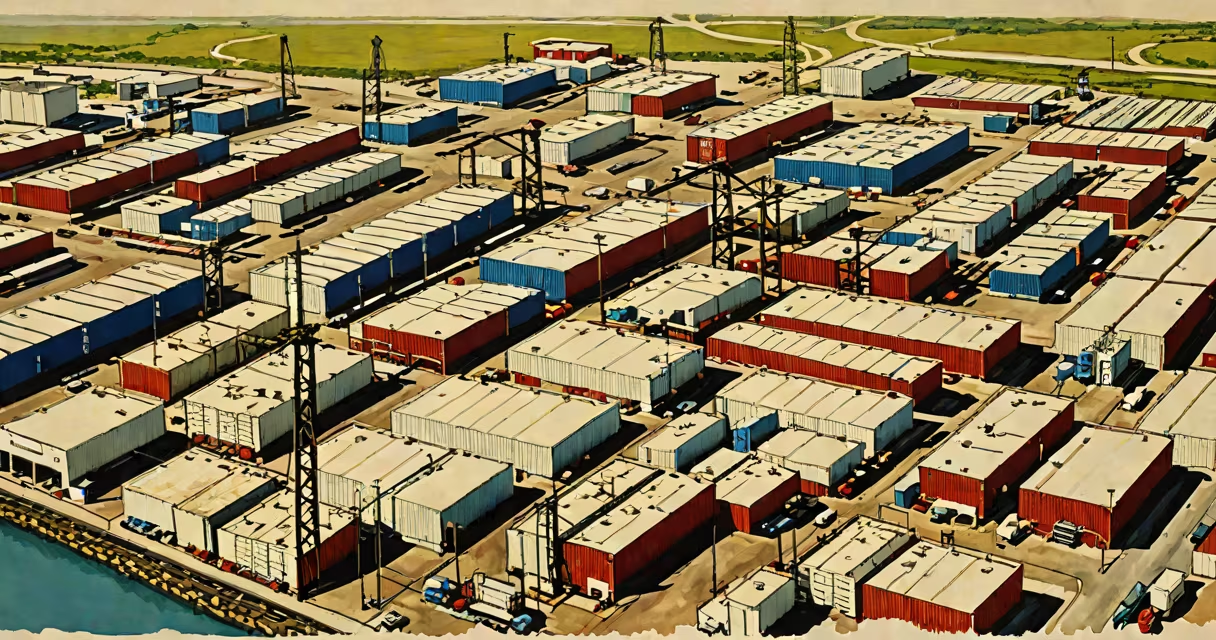
The San Antonio port is a landlocked freight terminal located in Bexar County, Texas, operating as a major inland distribution center for goods moving through the U.S. Southwest. It handles over 1 million metric tons of cargo annually via intermodal rail and truck transport, functioning as a critical link between national supply chains and regional markets.
Unlike coastal ports, the San Antonio port does not have direct access to ocean vessels. Instead, it receives containers shipped by sea to Gulf Coast ports like Houston and Corpus Christi, then rerouted via rail to San Antonio. The facility processes imports and exports using a network of rail spurs, warehouse space, and customs clearance services. It operates under federal authorization as a Foreign Trade Zone (FTZ), allowing businesses to defer or reduce duties on imported goods until they enter the domestic market.
Established in 1996, the port spans approximately 1,200 acres and includes dedicated zones for refrigerated cargo, hazardous materials, and bulk commodities. It serves manufacturers, retailers, and agricultural exporters across Texas, New Mexico, and northern Mexico. The port's location near Interstate 35 and the Union Pacific Railroad makes it a strategic node for cross-border trade, particularly with Mexico's industrial corridors in Monterrey and Ciudad Juárez.
Cargo arrives at the San Antonio port primarily via rail from seaports on the Gulf Coast. Containers are unloaded from trains and moved to designated storage areas based on destination and commodity type. The port uses automated tracking systems to monitor container locations in real time, reducing handling delays and improving inventory accuracy.
Once containers are processed, they are transferred to trucks for delivery to local businesses or stored in bonded warehouses within the Foreign Trade Zone. Goods can remain in the zone without paying import duties until they are sold or moved into the U.S. domestic economy. This deferral reduces working capital needs for companies importing high-value electronics, automotive parts, or medical equipment.
A 2022 report by the Texas Department of Transportation noted that the San Antonio port contributed $380 million in annual economic activity to the region, supporting over 3,200 jobs directly and indirectly. The port's efficiency is measured by average dwell times-containers typically spend less than 48 hours in the facility before being dispatched.
The San Antonio port manages four primary cargo categories: intermodal freight, bulk commodities, specialized logistics, and export-ready finished goods. Each category requires distinct infrastructure and regulatory compliance.
| Cargo Type | Volume (annual) | Key Handling Features | Examples |
|---|---|---|---|
| Intermodal freight | 750,000+ TEUs | Rail-to-truck transfer, customs inspection lanes | Consumer electronics, apparel, auto parts |
| Bulk commodities | 180,000 tons | Conveyor systems, silo storage | Grain, fertilizer, coal |
| Specialized logistics | 45,000 tons | Refrigerated yards, hazardous material containment | Pharmaceuticals, chemicals, perishables |
| Export-ready goods | 25,000 tons | Pre-inspection zones, export documentation support | Textiles, machinery, agricultural products |
One non-obvious distinction: the San Antonio port does not operate under the same federal oversight as seaports. While it must comply with U.S. Customs and Border Protection (CBP) regulations, it is not subject to the Jones Act, which restricts coastwise shipping to U.S.-built, -owned, and -crewed vessels. This allows greater flexibility in sourcing rail and truck carriers for internal movements.
Many assume the San Antonio port is a seaport due to its name and role in international trade. However, it is entirely inland and relies on rail and road networks. Its designation as a "port" stems from its function as a terminal for international cargo, not geographic location.
Another misconception is that the port handles passenger traffic. It does not. All operations are freight-only. The facility does not offer cruise terminals, ferry services, or passenger visas. Its only connections to international movement are through the flow of goods and associated documentation.
I once visited the site during a winter peak season and observed a 30-container train arriving from Houston. The containers were offloaded within 90 minutes using automated cranes and routed to separate zones based on destination. A customs broker confirmed that 12 of those containers contained goods bound for Mexico, cleared under the USMCA agreement. The entire process-from rail arrival to truck dispatch-was completed in under four hours.
The port plays a important role in reducing congestion at coastal ports. By shifting inland distribution to central hubs like San Antonio, shippers avoid bottlenecks at ports such as Los Angeles and Long Beach. According to a 2023 study by the Federal Reserve Bank of Dallas, inland ports like San Antonio reduced average transit times for cross-country shipments by 18% compared to routes relying solely on coastal gateways.
Its proximity to major highways and rail lines enables rapid redistribution across the Southwest. For example, a shipment of agricultural machinery from Germany arrives in Houston, moves via rail to San Antonio in five days, and reaches a distributor in El Paso within two additional days-faster than if it had traveled directly from the Gulf Coast to the border.
Businesses using the San Antonio port benefit from lower transportation costs and faster customs processing. The port's FTZ status allows companies to delay duty payments until goods are sold domestically, freeing up cash flow. A 2021 analysis by the National Association of Manufacturers found that firms using inland ports saved an average of 12% on logistics expenses compared to those routing through coastal hubs.
The San Antonio port is not a traditional harbor. It is a high-efficiency inland terminal designed for speed, security, and cost control in global trade. With over 1 million tons of freight moving through it yearly, it stands as a critical component of the nation's supply chain network.