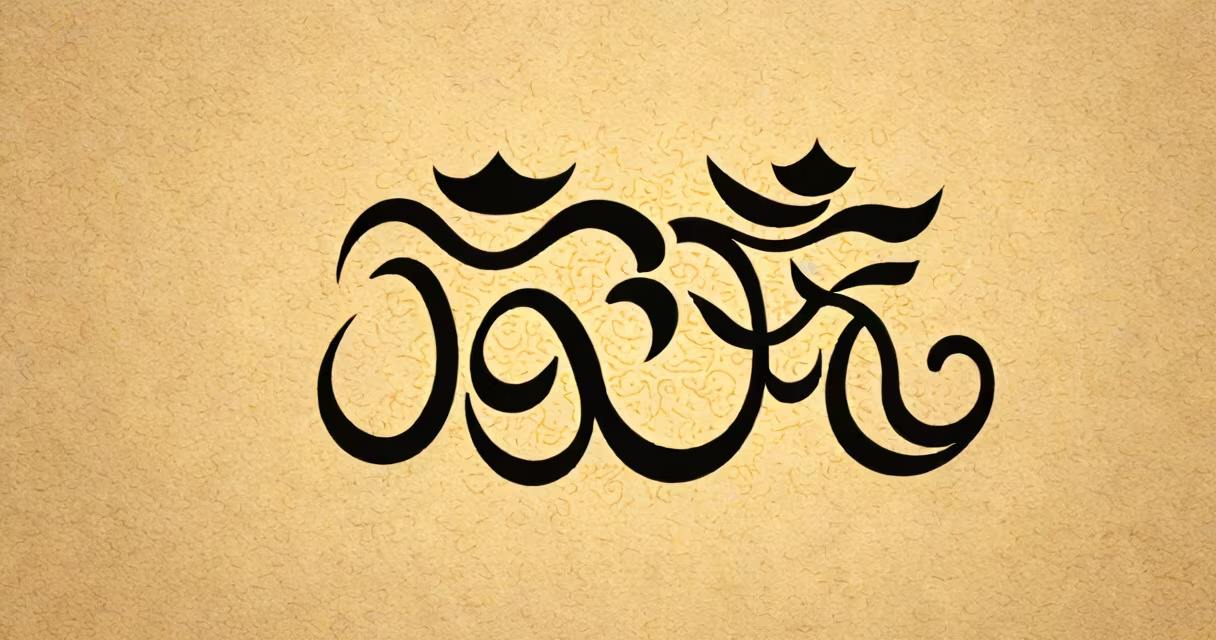
The sanskrit symbol for om (ॐ) is a sacred syllable representing the essence of the universe and the ultimate reality in Hinduism, Buddhism, and Jainism. It combines three sounds-A, U, and M-and embodies the cycle of existence: creation, preservation, and dissolution.
Used in religious rituals, meditation, and spiritual practice, the symbol appears in manuscripts, temples, and personal devotional objects. Its form evolved from early Brahmi script and is standardized in modern Devanagari script. The symbol is not merely a visual representation-it is a sonic and metaphysical concept.
According to the Mandukya Upanishad, om is the sound that existed before time began. It contains all other sounds and is considered the root vibration of all creation. The symbol's shape reflects this idea: the downward curve represents the waking state, the upper curve the dream state, the semicircle the deep sleep state, and the dot above the apex signifies transcendence beyond all states.
The symbol functions as both a phonetic and symbolic unit. When chanted aloud, om begins with the "A" sound (from the back of the throat), moves to "U" (middle of the mouth), and ends with "M" (lips closed). This sequence mirrors the stages of consciousness and the physical act of breathing.
Chanting om activates the vagus nerve, which regulates heart rate and stress response. A 2016 study published in the Journal of Ayurveda and Integrative Medicine found that regular chanting of om reduced cortisol levels and improved attention span in participants after eight weeks of daily practice.
In yoga, om is often intoned at the beginning and end of sessions. The sound is believed to align the practitioner's energy with cosmic rhythms. Some teachers recommend chanting om for 108 repetitions during meditation, based on the belief that 108 is a sacred number in Indian tradition.
The symbol consists of four distinct elements:
The semicircular gap between the upper curve and the dot represents maya, or illusion, the veil between the material world and pure awareness. This structure reflects the philosophy that enlightenment lies beyond perception.
Modern digital fonts render the symbol using Unicode codepoint U+0950 (Devanagari Letter O). However, variations exist across regional scripts-Tamil, Telugu, and Tibetan versions differ slightly in form but retain the core meaning.
Om appears in countless contexts: temple carvings, prayer beads (mala), yoga studios, and even on clothing and tattoos. It is common in Hindu homes, where it is inscribed on doorways or placed on altars.
Scientific research supports its use in mindfulness. A 2021 study from the University of California, San Diego, showed that individuals who listened to recordings of om chants experienced increased alpha brainwave activity-associated with relaxed focus-compared to control groups.
Despite widespread use, the symbol is often misapplied. For example, some Western brands use om in logos without understanding its cultural weight. In 2019, the fashion brand Gucci faced criticism for using the symbol in a promotional campaign, leading to backlash from Indian scholars and spiritual communities.
| Use Case | Correct Context | Common Misuse |
|---|---|---|
| Yoga class | Chanted at start/end to center the group | Used as decorative art without context |
| Temple entrance | Part of ritual purification and blessing | Painted on storefronts for aesthetic appeal |
| Personal meditation | Chanted silently or aloud to focus mind | Worn as jewelry without reverence |
Many people mistake om for a generic spiritual symbol. It is not interchangeable with other sacred signs like the lotus, the swastika, or the bindi. Each has distinct origins and meanings.
Another misconception is that om is purely a Hindu symbol. While it originates in Vedic texts, it is also central to Buddhist and Jain traditions. In Mahayana Buddhism, om is part of the mantra "Om Mani Padme Hum," used in meditation and compassion practices.
A lesser-known fact: the symbol is sometimes written with a horizontal line beneath it in ancient manuscripts. This line, called the "bindu," represents the point of origin-the unmanifest source from which all forms emerge. It is absent in most modern representations but critical in traditional iconography.
I once attended a silent retreat in Rishikesh, India, where participants practiced meditation for 12 hours daily. On the third morning, we gathered in a courtyard under a canopy of trees. A teacher led us through a 15-minute session of chanting om, slowly and in unison.
At first, my mind wandered. But after five minutes, a deep stillness settled. My breath slowed. The vibrations resonated in my chest and skull. By the end, I felt a sense of unity-not just with the others, but with the air, the earth, and the silence itself. That moment clarified why the symbol is not just a letter-it is a portal.
The sanskrit symbol for om is more than a mystical glyph. It is a multidimensional expression of sound, shape, and consciousness. Its use in spiritual life is rooted in centuries of philosophical inquiry and ritual precision. Understanding its layers-linguistic, symbolic, physiological-reveals why it remains a living tradition across cultures and continents.