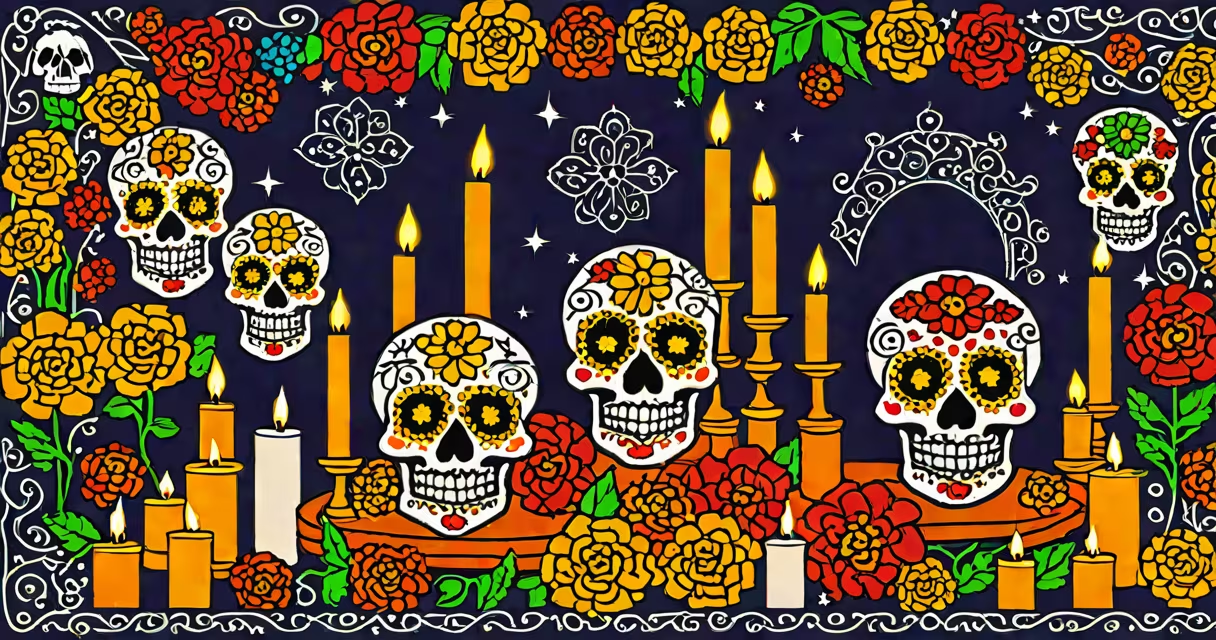
The Day of the Dead Mexico, known as Día de Muertos, is a multi-day tradition observed on November 1 and 2 to honor deceased relatives through altars, offerings, and communal remembrance. Rooted in pre-Hispanic Mesoamerican beliefs and blended with Catholic practices introduced during colonization, it treats death as a natural part of life rather than something to fear.
Altars, or ofrendas, are central to the celebration. Families build them in homes, cemeteries, and public spaces using specific elements: marigold petals (cempasúchil) to guide spirits, candles for light, incense (copal) to purify air, photos of the dead, and favorite foods and drinks of the departed. The inclusion of salt and water symbolizes purification and sustenance. These components are not symbolic fluff-they follow centuries-old indigenous cosmology, particularly the Nahua concept of the soul's process between worlds.
While often mistaken for Halloween due to shared dates and skull imagery, Día de Muertos differs fundamentally in tone and purpose. Halloween emphasizes fear, monsters, and costumes. Día de Muertos is joyful, intimate, and deeply personal. It is not about mourning but about maintaining connection. A 2017 study by the National Institute of Anthropology and History (INAH) found that 87% of surveyed families in Oaxaca and Michoacán built altars annually, with 63% including food prepared specifically for their ancestors' tastes.
Observances begin on October 31 with the arrival of children's souls, believed to return on November 1. Adults' souls arrive on November 2. Families visit gravesites to clean and decorate tombs with flowers, music, and food. In Puebla, it's common to see families gather at the cemetery with picnic blankets, playing traditional songs like "La Llorona" while sharing mole and pan de muerto.
Each element on the altar holds meaning. For example, sugar skulls (calaveras de azúcar) are inscribed with the names of the deceased. They're not meant to be eaten immediately but offered as tribute. After the ritual, they may be consumed-symbolizing the cycle of life and death. The use of marigolds is not arbitrary: their scent and vibrant orange color are believed to attract spirits from the spirit world.
A lesser-known fact is that many of the traditions were preserved under colonial suppression. Spanish friars banned indigenous death rites, but communities adapted by merging them with All Saints' and All Souls' Days. This syncretism allowed practices to survive. Today, UNESCO recognizes Día de Muertos as Intangible Cultural Heritage of Humanity, citing its role in sustaining cultural memory.
Different regions in Mexico express Día de Muertos in distinct ways. While core elements remain consistent, local customs vary widely:
| Region | Distinctive Practice | Key Offerings |
|---|---|---|
| Oaxaca | Elaborate processions with giant paper mache skeletons (alebrijes) | Chiles en nogada, tamales, mezcal |
| Mexico City | Public altars in parks and museums; street performances | Pan de muerto, fruit, chocolate |
| Michoacán | Traditional dances like the Danza de los Viejitos (Dance of the Old Men) | Barbacoa, atole, candied pumpkin |
| Yucatán | Use of red and white flowers; focus on ancestral lineage | Coconut bread, tamales with hoja santa |
In Michoacán, the Danza de los Viejitos involves elders dancing in exaggerated movements to mimic aging and death. The dance is not entertainment-it's a spiritual act performed to honor ancestors and affirm continuity across generations.
Many assume Día de Muertos is a "Mexican Halloween." That's incorrect. The holiday lacks horror themes. Skulls are not symbols of terror but of remembrance. Sugar skulls are edible art, not macabre decor. The belief system is not pagan in the Western sense-it's animist and cyclical, viewing death as a continuation of existence.
Another error is assuming the tradition is uniform across Latin America. While similar holidays exist-like Día de Todos los Santos in Spain or Día de los Fieles Difuntos in Colombia-each has unique roots. Día de Muertos in Mexico is uniquely shaped by Nahua, Maya, and Aztec cosmologies, not just Catholicism.
I once attended a community altar in San Miguel de Allende. The family had placed a small plate of tamales and a glass of pulque beside their grandmother's photo. When I asked why pulque, the daughter said, "She hated coffee. She loved this." That moment clarified the emotional core: this is not performance. It's intimacy.
Día de Muertos is not just a holiday-it's a living practice of memory. It resists erasure. In 2020, despite pandemic restrictions, 68% of Mexicans still observed the holiday at home, according to a survey by the National Institute of Statistics and Geography (INEGI). Many created digital altars online, showing adaptation without loss of meaning.
The Day of the Dead Mexico remains a resilient expression of love beyond death. It is not about fear, but presence. Not about loss, but continuity. It is a quiet revolution-one that honors the past by keeping it alive in the present.