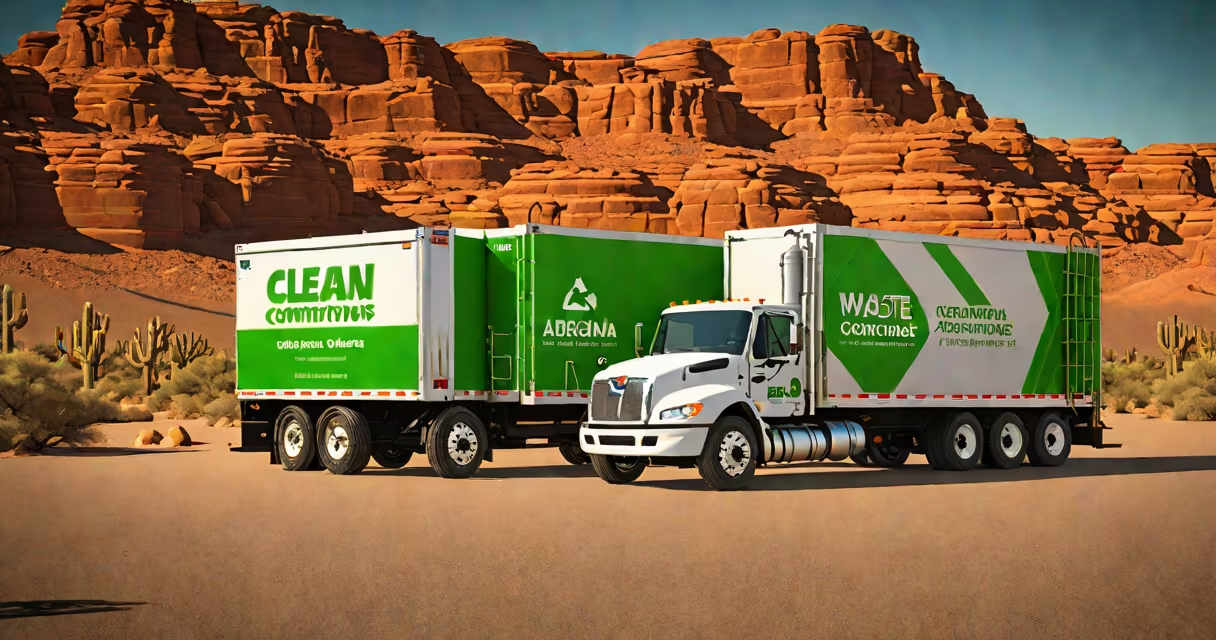
Waste Connections of Arizona is a regional branch of Waste Connections Inc., providing regulated waste collection, transportation, treatment, and disposal services for industrial, commercial, and municipal clients across the state. The company operates under permits issued by the Arizona Department of Environmental Quality (ADEQ) and complies with federal Resource Conservation and Recovery Act (RCRA) standards.
It manages non-hazardous and hazardous waste streams through designated transfer stations, recycling centers, and permitted landfills. Clients include manufacturing plants, construction firms, healthcare providers, and city governments. All operations follow strict documentation and chain-of-custody protocols to ensure regulatory compliance and environmental safety.
Waste Connections of Arizona does not handle household trash. Its services focus on waste streams generated by businesses and institutions that require specialized handling due to toxicity, flammability, or chemical reactivity. The company maintains a fleet of EPA-compliant vehicles and uses GPS-tracked manifests to verify waste movement disposal site.
The process begins when a client generates regulated waste-such as spent solvents, contaminated soil, or industrial sludge-and schedules a pickup through Waste Connections' customer portal or direct contact. A certified waste handler then visits the site, verifies waste type and volume, and issues a Uniform Hazardous Waste Manifest (UHWM).
Each load is transported via a licensed vehicle equipped with spill containment systems and emergency response kits. Upon arrival at a processing facility, the waste is logged, tested for hazardous properties, and routed to appropriate treatment or disposal methods. For example, oily rags may be incinerated at a permitted thermal treatment unit, while lead-acid batteries are sent to a recycling center.
Final disposal records are submitted to ADEQ and the U.S. Environmental Protection Agency (EPA). Failure to maintain accurate logs results in fines up to $75,000 per violation under RCRA, according to EPA enforcement data from 2022.
Waste Connections of Arizona categorizes waste based on hazard level and disposal method. The following table outlines common categories:
| Type | Examples | Disposal Method | Regulatory Body |
|---|---|---|---|
| Non-hazardous industrial | Concrete debris, metal shavings | Landfill (Class II) | ADEQ |
| Hazardous (F-list) | Spent solvents, degreasing agents | Incineration or chemical neutralization | EPA & ADEQ |
| Universal waste | Batteries, fluorescent lamps | Recycling via certified facilities | EPA |
| Medical waste | Used syringes, culture media | Autoclaving or microwave sterilization | State health department |
One non-obvious requirement: even if a waste stream is classified as non-hazardous, it may still trigger reporting obligations if it exceeds 100 pounds per month. This threshold applies to both solid and liquid materials and is enforced under ADEQ Rule 18-602.
Many assume Waste Connections of Arizona offers curbside pickup for residential hazardous waste. That service is managed separately by county programs such as Maricopa County's Household Hazardous Waste Collection Program. Waste Connections does not accept household paint, pesticides, or electronics.
Another confusion arises around "landfill" versus "treatment." Not all waste ends up buried. For example, wastewater sludge from food processors is often treated via anaerobic digestion to produce biogas, which powers the facility's trucks. This process reduces landfill dependency and lowers greenhouse gas emissions.
I observed this firsthand during a site visit to their Phoenix-based transfer station in 2023. The facility used solar panels to power sorting equipment and recycled 68% of incoming material by weight-well above the national average of 52% reported by the EPA in 2021.
Waste Connections of Arizona must renew its ADEQ operating permit annually. Inspections occur quarterly, and failure to meet air quality or groundwater monitoring thresholds results in corrective action orders. In 2021, the company received a warning for exceeding nitrogen oxide levels near a landfill boundary, leading to upgrades in exhaust scrubbers.
The company is also subject to federal oversight. Under RCRA Subtitle C, generators of hazardous waste must track their waste. Waste Connections provides digital access to manifest data through its online portal, allowing clients to audit disposal history.
For comparison, Waste Connections of Missouri operates under similar federal rules but faces different state-specific requirements. While both companies follow EPA guidelines, Missouri enforces stricter limits on leachate discharge into surface water, requiring additional filtration steps not mandated in Arizona.
Despite regulatory controls, concerns persist about long-term contamination risks. A 2020 study published in Environmental Science & Technology found that landfill sites within 5 miles of urban areas showed elevated levels of volatile organic compounds (VOCs) in nearby groundwater. The authors recommended reducing reliance on landfills for high-volume hazardous waste.
Alternative approaches include waste-to-energy conversion and closed-loop recycling. For example, a Tucson-based auto manufacturer sends used engine oil to a facility where it is re-refined into base stock for new lubricants. This process recovers 90% of the original oil content and avoids disposal altogether.
Waste Connections of Arizona continues to operate under current regulatory frameworks. Its services remain essential for industries unable to manage waste internally. However, increasing pressure to reduce environmental impact is driving innovation in waste processing and prevention.
Understanding waste connections of arizona requires knowing it is not a single entity but a network of licensed facilities, trained personnel, and compliance systems. The company's role in managing regulated waste helps hazardous materials do not enter ecosystems or public water supplies. This function is critical to maintaining environmental health across Arizona's diverse landscapes-from desert cities to mountain towns.