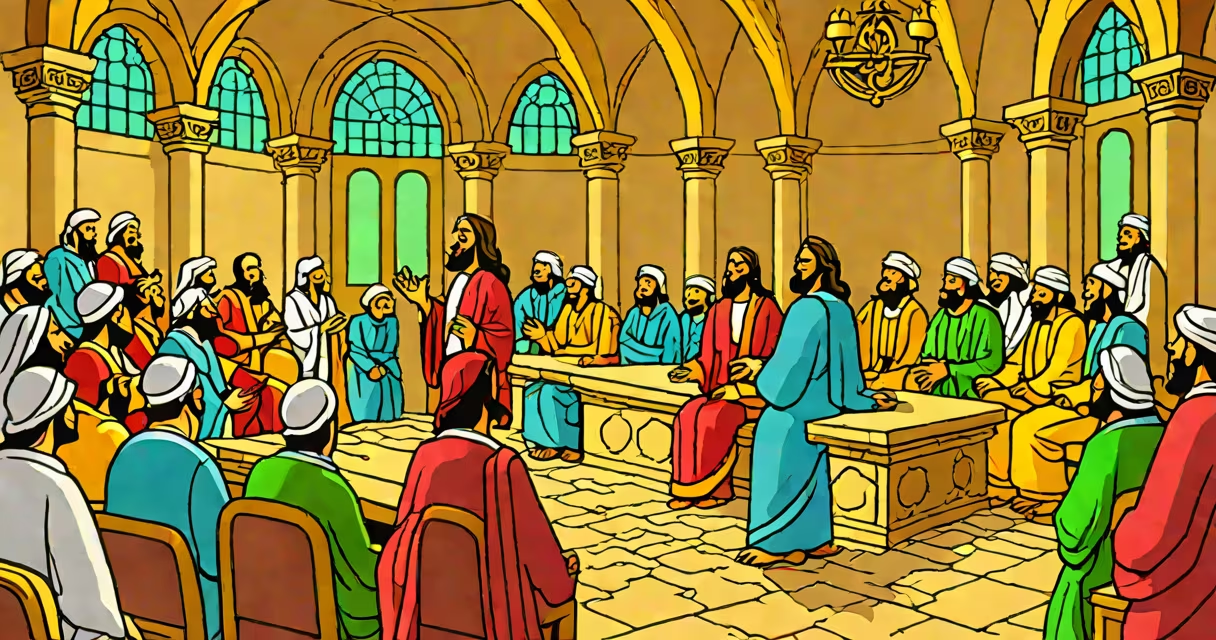
Jesus did not reject organized religion as a concept, but he consistently criticized the religious leadership of his time-particularly the Pharisees, Sadducees, and temple priests-for hypocrisy, legalism, and prioritizing ritual over justice and mercy. His teachings focused on ethical behavior, compassion, and personal relationship with God rather than institutional authority.
The term "organized religion" as we understand it today-structured institutions with formal doctrine, hierarchy, and sacraments-did not exist in Jesus's lifetime. The religious system he engaged with was primarily Second Temple Judaism, centered on the Jerusalem Temple, local synagogues, and rabbinic interpretation of Torah. Jesus challenged the power structures within that system, especially those that excluded the poor, sick, and marginalized.
He spoke against leaders who "sit in Moses' seat" (Matthew 23:2)-meaning they held authority based on tradition, not divine mandate-and warned that their teachings were often empty of moral substance. He called them "hypocrites" and accused them of burdening people with rules while failing to live by them themselves.
Jesus attended synagogue services regularly, taught in them, and cited scripture as authoritative. He did not oppose worship or community gatherings. Instead, he redefined what it meant to be faithful. When he healed on the Sabbath, he defied strict interpretations of rest laws, arguing that human need took precedence over ritual observance.
His actions disrupted the established order. He overturned tables in the Temple courtyard, calling it a "den of robbers" (Mark 11:17), not because he opposed prayer or sacrifice, but because he saw the space being used for commercial gain and political manipulation. This act was symbolic-intended to expose corruption and reclaim sacred space for authentic worship.
Jesus also welcomed tax collectors, sinners, and women-groups excluded from mainstream religious life. He ate with them, affirmed their dignity, and taught that God's kingdom included those the religious elite deemed unworthy. This wasn't rejection of structure-it was expansion of inclusion.
Jesus's most direct critique came in Matthew 23, where he delivers a series of "woes" against scribes and Pharisees. He accuses them of building tombs for prophets while having murdered the ones who came before. He condemns their focus on outward appearances-tithing mint and dill while neglecting justice, mercy, and faithfulness (Matthew 23:23).
He did not oppose prayer, fasting, or almsgiving. But he criticized those who performed these acts publicly to be seen by others. "When you give to the needy," he said, "do not let your left hand know what your right hand is doing" (Matthew 6:3). His concern was authenticity, not performance.
Jesus also rejected the idea that salvation depended on lineage or temple access. He told the Samaritan woman at the well that true worshipers would worship in spirit and truth-not in Jerusalem or on Mount Gerizim, but through inner transformation (John 4:21-24). This shifted focus from place and institution to relationship and intention.
Many assume Jesus rejected all religious institutions. That is incorrect. He did not dismantle synagogues or abolish the Temple. He did not call for a new church or a replacement system. He operated within existing frameworks while challenging their misuse.
Another misconception is that Jesus opposed all authority. He acknowledged authority-"The scribes and the Pharisees sit on Moses' seat," he said-but he insisted that leaders must practice what they preach. Authority without integrity is dangerous.
A lesser-known fact: Jesus never formed a sect or wrote a creed. He did not establish a permanent organization. His movement grew after his death, shaped by apostles like Paul and later councils. The early Christian church evolved into an institutional form long after Jesus's ministry ended.
| Passage | Context | Jesus's Message |
|---|---|---|
| Matthew 23:1-12 | Addressing scribes and Pharisees | Leadership should serve, not dominate. Call no one "rabbi" or "father" except God. |
| Mark 11:15-18 | Expulsion from the Temple | Temple was meant for prayer, not profit. "My house shall be called a house of prayer" (Isaiah 56:7). |
| John 4:21-24 | Talk with Samaritan woman | True worship is spiritual and truthful-not tied to location or ritual. |
These passages show a consistent pattern: Jesus upheld core values-justice, mercy, faith-but rejected systems that distorted them for power or prestige.
I once visited the ancient site of Capernaum, where Jesus taught in a synagogue. The ruins show a modest building, not grand or ornate. Inside, a small stone floor remains. A local guide pointed out that the synagogue was likely run by lay elders, not a centralized priesthood. That setting-simple, communal, accessible-mirrored Jesus's own approach. He didn't seek to replace institutions, but to renew them from within.
Some claim Jesus said, "I am not of this world," implying separation from earthly systems. But this statement appears in John 17:14, during his farewell discourse. It reflects spiritual identity, not political or institutional rejection. Jesus remained deeply engaged with society-eating, healing, debating.
Others cite "Render unto Caesar" (Matthew 22:21) as proof he endorsed state authority. But the context shows he distinguished between religious and civil duties. He did not endorse the Roman Empire, nor did he condemn paying taxes. He simply refused to let either domain override moral responsibility.
According to the New Proof scholar N.T. Wright, "Jesus didn't come to destroy religion-he came to fulfill it." He reinterpreted Jewish law and prophecy, not discarded them. The Kingdom of God he proclaimed was both present and future-a reality breaking into history through love and service.
Modern theologian Marcus Borg notes that Jesus's message was "not anti-religion, but pro-relationship." He valued connection with God and neighbor above rituals, rules, and rankings. His vision was inclusive, not exclusive.
Understanding what Jesus said about organized religion requires distinguishing between institutions and ideals. He did not oppose community, worship, or shared belief. He opposed pride, exclusion, and hollow ceremony.
For believers today, this means asking: Does our religious practice reflect Jesus's priorities-compassion, justice, humility-or does it serve status, comfort, or control?
Jesus's words remain relevant not because they condemn all organized religion, but because they challenge every form of it to stay true to its purpose. Institutions may endure, but faith must be lived, not just performed.