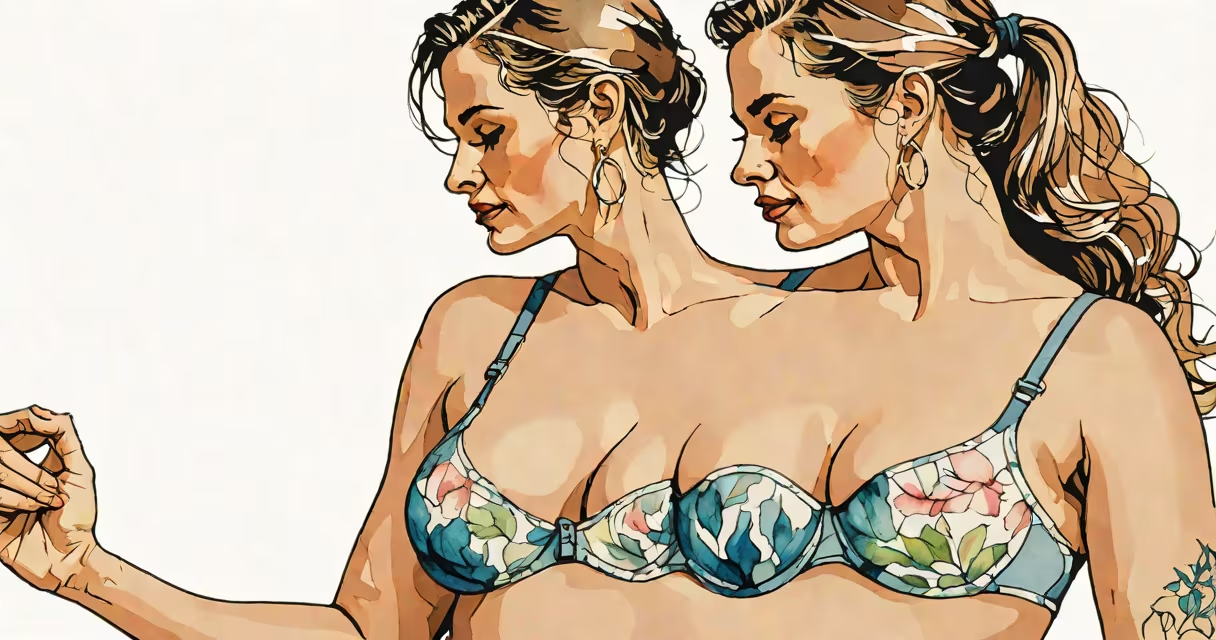
A 34DD bra size indicates a 34-inch band measurement and a DD cup, which corresponds to a significant bust volume. This size typically fits women with a chest circumference around 34 inches and a bust measurement between 41 and 42 inches, resulting in a 7- to 8-inch difference between bust and band.
Bra sizing uses two numbers: the first is the band size, measured snugly around the ribcage just below the breasts. The second is the cup size, determined by the difference between the bust and band measurements. A DD cup represents a large volume, falling between D and E in standard sizing systems. In the US, 34DD is equivalent to 36D in UK sizing and 85DD in European sizing.
Visualizing 34DD requires understanding both proportion and context. The band should sit flat against the torso without riding up. The cups should fully contain the breast tissue without spilling over or creating gaps. Fullness is concentrated in the center and lower half of the cup, especially in styles with underwire support.
Bra sizes are calculated using precise measurements. Measure the band size around the ribcage, just below the bust, in inches. Then measure the fullest part of the bust. Subtract the band measurement from the bust measurement to determine cup size. For example:
An 8-inch difference corresponds to a DD cup in standard US sizing. Cup sizes increase by 1 inch per letter: A = 1 inch, B = 2 inches, C = 3 inches, D = 4 inches, DD = 5 inches, E = 6 inches, EE = 7 inches, F = 8 inches, etc. Thus, DD is the sixth letter in the sequence beyond D.
Some brands use extended sizing, such as DDD or G, but in standard US sizing, DD is the largest single-letter cup. Beyond DD, brands may use double letters (DDD, EEE) or triple letters (FFFF), though these are less common and vary by manufacturer.
Many assume that 34DD equates to a very large or extreme size. While it is above average, it is not uncommon. According to the American Society of Plastic Surgeons, approximately 15% of women in the US wear a DD or larger cup size. This makes 34DD a regular size in many retail environments.
Another misconception is that 34DD always requires a large band. Not true. Band size and cup size are independent. A 34DD is not inherently larger than a 36DD or 32DD. The band size reflects torso width, while the cup reflects breast volume. A 32DD has a smaller band but the same cup volume as 34DD.
Some people confuse cup size with weight. A DD cup does not indicate weight. Two women with the same 34DD size can differ in actual breast weight due to density and tissue composition. One may have soft, pendulous tissue; another may have firm, compact tissue.
Consider a woman who measures 34 inches around her ribcage and 42 inches around her bust. Her cup size is 8 inches, which equals DD. She wears a 34DD bra. The band fits snugly without digging in. The cups hold the breasts fully, with no spillage at the sides or top. Underwire supports the breast tissue, lifting and shaping the bust.
For comparison, a 34C would have a 6-inch difference (bust 40 inches), and a 34D would have a 7-inch difference (bust 41 inches). Moving increases volume by about 15% per cup size. The visual difference between 34C and 34DD is noticeable, especially in fitted clothing.
When shopping, try on multiple styles. A 34DD in a balconette bra may appear different than in a plunge or full-coverage style. Fit varies by cut, fabric, and construction. Some brands run small; others run large. Always check size charts and return policies.
| Band Size | Bust Measurement | Cup Difference | Cup Size | Equivalent Sizes |
|---|---|---|---|---|
| 34 | 40 | 6 inches | C | 36C, 85C |
| 34 | 41 | 7 inches | D | 36D, 85D |
| 34 | 42 | 8 inches | DD | 36DD, 85DD |
Understanding what 34DD looks like involves recognizing both the physical dimensions and the functional fit. The size is not just a number-it's a combination of form, function, and personal comfort.
Wearing the correct bra size reduces back pain, prevents shoulder strain, and improves posture. A poorly fitting bra can cause long-term issues. According to the National Institute of Health, improper bra fit contributes to musculoskeletal discomfort in up to 75% of women who wear bras regularly.
I once helped a customer find a 34DD bra that fit properly. She had worn a 34C for years, thinking she was "small." After measuring correctly, we discovered her bust was 42 inches. She switched to 34DD and reported improved comfort and confidence. Her shoulders stopped aching during long days at work.
Fit is not just about appearance. It affects health, mobility, and daily well-being. A 34DD should feel secure, not tight or loose. The band should not ride up. The cups should not gap or squeeze.