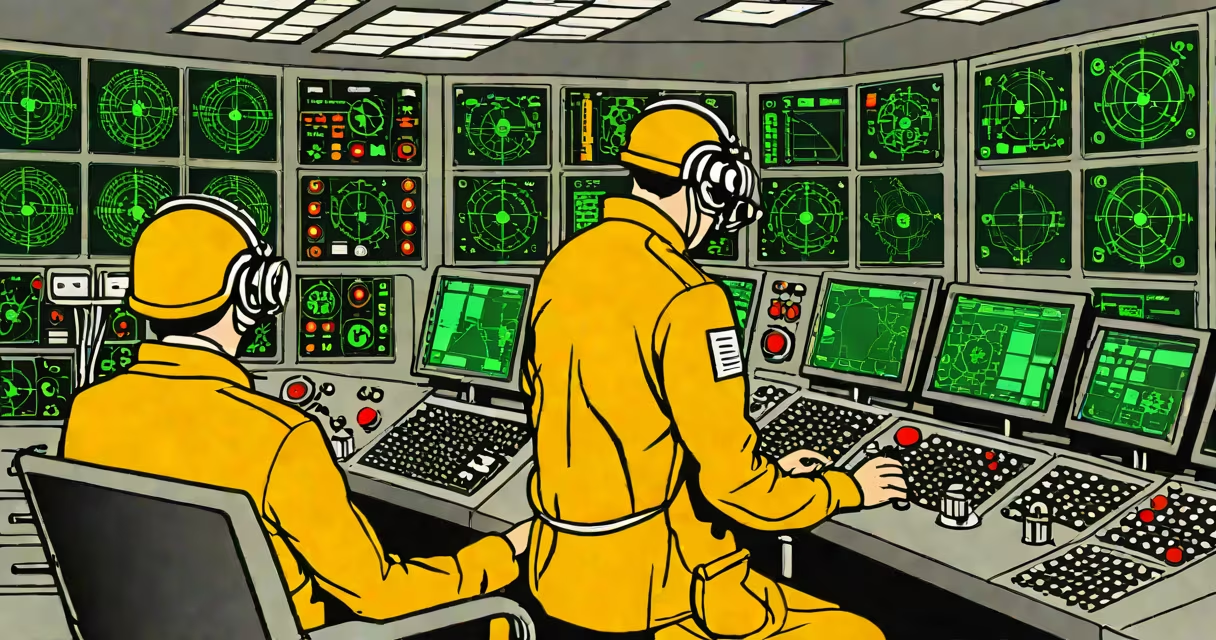
Nuclear technicians operate and maintain equipment in nuclear facilities, monitor radiation levels, and support reactor operations under strict safety protocols. They work primarily in power plants, research labs, and waste management sites, ensuring systems run safely and efficiently.
These professionals are essential to the day-to-day functioning of nuclear infrastructure. They interpret data from sensors, perform routine inspections, and respond to anomalies in real time. Their work prevents equipment failure and minimizes exposure to ionizing radiation.
According to the U.S. Bureau of Labor Statistics, nuclear technicians held about 18,000 jobs in 2022, with most employed in utility and industrial settings. The role requires certification, physical readiness, and continuous training due to high-stakes environments.
Nuclear technicians spend shifts monitoring reactor parameters such as temperature, pressure, and neutron flux. They use calibrated instruments to detect radiation levels in air, water, and surfaces. Any deviation triggers immediate reporting and corrective action.
During maintenance cycles, technicians assist engineers in dismantling components, testing materials for radioactivity, and documenting results. They prepare samples for analysis and handle contaminated tools using specialized containment procedures.
A typical shift includes logging readings every 15 minutes, conducting walk-through inspections of equipment rooms, and participating in emergency drills. One technician reported during a simulated loss-of-coolant event, their team isolated a valve leak within eight minutes using predefined checklists and real-time sensor feedback.
Entry-level positions require at least an associate degree in nuclear technology or a related field. Programs cover radiation physics, electrical systems, and safety regulations. Many employers provide on-site training lasting six to twelve months.
Technicians must pass written exams on federal regulations (Title 10 of the Code of Federal Regulations, Part 50) and demonstrate proficiency in emergency response. Physical requirements include good vision, color perception, and ability to wear protective gear for extended periods.
Advanced roles may involve working with remote handling tools, interpreting complex system schematics, or supporting decommissioning projects. The American Nuclear Society notes that ongoing education is mandatory-technicians must complete 16 hours of continuing education annually.
Roles vary by facility type and operational focus. The following table outlines common specializations:
| Type | Primary Setting | Key Duties | Example Task |
|---|---|---|---|
| Power Plant Technician | Nuclear power station | Monitor reactor performance, report anomalies | Record coolant flow rates during startup sequence |
| Research Lab Technician | University or national lab | Prepare radioactive isotopes, calibrate detectors | Set up gamma spectrometry equipment for material analysis |
| Waste Management Technician | Storage or disposal site | Track waste containers, verify labeling accuracy | Scan barcodes on spent fuel casks before transport |
| Health Physics Technician | Hospitals or clinics | Ensure patient safety during radiological procedures | Measure radiation dose delivered during CT scans |
Each role demands specific licensing. For example, health physics technicians must hold a state-issued license to handle medical isotopes, while power plant technicians require a license from the Nuclear Regulatory Commission (NRC).
Nuclear technicians are not engineers. They do not design systems or approve safety plans. Instead, they execute procedures under engineering oversight. A technician's responsibility ends at following protocol-not making decisions about system changes.
Another myth is that all nuclear technicians work in reactors. In reality, about 40% support non-reactor applications, including cancer treatment centers, food irradiation facilities, and industrial imaging services.
One non-obvious fact: nuclear technicians often work in teams of three, known as "triplets," to ensure accountability. This practice reduces human error during critical operations. During a 2019 incident at a Pennsylvania plant, a triplet caught a misaligned control rod before it caused a shutdown, preventing a $2 million delay.
At a pressurized water reactor in Idaho, a team of three nuclear technicians prepares for a scheduled startup. They begin at 05:00 AM, checking sensor calibration logs and verifying that all safety interlocks are engaged.
By 06:30, they confirm that primary coolant pumps are running at 98% efficiency. Neutron flux readings remain stable below 10⁻⁶ n/cm²·s. At 07:15, a minor spike in temperature occurs in the secondary loop. The lead technician flags the anomaly, pauses the sequence, and notifies the senior engineer.
After review, the team resumes only after confirming no mechanical fault. The entire process takes 12 hours. All actions are logged in the plant's digital record system, auditable by the NRC.
This scenario illustrates how nuclear technicians act as frontline monitors, applying standardized procedures to prevent risks. Their role is not glamorous, but it is indispensable.
Understanding what nuclear technicians do reveals a profession grounded in precision, compliance, and vigilance. These individuals ensure that nuclear energy remains both productive and safe. Their work supports electricity generation, medical treatments, and scientific research worldwide.